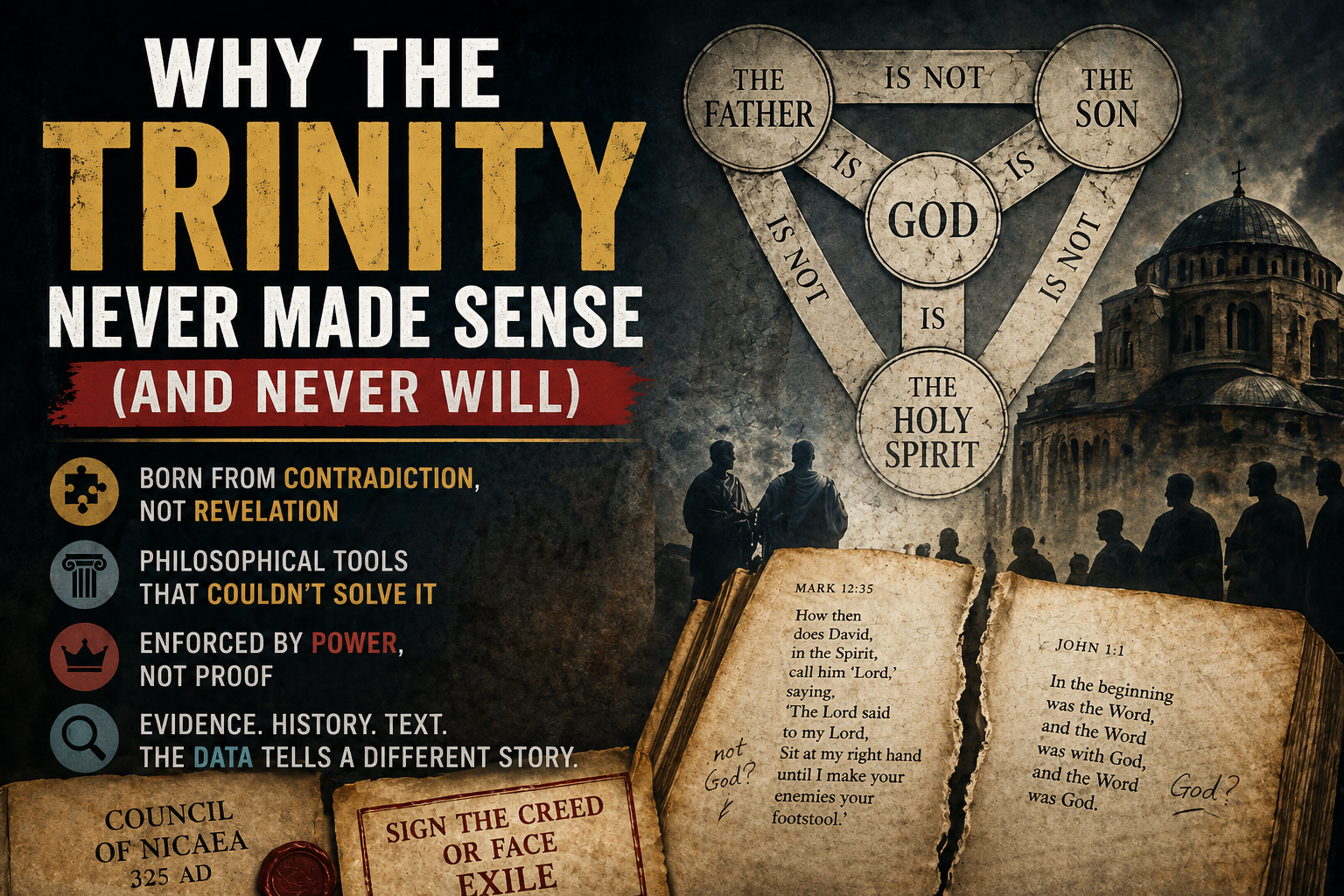
The Trinity never made sense to me. Not when I first encountered it in Sunday school, not when professors tried explaining it with elaborate diagrams, and not when pastors assured me it was simply a divine mystery beyond human comprehension. Turns out that confusion wasn’t my fault.
The doctrine emerged from a specific problem: biblical texts present Jesus as both God and not God. Early Christian thinkers faced this contradiction head-on and attempted to create a framework that would preserve both claims without choosing sides. Think of it as an algebra problem where X equals 1 and X equals 3 simultaneously. The Trinity became their solution—a philosophical construct meant to reconcile the irreconcilable.
The process ran into trouble from the start. The architects of this doctrine operated under a critical assumption: the Bible speaks with one unified voice. Every author, they believed, shared the same perspective on God and Jesus’s nature. This meant forcing agreement between texts that portrayed these relationships differently. When you assume unity where none exists, you create problems that can’t be solved.
The philosophical tools available at the time made things worse. Questions about deity, agency, and personhood had plagued thinkers for over a thousand years before Christianity entered the scene. The frameworks inherited from classical philosophy simply couldn’t handle the specific tensions Christianity introduced. No amount of intellectual gymnastics could eliminate the contradictions. After stripping away layers of explanation and hitting bedrock assumptions, unresolved questions remained.
Political power stepped in where philosophy failed. When theological debates threatened unity, emperors demanded resolution. The message became clear: accept this doctrine or face exile. Sign the creed or lose your position. What began as an intellectual exercise transformed into a test of loyalty. Once established through coercion, institutional power maintained the doctrine for centuries. Churches continued teaching it not because the contradictions were resolved, but because questioning meant challenging authority.
This explains why every analogy for the Trinity falls short. Water existing as ice, liquid, and vapor. The sun producing light and heat. A three-leaf clover. These comparisons fail not because we lack understanding, but because they attempt to illustrate something inherently contradictory. When explanations don’t work, tradition falls back on mystery. “It’s beyond human comprehension” becomes the final refuge when logic breaks down.
I spent years thinking my inability to grasp the Trinity reflected some spiritual or intellectual shortcoming. Seminary friends would nod knowingly when I expressed confusion, as if admitting difficulty meant admitting weakness. But the problem was never with those of us asking questions. The doctrine itself contains unresolvable tensions that no amount of faith or study can reconcile.
Looking at the historical development changes everything. Instead of viewing the Trinity as revealed truth, I see it as a human attempt to solve an unsolvable problem. The biblical authors didn’t share a unified perspective on Jesus’s nature—they wrote from different viewpoints, addressing different communities, with different theological concerns. Forcing their diverse voices into harmony created the very contradictions the Trinity attempts to resolve.
The enforcement mechanism matters too. When exile threatens those who disagree, when institutional power demands compliance, truth becomes secondary to survival. Generations inherited not a solution but an enforced compromise, maintained through social pressure rather than intellectual satisfaction.
This realization freed me from years of theological frustration. The dissatisfaction I felt wasn’t evidence of inadequate faith or limited intelligence. The analogies failed because the concept they illustrated was internally inconsistent. The appeals to mystery masked contradiction rather than revealing truth.
Evidence matters more than tradition. Textual analysis reveals diverse perspectives among biblical authors. Historical investigation shows how political pressure shaped doctrine. Philosophical examination exposes the inadequacy of available frameworks. These data points tell a different story than the one institutional power promotes.
The Trinity stands as a testament to Christianity’s complex evolution—a philosophical construct born from textual tensions, shaped by inadequate tools, and enforced through political power. Recognizing this history doesn’t diminish faith but clarifies it. We can acknowledge the human fingerprints on doctrine without abandoning spiritual pursuit. We can value the questions more than forced answers.
Understanding where the Trinity came from and why it persists despite its contradictions allows for honest engagement with Christian tradition. No more pretending confusion equals failure. No more accepting “mystery” as explanation. Just clear-eyed recognition that some problems resist solution, and that forcing answers through power rather than persuasion leaves lasting theological scars.
The next time someone struggles to explain the Trinity through analogy, or retreats into mystery when pressed for clarity, I remember: the problem isn’t with the questioner. Two thousand years of institutional enforcement can’t resolve a contradiction that exists at the doctrine’s core. Data tells a more honest story than dogma ever could.