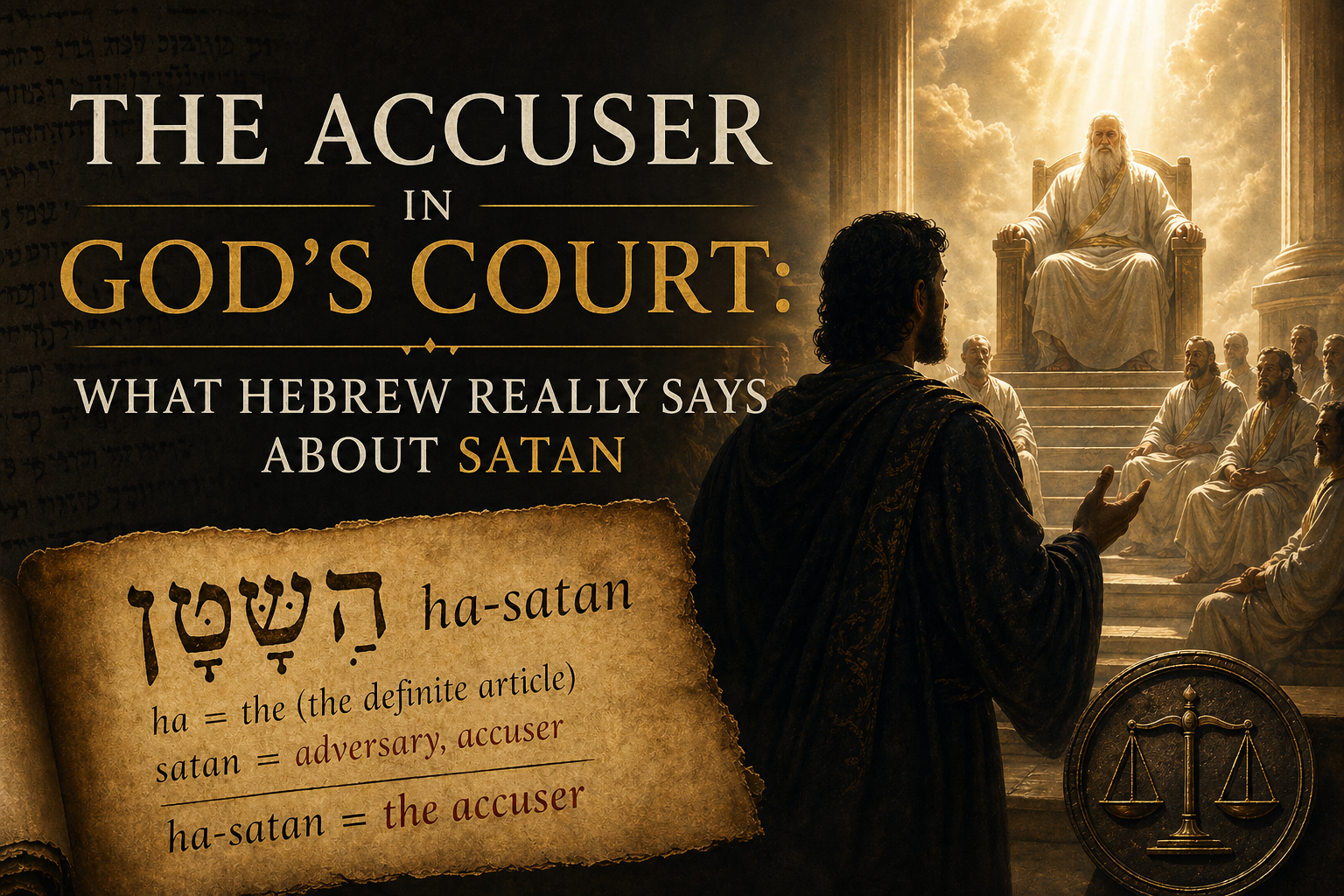
Twenty-five years in a megachurch taught me many things. One of the most jarring discoveries came not from the teaching, but from the Hebrew text itself. After years of learning about Satan as God’s cosmic enemy—the fallen angel who rules hell and battles heaven—I found something different in the original scriptures.
The book of Job changed everything.
In Hebrew, the figure we call “Satan” isn’t actually named Satan at all. The text reads “ha-satan,” where “ha” is the definite article meaning “the.” Satan itself translates to “adversary” or “accuser.” Put them together and you get “the accuser”—a job title, not a personal name.
This distinction matters more than you might think.
In Job chapters one and two, this accuser appears among the “sons of God” in what scholars call the divine council. Picture a heavenly courtroom. God presides, and various divine beings serve different functions. The accuser stands among them, not as an intruder or rebel, but as a member of the court. His role? Prosecutor.
When the accuser challenges Job’s righteousness, he does so within the system, not against it. God grants permission for the testing. The accuser reports back. They have conversations. This is not warfare between good and evil—it’s legal procedure in a divine court.
The contrast with our modern understanding couldn’t be starker. We’ve been taught to see Satan as a fallen archangel, once called Lucifer, who rebelled against God and now rules a kingdom of demons in hell. He tempts humanity, wages spiritual warfare, and stands as God’s ultimate enemy. But in the earliest Hebrew texts, no such figure exists. Instead, we find a subordinate member of God’s council doing his assigned job.
This discovery unsettled me. Years of sermons, Sunday school lessons, and theological teaching had painted one picture. The Hebrew text painted another. The accuser in Job bears almost no resemblance to the horned devil of popular imagination or even the more sophisticated fallen angel of theological discourse.
The implications run deep. If our earliest biblical texts present the accuser as part of God’s governance structure rather than his opposition, what does that mean for our understanding of evil? Of suffering? Of the very nature of the cosmic order?
These questions led me down a path of intensive study. I traced references through the Hebrew Bible, examining each appearance of this figure. The pattern held: in the oldest texts, the accuser works for God, not against him.
So how did we get from a divine prosecutor to the Prince of Darkness? How did a member of God’s council become his greatest enemy? The transformation didn’t happen overnight, and it didn’t happen in a vacuum. Historical events, cultural exchanges, and evolving theological needs all played their parts.
The story of this transformation reveals as much about human nature and religious development as it does about any supernatural reality. It shows how religious concepts evolve, absorb influences from surrounding cultures, and reshape themselves to meet new challenges and fears.
Understanding this evolution doesn’t diminish the power these ideas hold. If anything, it enriches our grasp of how religious thought develops and adapts. The accuser of Job and the Satan of later tradition serve different theological purposes, address different human concerns, and reflect different worldviews.
My journey from believing traditional demonology to understanding the Hebrew concept of the accuser took years. It required setting aside assumptions, learning ancient languages, and being willing to see familiar texts with fresh eyes. The result has been a more nuanced, historically grounded understanding of these crucial religious concepts.
The next step in this exploration examines the precise mechanisms of transformation—how, when, and why the accuser became Satan. That story involves Persian influence, apocalyptic literature, and the human need to explain evil in an increasingly complex world.