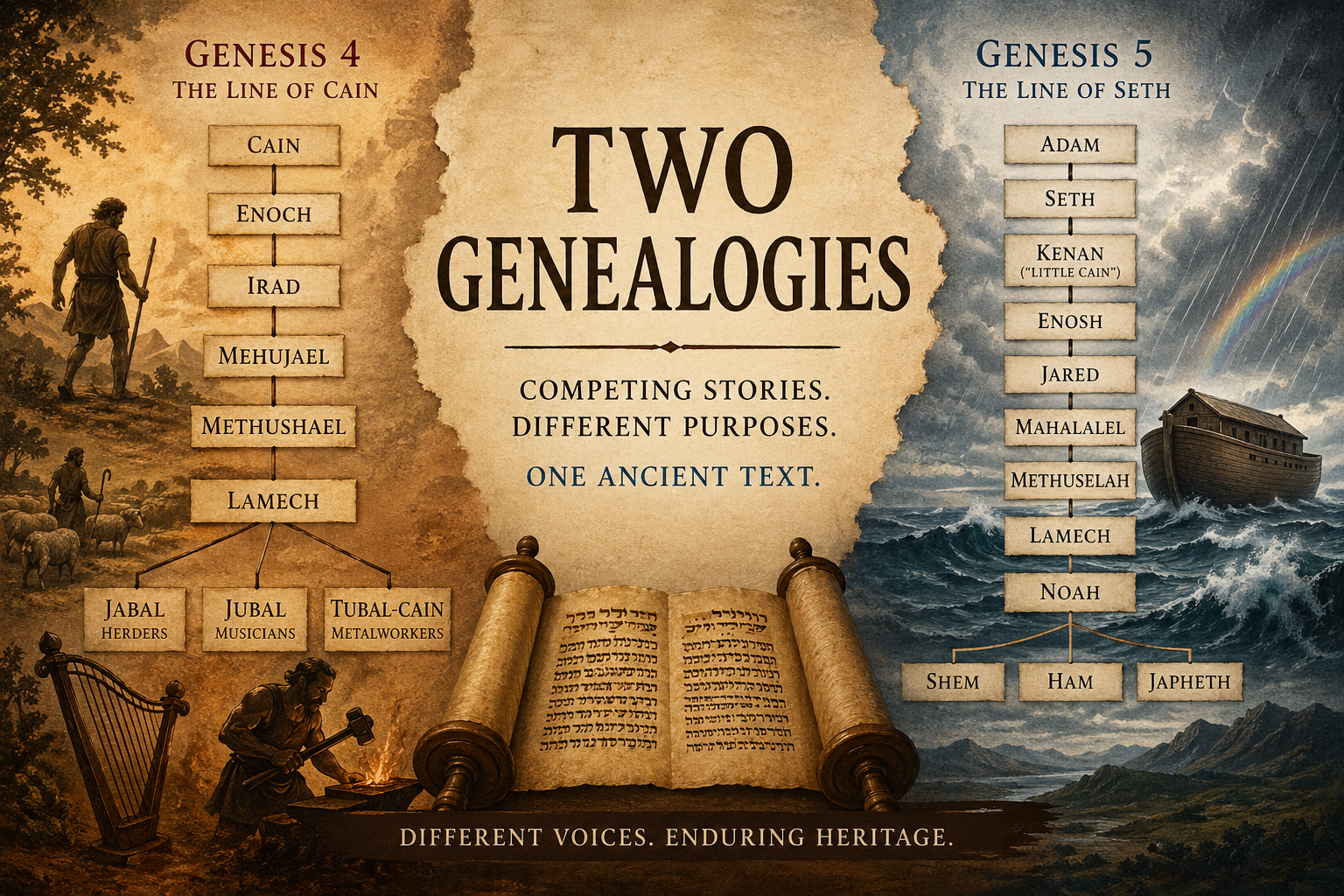
The genealogies in Genesis have puzzled readers for centuries. Two family trees sit side by side in chapters 4 and 5, telling what seem like parallel stories with eerily similar names. After years of studying these texts, I’ve come to see them not as complementary accounts but as competing narratives from different authors, each with their own agenda.
The traditional reading treats these as the line of Cain versus the line of Seth—the bad guys versus the good guys. Chapter 4 follows Cain after he kills Abel, tracing his descendants down to Lamech. Chapter 5 starts fresh with Adam, through Seth, and also ends up at a Lamech. Simple enough, right? Two brothers, two lineages.
But look closer at the names. The overlap is striking. Genesis 4 gives us Cain, Enoch, Irad, Mehujael, Methushael, and Lamech. Genesis 5 presents Kenan (essentially “Little Cain”), Enosh, Jared, Mahalalel, Methuselah, and Lamech. These aren’t just similar—they’re variants of the same tradition, like hearing two versions of a family story at different reunions.
The real revelation comes when you trace where each genealogy leads. The Genesis 5 account, which scholars associate with the Priestly source, builds toward Noah and the flood. Lamech fathers Noah, who fathers Shem, Ham, and Japheth. The whole lineage serves as prologue to the deluge that wipes out humanity. This author shows no awareness of Cain or Abel—the genealogy picks up directly from the creation account in Genesis 1, as if those brothers never existed.
Genesis 4 tells a completely different story. Here, Lamech doesn’t father Noah. Instead, his children are Jabal, Jubal, and Tubal-cain. The text explicitly identifies these figures as the ancestors of contemporary groups: Jabal for nomadic herders, Jubal for musicians, and Tubal-cain for metalworkers. The author is explaining the origins of professions and social groups that existed in their own time.
This creates an impossible scenario if we read these genealogies as sequential history. Genesis 4’s author describes Cain’s descendants as the ancestors of people still living—herders still tend flocks, musicians still play instruments, metalworkers still forge tools. There’s no flood coming to wipe them out. They’re the progenitors of ongoing human civilization.
Meanwhile, Genesis 5’s author is building toward total destruction. Every person in this genealogy except Noah and his immediate family will die in the flood. There’s no room for Jabal’s herders or Jubal’s musicians to survive and establish lasting professions.
I’ve spent considerable time comparing these texts in Hebrew, and the evidence points to two separate traditions that later editors wove together. The Priestly author of Genesis 5 picks up their narrative thread from Genesis 1, skips over the Garden of Eden story entirely, and moves straight from creation to genealogy to flood. The other author presents an etiology—an origin story—for the social structure of their world.
The editors who compiled Genesis didn’t harmonize these accounts. They preserved both, letting the tensions stand. Where modern readers see contradiction, ancient compilers saw value in maintaining multiple perspectives. Each genealogy served a purpose: one to explain the world as it exists, another to set up the cosmic reset of the flood narrative.
This approach to the text—recognizing distinct sources rather than forcing harmony—has transformed how I read these ancient genealogies. They’re not dry lists of names but windows into how different communities understood their origins and their world. One group saw history building toward catastrophe and renewal. Another saw it as the unfolding story of human civilization and innovation.
The names themselves tell the story of a shared cultural memory, preserved in different forms by different groups. Like variations on a melody, each genealogy reworks common material for its own purposes. The challenge isn’t choosing which one is “correct” but understanding what each contributes to the larger narrative of Genesis.
When I teach these texts now, I encourage students to read each genealogy on its own terms first. What story does Genesis 4 tell when isolated from chapter 5? What worldview emerges from Genesis 5 when read apart from chapter 4? Only then can we appreciate the editorial decision to include both, preserving the diversity of ancient Israelite tradition rather than flattening it into false consistency.