I grew up memorizing Bible verses every Sunday. Gold stars for perfect recitation. What nobody mentioned was that most of those verses came from Paul, not Jesus.
This realization hit me years later while comparing red-letter editions—where Jesus’s words appear in red—against the rest of the New Testament. The red sections were sparse. Most Sunday sermons drew from black text. Paul’s black text.
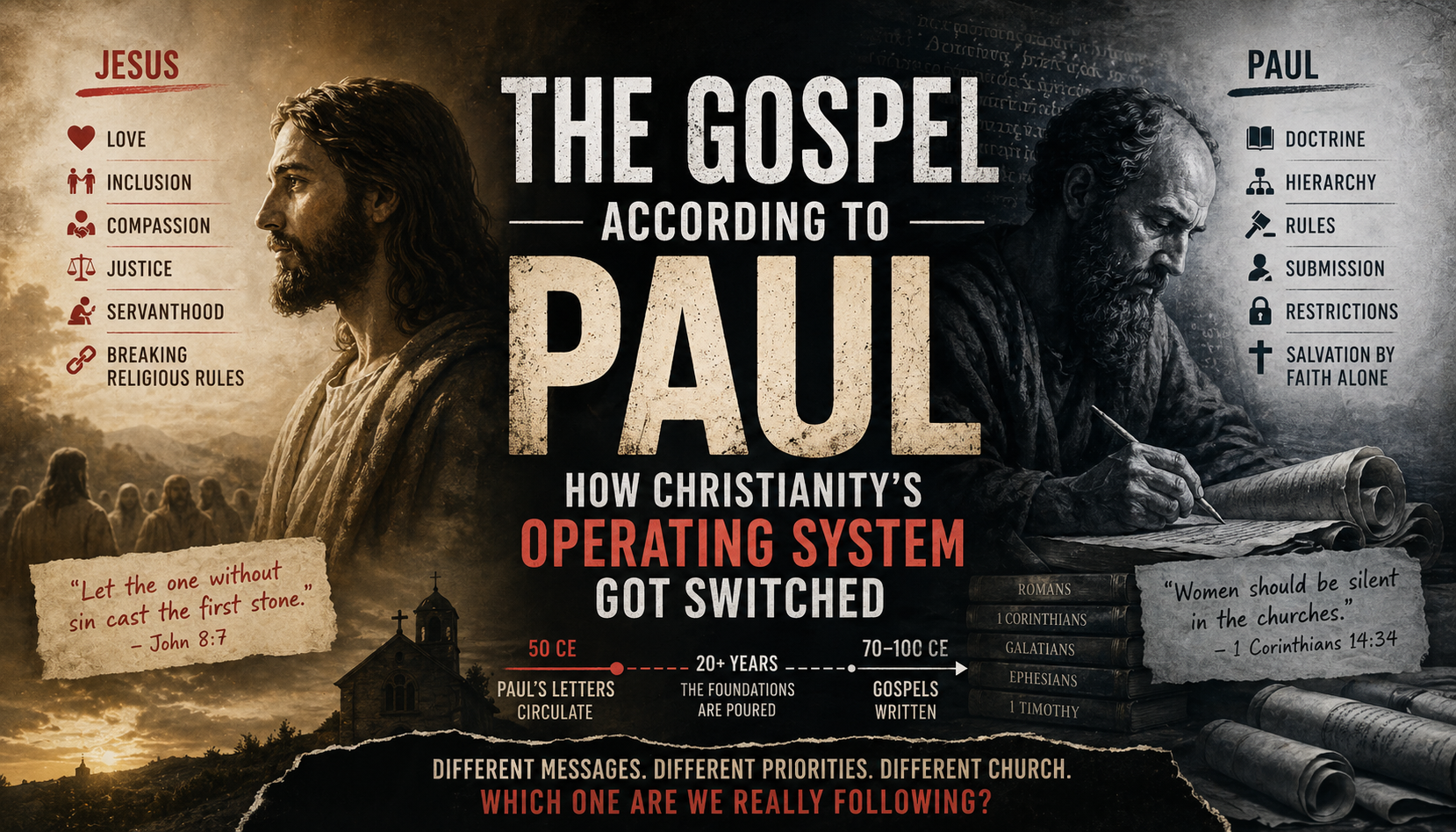
The timeline tells an uncomfortable story. Jesus wrote nothing. His followers recorded his sayings decades after his death, somewhere between 70-100 CE for most gospels. But Paul’s letters? Those circulated as early as 50 CE, barely twenty years after the crucifixion. First-generation Christians learned their theology from Paul’s correspondence before they ever read Matthew, Mark, Luke, or John.
Think about that sequence. The foundation got poured before the cornerstone arrived.
Paul never met Jesus during his ministry. He persecuted early believers as Saul, then claimed a vision on the Damascus road transformed him into Christianity’s chief architect. No apprenticeship. No years following Jesus through Galilee. Just a vision, then straight to writing the instruction manual.
And what an instruction manual he wrote. Thirteen letters that became Christianity’s operating system. When your pastor preaches about women keeping silent in church, that’s Paul (1 Corinthians 14:34). When the youth group teaches purity culture, that’s Paul’s anxiety about the flesh. When someone condemns homosexuality using scripture, they’re quoting Paul’s letter to the Romans, not the Sermon on the Mount.
Jesus, according to the gospel accounts, spent his time differently. He ate with tax collectors. Defended an adulteress from stoning. Told stories about good Samaritans and prodigal sons. His harshest words targeted religious authorities who “tie up heavy burdens, hard to bear, and lay them on people’s shoulders.”
The contrast feels stark when you read them side by side. In the gospels, Jesus says “Let the one without sin cast the first stone.” In his letters, Paul creates extensive sin catalogs. Jesus says “Judge not, lest you be judged.” Paul judges conduct constantly—what to eat, what to wear, who can speak, who can teach.
I started tracking which verses got quoted most in my church. The results were consistent: Paul dominated. Salvation by faith alone? Paul’s innovation in Romans and Galatians. Jesus, in Matthew 25, describes judgment based on feeding the hungry and visiting prisoners. Church hierarchy and submission to authority? Paul’s blueprint in his pastoral letters. Jesus told his disciples that whoever wanted to be first must be last and servant of all.
This isn’t about discarding Paul or declaring him illegitimate. His letters preserve crucial early church history. But when churches claim they follow Jesus while their actual practice flows from Pauline doctrine, something’s misaligned.
I’ve watched this play out in pastoral counseling sessions. A couple struggles with guilt over premarital sex—the framework comes from Paul’s writings on sexual immorality. A woman questions whether she can teach adult Sunday school—the prohibition traces to Paul’s first letter to Timothy. Parents agonize over a gay child—again, Paul’s letters provide the proof texts.
Meanwhile, Jesus’s actual recorded words on these topics? Silence.
The early church made choices about which texts to preserve and elevate. They had Paul’s letters in hand while Jesus’s sayings were still oral tradition. By the time the gospels were compiled and circulated widely, Pauline theology had already shaped two generations of believers.
You can run a simple thought experiment: Remove Paul’s letters from the New Testament. What remains? The gospels, with their parables and healings. The book of Acts, describing the early church’s formation. James’s practical wisdom about faith and works. John’s mystical meditations on love. Revelation’s apocalyptic visions.
The church without Paul looks radically different. Less obsessed with sexual purity. Less structured around male authority. Less focused on correct belief as the path to salvation. More concerned with radical hospitality, economic justice, and inner transformation.
Some argue Paul simply explained what Jesus meant. But Paul explicitly states he received his gospel through revelation, not from other apostles. He visited Jerusalem briefly, met with Peter and James, then went his own way. His theology developed independently, shaped by his Pharisaic training and Greek philosophical context.
The real Jesus—if we can speak of such a figure through the fog of decades and translation—seemed less interested in creating systematic theology than in breaking religious conventions. He touched lepers. He spoke with Samaritan women. He declared the Sabbath made for humans, not humans for the Sabbath.
Paul built systems. Jesus broke them.
Modern churches face an identity crisis when confronting this gap. They market themselves as followers of Jesus but operate on Pauline software. The gentle carpenter who blessed the meek becomes subordinated to the tentmaker’s corporate structure.
I’ve sat through too many sermons that started with a Jesus story and pivoted to Paul’s commentary. The good Samaritan becomes a launching pad for Romans chapter 3. The woman at the well segues into Ephesians on submission. Jesus becomes the appetizer. Paul provides the meal.
When pressed, many pastors admit the tension. They know their congregations expect Pauline doctrine wrapped in Jesus packaging. Speaking purely from the red letters would revolutionize their churches—and probably empty them.
Because Paul’s system works institutionally. It creates clear hierarchies, behavioral codes, and membership boundaries. It transforms a movement into an organization. Jesus’s teachings, taken alone, resist institutionalization. How do you build a power structure on “the last shall be first”? How do you maintain authority while preaching “call no man your master”?
The early church chose institutional survival. Paul provided the blueprint. His letters offered concrete guidance for daily disputes—marriage conflicts, food restrictions, worship protocols. Jesus’s parables about mustard seeds and hidden treasures gave little practical administrative guidance.
So Christianity became Paulianity, though nobody admits this directly. The brand stays “Christian” while the operating manual comes from Paul. Like buying a product based on packaging, then discovering different ingredients inside.
This matters because real people suffer under doctrines they believe come from Jesus but actually originate with Paul. The gay teenager condemned with Romans 1 never hears that Jesus said nothing about homosexuality. The woman gifted to teach gets silenced by 1 Timothy, not by the rabbi who included Mary Magdalene among his closest followers.
We’ve created elaborate theological gymnastics to harmonize Paul with Jesus, pretending no tension exists. But the tension screams from the pages. One preached on hillsides and beaches. The other wrote from jail cells and urban apartments. One spoke in parables about seeds and coins. The other constructed arguments about law and grace.
Both voices matter. But honesty demands we stop conflating them. When we quote Paul, we should say we’re quoting Paul. When churches enforce Pauline doctrine, they should acknowledge its source. The couple seeking counsel, the youth struggling with identity, the woman called to ministry—they deserve to know whose words shape the advice they receive.
Because following Jesus and following Paul lead to different destinations. One points toward compassion and transformation. The other toward order and control. Churches can choose either path, or attempt to walk both. But they should stop pretending they’re the same road.