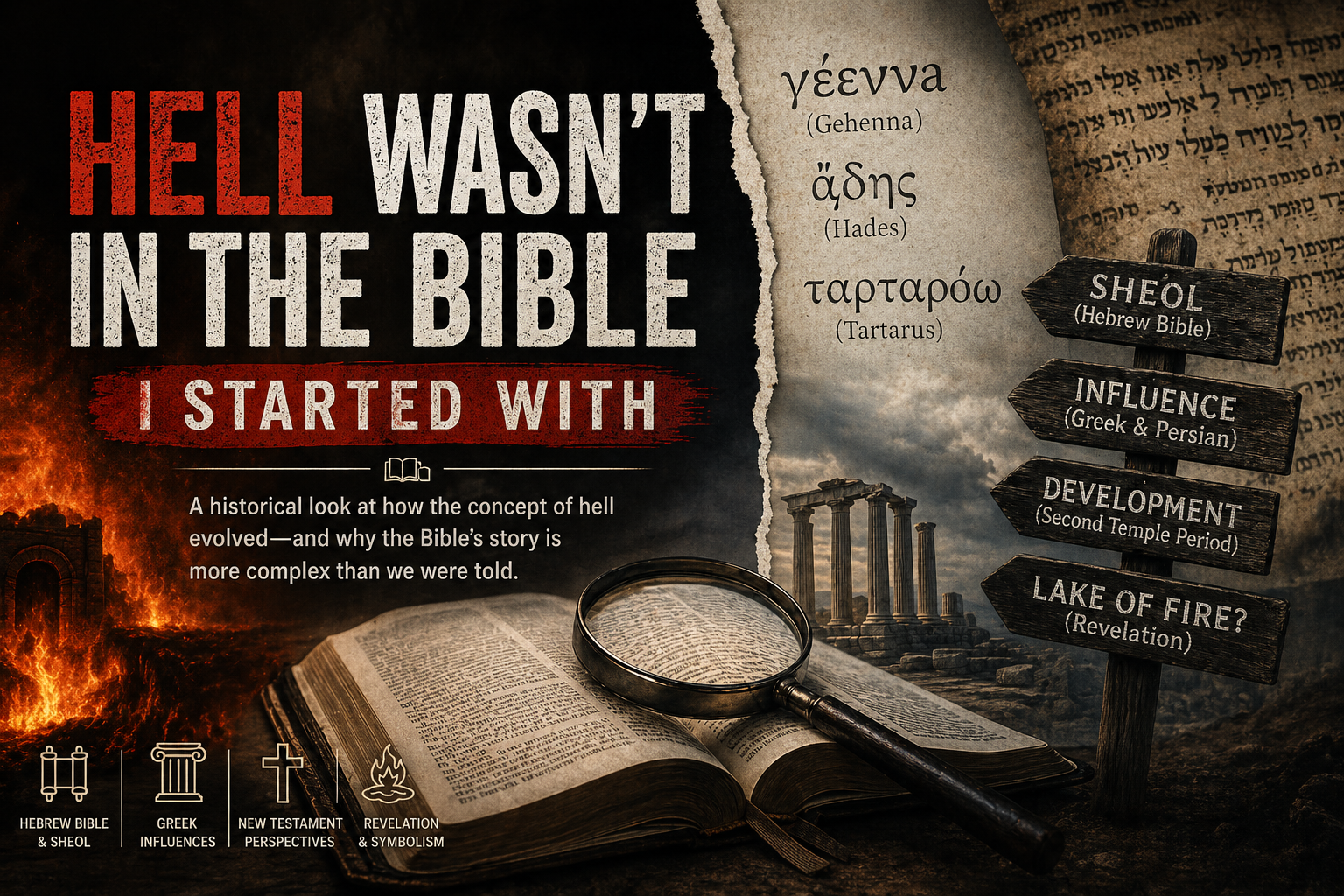
I spent years believing hell was as real as the ground beneath my feet. The sermons I heard painted vivid pictures of eternal flames and endless torment. But when I started examining the actual texts and their history, the certainty crumbled into something far more complex.
The video that sparked this investigation made bold claims: hell exists whether you believe in it or not. It cited specific verses as proof. But those proof texts tell a different story when you trace them back through history.
The Hebrew Bible Never Mentions Hell
Start with the Hebrew Bible—what Christians call the Old Testament. Search every page, and you won’t find hell. You’ll find Sheol, but that’s not hell. Sheol was where everyone went when they died. Kings and peasants, prophets and villains—all descended to the same shadowy realm. No fire. No torment. No separation based on moral conduct.
This matters because if hell was always part of God’s plan, why does the foundational text of Judaism lack any mention of it? The Hebrew Bible spans centuries of writing, yet its authors consistently describe one undifferentiated afterlife.
When Hell Enters the Picture
The concept of differentiated afterlives—reward for the righteous, punishment for the wicked—emerges during the Greco-Roman period. Jews living under foreign oppression began asking hard questions about justice. If God is just, why do tyrants prosper while the faithful suffer?
Greek philosophy offered answers. Greek mythology provided imagery. Concepts like Tartarus (a punitive abyss), the Phlegethon (river of fire), and the Acherusia (lake of the dead) began seeping into Jewish thought. These weren’t divine revelations; they were cultural imports, adapted to address theological crises.
By the time the New Testament authors were writing, multiple competing models of the afterlife circulated through Jewish communities. The texts reflect this diversity rather than presenting a unified doctrine.
Three Different Words, Three Different Concepts
The New Testament uses three distinct Greek words that English Bibles translate as “hell.” Each carries different connotations:
Gehenna appears primarily in the Gospels, referencing the Valley of Hinnom outside Jerusalem—a place associated with child sacrifice and later used as a garbage dump. Jesus uses it metaphorically for judgment, but the metaphor’s exact meaning remains disputed.
Hades functions as the Greek equivalent of Sheol—the realm of the dead. It’s not inherently punitive. Luke’s parable of the rich man and Lazarus depicts suffering in Hades, but parables aren’t doctrinal statements.
Tartarus appears only once, in 2 Peter, describing where rebellious angels are confined.
Here’s what strikes me: Paul, Christianity’s most prolific theologian, never uses any of these terms. Not in Romans, where he lays out his systematic theology. Not in Corinthians, where he discusses the resurrection. If eternal conscious torment was central to the gospel, wouldn’t Paul mention it?
The Second Thessalonians Problem
The video cited 2 Thessalonians 1:9 as proof of eternal separation from God. But Second Thessalonians presents problems. Many scholars consider it pseudepigraphic—written by someone other than Paul, likely after his death. The writing style differs from Paul’s authenticated letters. The theological emphasis shifts.
More importantly, the verse speaks of “everlasting destruction,” not eternal torment. Destruction implies cessation of existence—annihilation, not ongoing consciousness. The Greek word used, olethros, appears elsewhere in Paul’s writings referring to complete ruin, not perpetual suffering.
Revelation’s Lake of Fire
Revelation gives us the “lake of fire,” perhaps the most vivid hell image in Scripture. But Revelation is apocalyptic literature—a genre defined by symbolic imagery, not literal description. The book describes a seven-headed beast rising from the sea, a woman clothed with the sun, and locusts with human faces. Taking these images literally misses the genre’s entire point.
Consider Revelation 20:14: “Death and Hades were thrown into the lake of fire.” If Hades equals hell, then hell gets thrown into hell. The text distinguishes between Hades (the temporary realm of the dead) and the lake of fire (the final judgment). They’re not synonymous.
Revelation almost didn’t make it into the Bible. Early Christian communities questioned its authorship and theology. Athanasius, the influential 4th-century bishop, championed its inclusion. Without his advocacy, Christianity’s hell imagery would look radically different.
The Function of Fear
After examining the texts and their history, I see how “hell” functions rhetorically. It’s a behavioral lever—fear packaged as theology. The threat of eternal torment motivates compliance in ways that love and grace apparently cannot.
But this creates a credibility problem. When people discover the textual complexity, the historical development, the borrowed imagery, they feel deceived. The certainty they were sold dissolves into scholarly disputes and ancient cultural exchanges.
The video insisted hell exists whether you believe it or not. But the historical record suggests hell exists precisely because people believe in it—because religious authorities found it useful, because oppressed communities needed justice, because Greek philosophy provided compelling frameworks.
Wrestling with Implications
I’m not arguing the afterlife doesn’t exist or that actions lack consequences. I’m pointing out that our contemporary concept of hell—eternal conscious torment in a lake of fire—emerges from a complex historical process rather than clear biblical teaching.
The Hebrew Bible presents Sheol. Greeks contributed Tartarus and rivers of fire. Zoroastrians offered dualistic cosmologies. Roman-era Jews synthesized these influences while grappling with theodicy. New Testament authors reflected this diversity without establishing unified doctrine. Church fathers selected which texts became canonical. Medieval theologians systematized the imagery. Modern preachers weaponized the fear.
Each step moved us further from the original texts and closer to the hell we know today—a hell that says more about human psychology and power dynamics than about divine revelation.
The video wanted viewers to accept hell’s reality without question. But questions are exactly what this topic demands. Not to undermine faith, but to distinguish between what texts actually say and what traditions have constructed around them. Between ancient metaphors and modern literalism. Between divine justice and human control mechanisms.
The stakes are high. How we conceive the afterlife shapes how we live now, how we treat others, how we understand God’s character. If we’re going to make claims about ultimate reality, we owe it to ourselves—and to those we influence—to ground those claims in careful reading rather than inherited assumptions.