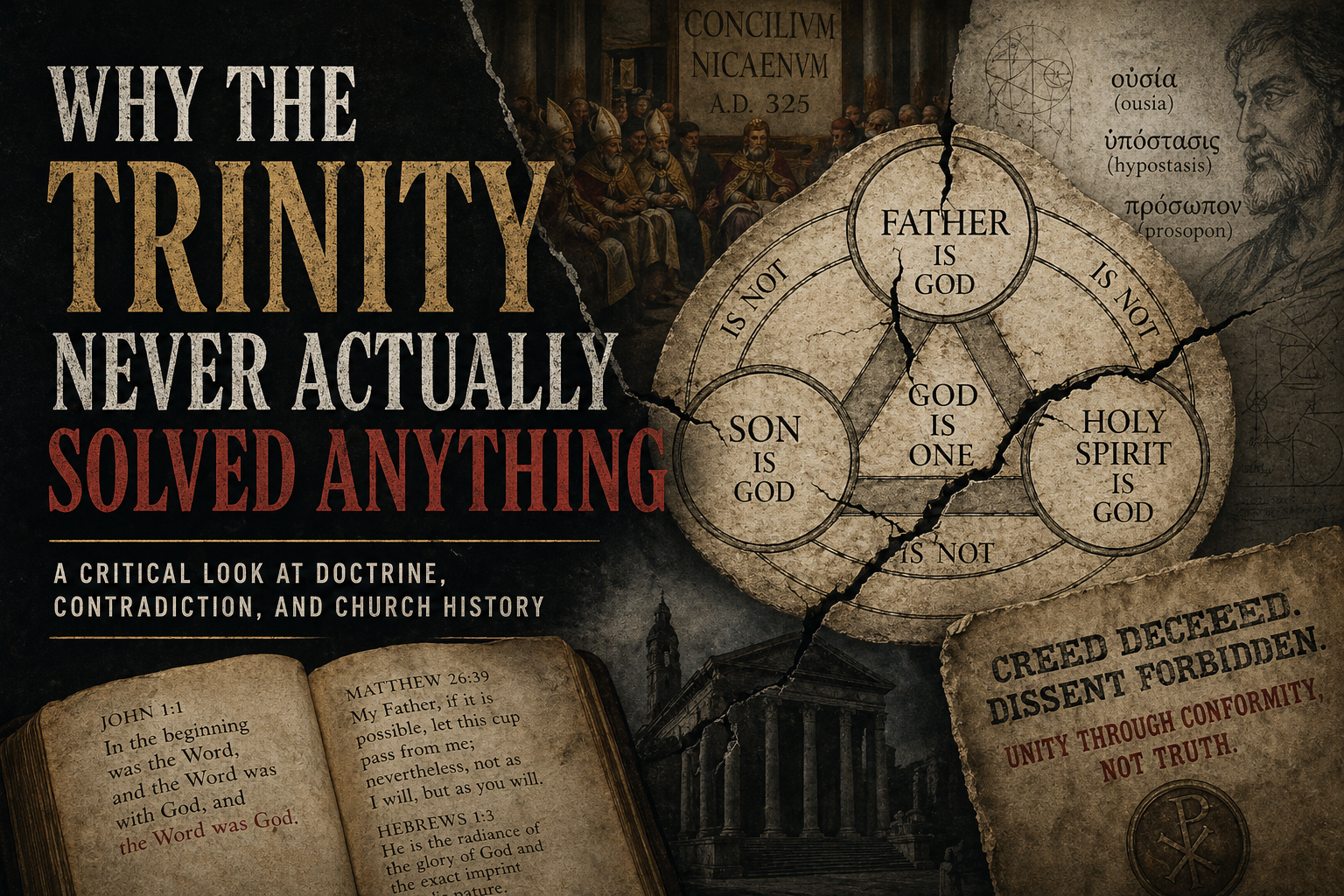
The Trinity never made sense to me. Not when I first encountered it in Sunday school, not when I studied theology in college, and certainly not after years of wrestling with the texts themselves. The standard explanations always felt forced—water becoming ice and steam, the sun giving off light and heat, a three-leaf clover. Each analogy crumbled under scrutiny.
I used to think the problem was me. Maybe I wasn’t smart enough, faithful enough, or spiritually mature enough to grasp this central mystery of Christianity. Turns out, the problem runs much deeper.
The Trinity exists because early Christians faced an impossible mathematical equation. The biblical texts present Jesus as both God and not-God simultaneously. Paul writes about Jesus as a distinct figure who mediates between God and humanity. John’s gospel declares “the Word was God.” Matthew and Luke present Jesus praying to the Father as a separate being. Yet other passages attribute divine prerogatives to Jesus—creating the universe, forgiving sins, receiving worship.
These aren’t minor discrepancies you can smooth over with creative interpretation. They represent fundamentally different understandings of who Jesus was and how he related to the God of Israel. The Trinity emerged as an attempt to solve this equation, to create a framework where all these contradictory statements could somehow be true at once.
The project failed for two primary reasons.
First, the church fathers assumed the Bible spoke with one voice. They believed every biblical author shared the same perspective on God and Jesus, just expressed differently. This assumption forced them to harmonize texts that were never meant to agree. When you start with the premise that Paul, John, and the Synoptic authors all believed exactly the same thing about Jesus’s nature, you’ve already painted yourself into a corner. The diverse perspectives in these texts reflect different communities, different contexts, and different theological developments. Forcing them into alignment creates problems that cannot be solved.
Second, the philosophical tools available in the fourth and fifth centuries simply weren’t up to the task. The church fathers relied on Greek philosophical categories to parse concepts of deity, personhood, and agency. But these frameworks, refined as they were, couldn’t resolve the fundamental tensions. How can three persons share one essence without becoming three gods? How can the Son be eternally begotten without being created? How can Jesus be fully divine and fully human without being two persons?
These questions didn’t get answered. They got buried.
The Trinity became official doctrine not through theological resolution but through imperial decree. When Constantine called the Council of Nicaea, the goal wasn’t to explore truth but to establish unity. Bishops who refused to sign the creed faced exile. The pattern repeated at subsequent councils—Constantinople, Ephesus, Chalcedon. Each gathering produced more precise language, more technical distinctions, but never actually resolved the core contradictions. They just made disagreement illegal.
Once established, institutional power maintained the doctrine through centuries of enforcement. Questions were met not with answers but with accusations of heresy. The appeal to “mystery” became a convenient escape hatch—we can’t understand it because God transcends human reason. But there’s a difference between genuine mystery and logical contradiction. A mystery invites deeper contemplation. A contradiction just doesn’t work.
This history matters because it shapes how we approach these questions today. When someone struggles to understand the Trinity, the problem isn’t their intelligence or faith. The doctrine itself contains unresolved tensions that no amount of analogies or mystical language can fix. Water, ice, and steam are all H2O—that’s modalism, a heresy. The sun, its light, and its heat are three aspects of one thing—that’s also modalism. Every analogy breaks down because the doctrine itself breaks down.
The biblical texts preserve a rich diversity of perspectives on Jesus and his relationship to God. Some authors emphasize his humanity, others his divinity. Some see him as God’s agent, others as God himself. These different voices tell us something important about how early Christians experienced and understood Jesus. Flattening them into a single systematic doctrine loses that richness.
I’ve learned to value the data over the dogma. The texts themselves, in all their complexity and contradiction, tell a more honest story than any creed. They show communities wrestling with extraordinary claims about an extraordinary figure. They preserve arguments, developments, and divergent traditions. They resist easy systematization because reality resists easy systematization.
The Trinity represents one attempt to make sense of this data, an attempt that ultimately required political power to enforce precisely because it couldn’t stand on its own logical merits. Recognizing this doesn’t diminish the texts or even necessarily the faith built on them. It just means approaching both with more honesty about what we actually have versus what tradition claims we have.
The next time someone tells you the Trinity is a beautiful mystery you just need to accept on faith, remember: confusion in the face of contradiction is the appropriate response. The fault lies not in your understanding but in the doctrine itself, a fourth-century solution that created more problems than it solved, maintained by power rather than persuasion, and preserving tensions it claimed to resolve.