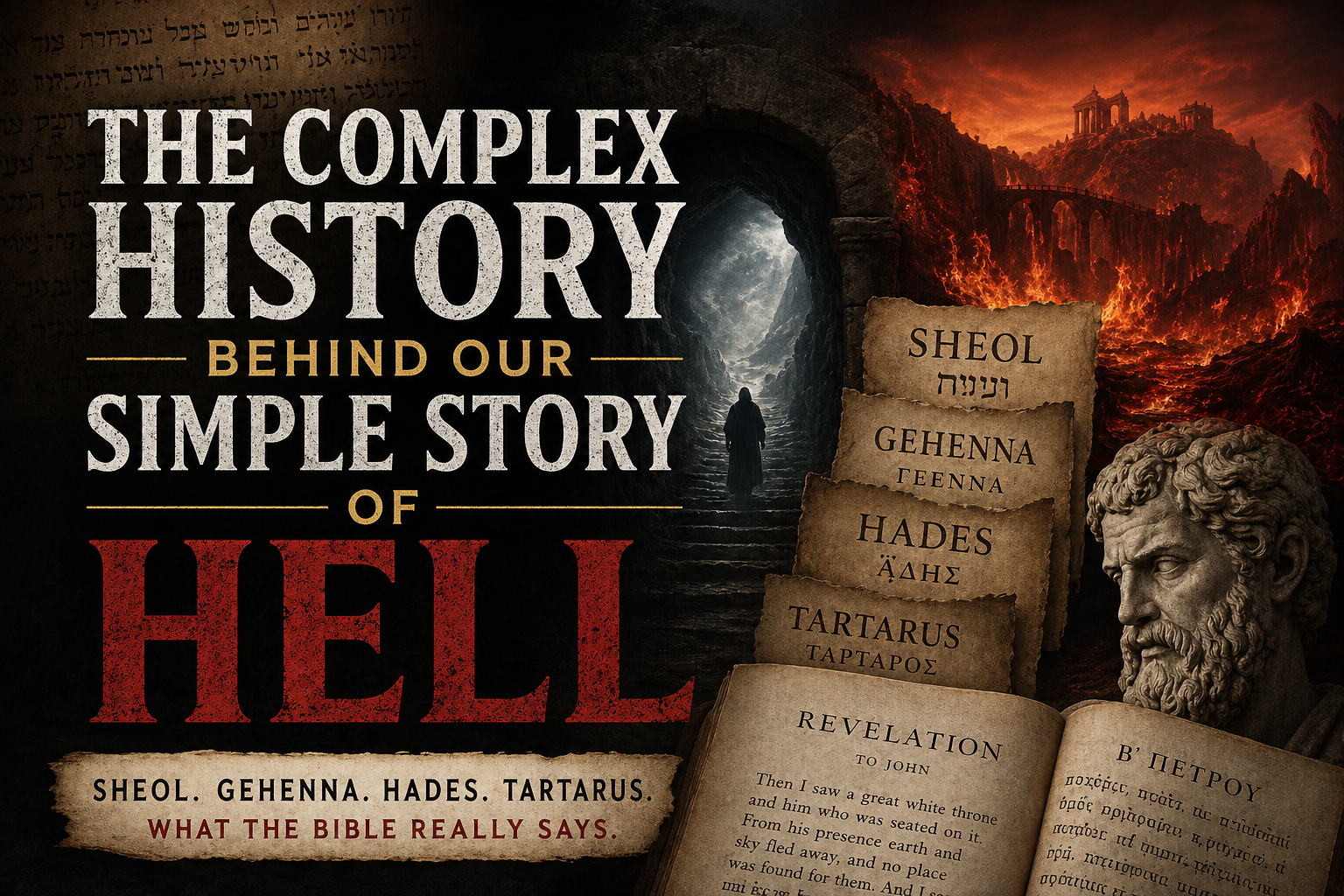
I spent years accepting what I was told about hell without examining the texts myself. When someone recently insisted that “hell is real whether you believe it or not,” citing specific Bible verses as proof, I decided to trace these claims back through the original sources. What I found was far more complex than the clean narrative I’d been handed.
The standard story goes like this: hell is eternal separation from God, a lake of fire where the wicked suffer forever. Simple, terrifying, effective. But when you actually read the Hebrew Bible, you find something entirely different. The ancient Israelites wrote about Sheol—a shadowy underworld where everyone went after death, righteous and wicked alike. No fire, no torment, no eternal punishment. Just a quiet, dusty afterlife for all.
This single destination for the dead remains consistent throughout the Hebrew scriptures. Job speaks of going down to Sheol. The Psalms reference it repeatedly. Ecclesiastes states plainly that the same fate awaits everyone. The concept of differentiated afterlives—paradise for the good, torment for the bad—simply doesn’t exist in these foundational texts.
So where did our modern conception of hell come from? The shift begins during the Greco-Roman period, when Jewish communities lived under foreign oppression. Watching their oppressors prosper while the faithful suffered, Jewish thinkers began developing new ideas about divine justice extending beyond death. They borrowed concepts from Greek mythology—the river Phlegethon, the punitive realm of Tartarus, the Acherusia lake. These foreign ideas merged with evolving Jewish thought to create something new: a segregated afterlife where moral accounts would finally be settled.
By the time we reach the New Testament, the terminology has become surprisingly inconsistent. The Gospel writers use three different Greek words that often get translated as “hell”—Gehenna, Hades, and Tartarus—but they don’t use them interchangeably or systematically. Gehenna references the Valley of Hinnom outside Jerusalem, a place associated with child sacrifice and later used as a garbage dump. Hades borrows directly from Greek mythology’s underworld. Tartarus appears only once, in 2 Peter, again lifting from Greek cosmology.
Here’s what struck me most: Paul never uses any of these terms. Not in Romans, not in Corinthians, not anywhere in his undisputed letters. The apostle who wrote more of the New Testament than anyone else never mentions hell as we understand it. His focus remains fixed on resurrection and life with Christ, not on detailed schemas of postmortem punishment.
When defenders of eternal hell cite 2 Thessalonians 1:9 about “everlasting destruction,” they’re standing on shaky ground. Most biblical scholars consider Second Thessalonians pseudepigraphal—written by someone else in Paul’s name. Even setting authorship aside, “everlasting destruction” reads more naturally as annihilation than eternal conscious torment. Destruction implies an ending, not perpetual suffering.
The book of Revelation provides the most vivid hell imagery with its “lake of fire,” but Revelation operates in the apocalyptic genre—a highly symbolic style of writing that ancient readers would have understood differently than we do. The text itself undermines any simple equation between different terms when it describes Death and Hades being thrown into the lake of fire. If Hades gets thrown into the lake, they can’t be the same thing.
Revelation’s path into the biblical canon reveals another layer of complexity. Many early Christians viewed it with suspicion. It gained widespread acceptance largely through Athanasius’s advocacy in the late fourth century. One influential bishop’s preference shaped two millennia of doctrine about eternal punishment.
The more I studied, the clearer it became that “hell” as popularly conceived—a unified biblical doctrine of eternal conscious torment—doesn’t emerge cleanly from the texts. Instead, we see multiple, sometimes contradictory concepts developing over centuries, influenced by political oppression, cultural exchange, and the needs of religious authorities.
This matters because the doctrine of hell functions primarily as an instrument of control. Fear drives compliance. The threat of eternal torture motivates behavior in ways that promises of reward often cannot. When someone tells you “hell is real whether you believe it or not,” they’re not making a statement about textual evidence or historical development. They’re wielding a rhetorical weapon refined over centuries.
I’m not arguing that ancient texts should dictate modern beliefs. People can believe whatever they find meaningful or true. But when specific claims about what “the Bible says” are used to frighten or manipulate, those claims deserve scrutiny. The historical record shows development, borrowing, and innovation—not timeless, unchanging doctrine dropped from heaven.
The Hebrew Bible knows only Sheol, where all the dead rest together. Greek influences introduced differentiated afterlives during a period of Jewish subjugation. The New Testament reflects this evolution through multiple, inconsistent terminologies. Paul ignores the entire concept. Revelation deploys apocalyptic symbolism that resists literal reading. Second Thessalonians, likely written by someone impersonating Paul, describes destruction rather than eternal torment.
Understanding this development freed me from a fear I’d carried since childhood. The texts themselves tell a far more human story than the one I’d been taught—a story of communities wrestling with injustice, borrowing from neighbors, and constructing meaning in the face of oppression. That story continues today whenever someone invokes eternal punishment to generate compliance rather than engaging with the complex, fascinating, and deeply human history of these ideas.