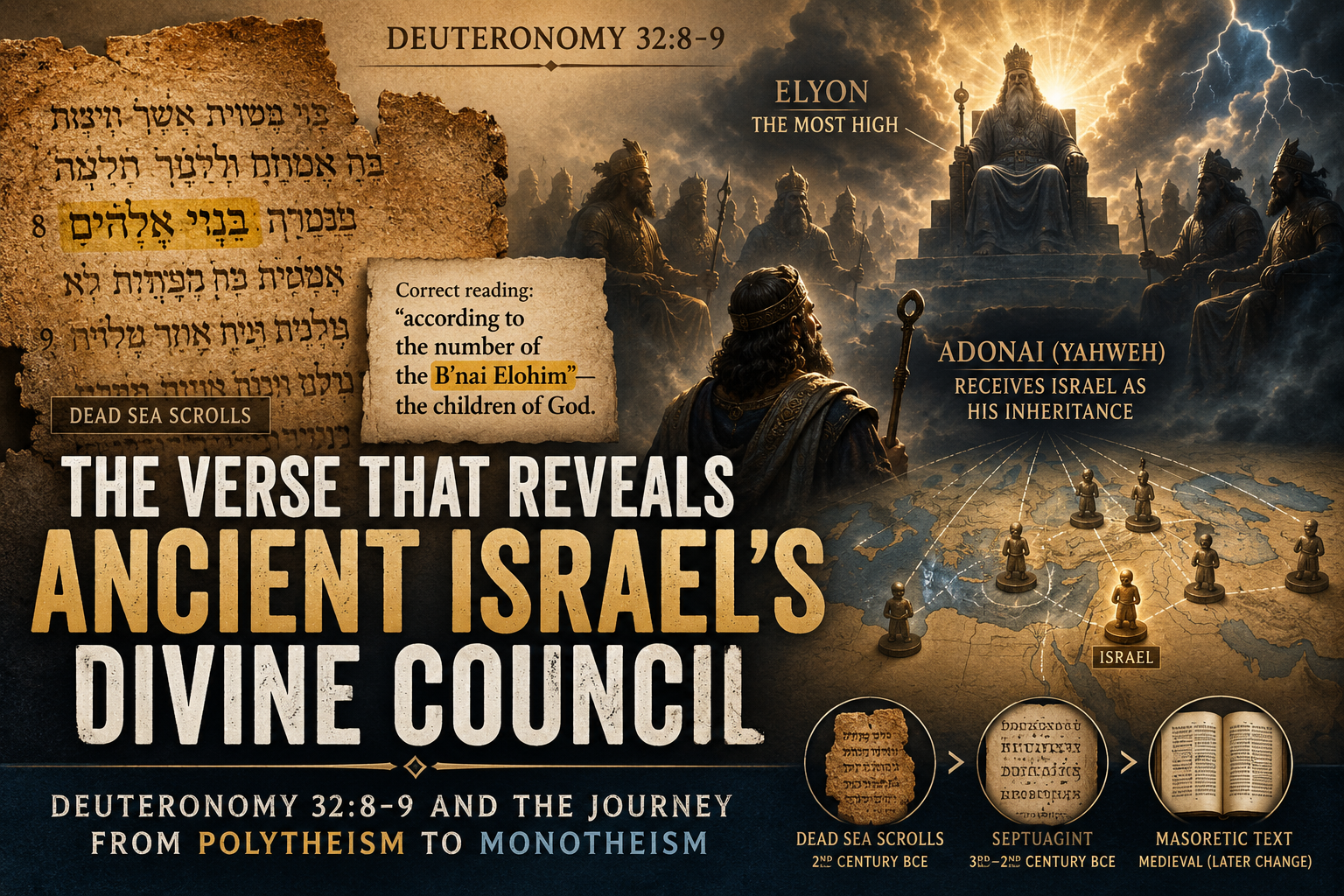
The first time I read Deuteronomy 32:8 in the Dead Sea Scrolls, everything I thought I knew about biblical monotheism unraveled. For years, I’d read this verse in standard translations: God divided the nations “according to the number of the children of Israel.” Simple enough. Then I encountered the actual Hebrew from Qumran.
The original text says something completely different. It reads “according to the number of the B’nai Elohim”—the children of God. Not the children of Israel. The children of God.
This discovery sent me down a research path that fundamentally changed how I read the Hebrew Bible.
The Text That Changes Everything
The passage in question appears straightforward in most modern Bibles. Deuteronomy 32:8-9 describes how nations were divided up in ancient times. But when you read the earliest manuscripts—particularly the Dead Sea Scrolls fragment and the Septuagint—you find a radically different theological picture.
Here’s what the corrected text actually says: Elyon (the Most High) divides up all the nations of the earth. He assigns them to the B’nai Elohim—the children of God. Then verse 9 delivers the kicker: “Adonai’s (Yahweh) portion was his people. Jacob was his share of the inheritance.”
Read that again. Adonai (Yahweh) receives Israel as his inheritance. From Elyon. As one of the B’nai Elohim.
The implications hit me like a thunderbolt. This text presents Adonai not as the supreme deity, but as one member of a divine council, receiving his allocated nation from a higher god called Elyon.
Making Sense of the Divine Council
My first instinct was to dismiss this reading as some kind of scribal error. But the more I studied, the more the evidence mounted. The Dead Sea Scrolls represent our earliest Hebrew manuscripts of this passage. The Septuagint, translated centuries before our medieval Hebrew texts, confirms this reading. The phrase “children of Israel” appears to be a later alteration.
Once I accepted this, other biblical passages suddenly made sense. All those references to God standing in the divine assembly, taking his place among the gods, pronouncing judgment in the midst of the elohim—these weren’t poetic metaphors. They described an actual theological framework that ancient Israelites once held.
The structure matches perfectly with what we know about ancient Near Eastern religions. Northwestern Semitic pantheons typically featured a supreme father deity presiding over a council of lesser gods. These second-tier deities often controlled specific nations or regions. Storm gods, in particular, commonly appeared at this level.
And throughout the Hebrew Bible, Adonai appears with storm imagery—thunder at Sinai, lightning in the Psalms, riding on clouds like the Canaanite Baal. He fits the storm deity archetype precisely.
Tracing the Theological Journey
Working through this material over months, I began to see the Hebrew Bible differently. Rather than a monolithic document presenting unchanging theology, I found a collection preserving multiple stages of religious development.
The earliest layers show Israel understanding their relationship with Adonai within a polytheistic framework. He was their god, their protector, the one who brought them from Egypt—but he existed within a broader divine hierarchy. Other nations had their own gods, allocated by Elyon in the cosmic distribution described in Deuteronomy 32.
This wasn’t seen as diminishing Adonai’s importance. For Israel, he was everything—their divine warrior, their lawgiver, their covenant partner. But the theological framework assumed other divine beings existed with their own domains.
The Shift to Monotheism
The textual changes in Deuteronomy 32:8 reveal something profound about Israel’s religious evolution. Somewhere between the original composition and the medieval manuscripts, scribes changed “children of God” to “children of Israel.” This wasn’t accidental. They were updating an older text that had become theologically problematic.
By the time of these later manuscripts, Jewish theology had developed strict monotheism. The idea that Adonai was subordinate to another deity, one among many divine beings, contradicted fundamental beliefs. So scribes harmonized the text with current theology.
But they couldn’t change everything. The Hebrew Bible preserves too many traces of the earlier worldview. Psalm 82 depicts God standing in the divine council, judging among the gods. Psalm 89 asks, “Who in the heavens can compare to Adonai? Who among the B’nai Elim is like Adonai?” The question assumes these divine beings exist—it just asserts Adonai’s superiority among them.
Reading Ancient Texts in Context
This research taught me to read biblical texts in their ancient context rather than through later theological lenses. When ancient Israelites sang that Adonai was the greatest of gods, they meant it literally—he was the greatest among existing deities, not the only deity that existed.
The movement from polytheism through henotheism (worshiping one god while acknowledging others) to monotheism took centuries. We can trace this development through biblical texts themselves. Earlier passages assume multiple divine beings. Later texts, especially from the exile period, assert Adonai alone is God.
Isaiah 45:5 declares, “I am Adonai, and there is no other; besides me there is no god.” This statement makes most sense as a polemical correction to earlier theology. You don’t need to assert you’re the only god unless people believe otherwise.
Why This Matters
Understanding Deuteronomy 32:8-9 in its original form transforms how we read the entire Hebrew Bible. Instead of trying to explain away references to divine councils and other gods as mere poetry, we can recognize them as windows into Israel’s theological development.
This doesn’t diminish the text’s value. If anything, it enriches our understanding. We witness a profound theological journey—from a small nation’s devotion to their particular deity within a polytheistic world to the revolutionary declaration that there exists only one God over all creation.
The corrected reading also explains numerous puzzling passages. Why does Exodus 15:11 ask, “Who is like you among the gods, O Adonai?” Why does Psalm 95:3 call Adonai “a great king above all gods”? These verses preserve the older theological framework, even as later texts move toward absolute monotheism.
The Complexity of Sacred Texts
My journey with Deuteronomy 32:8-9 taught me that biblical texts are far more complex than they appear in translation. They preserve multiple voices, multiple time periods, multiple theological perspectives. Scribes and editors worked to harmonize these voices, but traces of earlier beliefs remain embedded in the text.
This complexity shouldn’t trouble us. It reveals the richness of ancient Israel’s religious experience. We see a community wrestling with ultimate questions, developing new understandings, preserving both old and new insights in their sacred writings.
The story of Deuteronomy 32:8-9 reminds us to approach ancient texts with humility and curiosity. What seems like a straightforward passage might conceal layers of meaning, centuries of theological development, entire worldviews different from our own.
For me, discovering the original reading of this passage opened up new ways of understanding the Hebrew Bible. It showed me a text that’s not static but dynamic, not simple but beautifully complex, not hiding its development but preserving it for those willing to look closely.
The next time you read a familiar biblical passage, consider what lies beneath the translation. The original text might tell a very different story—one that’s been waiting thousands of years for someone to notice.