I grew up hearing the Noah’s Ark story countless times. Sunday school teachers would hand out coloring pages of animals walking two by two up the ramp. We sang songs about the “arky arky.” The whole narrative seemed straightforward—until I actually sat down and read Genesis carefully.
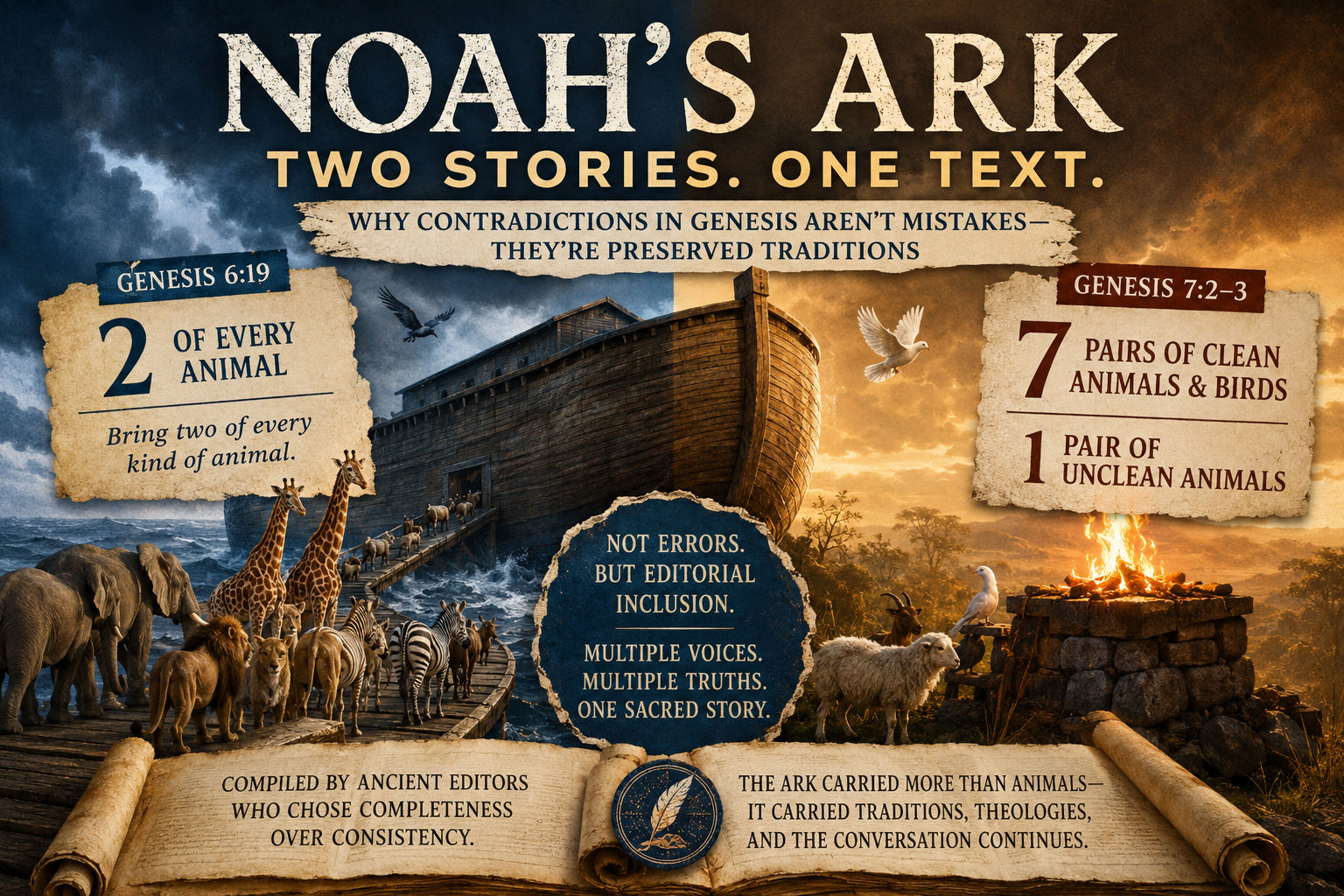
That’s when I noticed something odd. In chapter 6, God tells Noah to bring two of every animal onto the ark. Clear enough. But flip to chapter 7, and suddenly God’s instructions change completely. Now Noah needs seven pairs of clean animals, seven pairs of birds, and only one pair of unclean animals.
Wait, what?
I read it again. Then again. These weren’t supplementary instructions or clarifications. They were completely different commands that contradicted each other. You can’t bring both two animals and fourteen animals of the same species. It’s mathematically impossible.
The more I thought about it, the more the contradiction mattered. After the flood, Noah builds an altar and sacrifices some clean animals and birds. This makes sense if he brought seven pairs—he’d have extras. But if he only brought two of each animal, as chapter 6 states, those sacrifices would have caused immediate extinctions.
The Problem Gets Deeper
The contradictions raised another question that kept nagging at me. How did Noah even know which animals were “clean” and “unclean”? These categories don’t get explained until Leviticus and Deuteronomy, books that describe events happening centuries after the flood. The dietary laws that separate clean from unclean animals were given to Moses on Mount Sinai. Noah lived generations before Moses.
So either God revealed these complex ritual laws to Noah (and humanity somehow forgot them until Moses), or something else is going on with how this text was assembled.
I spent months digging into this puzzle. What I discovered changed how I understand not just the flood story, but religious texts in general.
Two Stories, One Text
Biblical scholars have long recognized that the flood narrative isn’t a single story. It’s two different flood stories woven together. Different communities preserved different versions of the flood tradition, and when scribes eventually compiled Genesis, they included both versions rather than choosing one.
You can actually separate the two narratives and read them independently. One tradition tells of two animals of each kind—simple, clean, memorable. This version emphasizes God preserving all creation equally. Every species gets saved, no favorites.
The other tradition requires seven pairs of clean animals and birds, plus single pairs of unclean animals. This version cares about ritual purity and proper worship. It uses the number seven, which carries deep religious significance as a symbol of completeness and divine perfection.
The ancient editors who compiled Genesis faced a choice. They could have picked one version and discarded the other. Instead, they preserved both, contradictions and all. They literally stitched two incompatible stories together, verse by verse, creating a narrative that argues with itself.
Why Keep Both Versions?
At first, this editorial decision baffled me. Why preserve obvious contradictions? Why not smooth them over or pick the “correct” version?
But the more I studied, the more I appreciated the wisdom in this approach. Each version serves a different theological purpose. The “two by two” story speaks to God’s universal care for creation. It’s democratic—every creature matters equally. Children understand this version immediately because it’s fair and balanced.
The “seven pairs” version addresses the community’s need for worship and thanksgiving. It recognizes that after surviving catastrophe, humans need to express gratitude. It provides enough clean animals for both sacrifice and species preservation. This version speaks to a more developed religious consciousness, one that understands sacred categories and ritual obligations.
By keeping both versions, the editors preserved different ways of understanding the same fundamental event. They refused to let one theological perspective dominate. They created space for multiple truths to coexist.
Reading Contradiction as Feature, Not Bug
This discovery forced me to reconsider what I expected from religious texts. I had assumed they should present consistent, non-contradictory narratives. But the flood story’s contradictions aren’t mistakes or oversights. They’re deliberate preservations of diverse traditions.
The same pattern appears throughout Genesis and other biblical books. Multiple creation accounts. Different versions of how David met King Saul. Contradictory genealogies. These aren’t errors but evidence of editorial inclusion—ancient scribes choosing comprehensiveness over consistency.
This approach reflects sophisticated theological thinking. The editors understood that divine mysteries exceed any single narrative’s capacity. Different communities experienced and understood God differently. Rather than declaring one perspective correct, the editors let the text hold multiple viewpoints in productive tension.
What Noah’s Ark Teaches About Sacred Texts
The flood story’s contradictions reveal how sacred literature actually develops. These texts weren’t dictated word-for-word from heaven. They emerged from communities preserving, retelling, and eventually writing down their sacred traditions. Different groups emphasized different aspects of the stories based on their own experiences and needs.
When these traditions eventually merged into written scripture, the editors faced impossible choices. Which version was “true”? Which details mattered most? Rather than playing judge, they often chose to include multiple versions, trusting future readers to wrestle with the complexities themselves.
This process makes the text more human and, paradoxically, more profound. The contradictions show us real people struggling to preserve and understand their encounters with the divine. We see communities negotiating between different theological priorities, trying to hold multiple truths simultaneously.
The Conversation Continues
Once I understood the flood narrative as a compilation of traditions rather than a single story, my entire approach to reading religious texts shifted. I stopped expecting them to function like instruction manuals or history textbooks. I began reading them as theological conversations, sometimes even arguments, preserved across generations.
The contradiction between two and seven pairs of animals no longer bothers me. Instead, it reminds me that scripture has always been a collaborative project. Multiple voices contribute. Different perspectives matter. The text itself demonstrates that religious truth is complex enough to require multiple tellings.
This understanding actually strengthens my appreciation for these ancient texts. They’re not simple moral fables or primitive myths. They’re sophisticated documents that preserve entire worldviews, complete with their tensions and contradictions. They trust readers to engage thoughtfully rather than passively accept.
The Noah’s Ark story still teaches about divine judgment and mercy, about destruction and renewal. But it also teaches us about the nature of sacred literature itself—how it develops, how it preserves multiple traditions, and how it invites us into an ongoing conversation about life’s deepest questions.
Every time I encounter those contradictory instructions about the animals, I’m reminded that religious texts are living documents. They carry the voices of countless communities who found meaning in these stories. They preserve not just narratives but entire ways of understanding the world. And they invite us to add our own voices to the conversation, wrestling with the same mysteries that captivated our ancestors.
The ark carried more than animals. It carried competing traditions, diverse theologies, and the recognition that some truths are too large for any single telling. That’s a cargo worth preserving, contradictions and all.