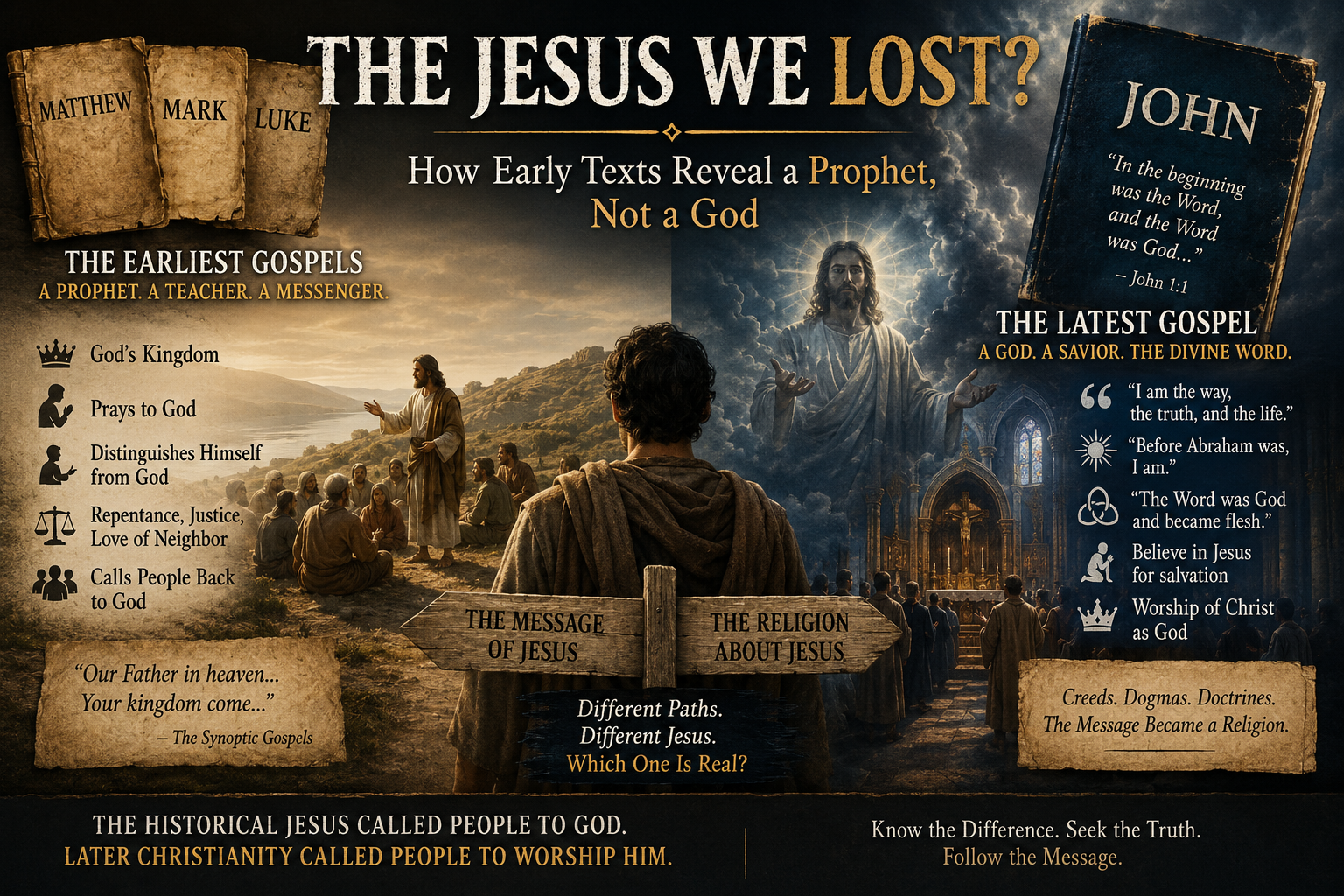
The first time I seriously questioned what I’d been taught about Christianity came during a comparative study of the Gospels. Reading them side by side revealed something startling: the Jesus in Matthew, Mark, and Luke bears little resemblance to the divine figure in John’s Gospel.
In the earlier texts, Jesus speaks constantly about God’s kingdom and calls people to repentance. He prays to God. He distinguishes himself from God. He acts as a prophet bringing an urgent message to his people. This Jesus fits squarely within Jewish monotheism, teaching the same fundamental truths that prophets before him proclaimed: worship one God alone, repent sincerely, and love both God and neighbor through concrete actions.
The Gospel of John tells a different story. Here, Jesus makes sweeping declarations about his own identity. “I am the way, the truth, and the life.” “Before Abraham was, I am.” The famous prologue announces that “the Word was God” and “became flesh.” These aren’t subtle theological hints; they’re explicit claims to divinity that would have shocked any first-century Jewish audience.
What struck me most forcefully was this: if Jesus really said these things about himself, why do Matthew, Mark, and Luke never mention them? Luke, in particular, presents itself as a careful historical account, yet contains no trace of Jesus claiming divine status. Not once does Luke’s Jesus declare himself to be God incarnate or the exclusive path to salvation.
This isn’t a minor discrepancy. The entire structure of orthodox Christian theology rests on the Incarnation—the belief that God became human in Jesus. Remove that pillar, and doctrines like the Trinity and vicarious atonement lose their foundation. Yet this central claim appears only in the latest Gospel, written decades after the others.
The historical puzzle becomes even more complex when you consider how Christian preaching developed. Paul’s letters, our earliest Christian documents, focus intensely on Jesus’s death and resurrection but say remarkably little about his actual teachings. The synoptic Gospels preserve teachings but don’t present Jesus as God. Only John’s Gospel provides the explicit divine claims that became Christianity’s theological cornerstone.
I began to see a pattern. The earliest sources show Jesus as a Jewish reformer calling people back to authentic faith. He condemns religious hypocrisy, champions the poor and marginalized, and insists that true worship requires both sincere devotion and ethical action. His message centers on God, not on himself.
As decades passed and the movement spread beyond its Jewish origins, the focus shifted. Jesus became the message rather than the messenger. The prophet who pointed to God became the God to whom people pointed. The teacher of repentance became the object of worship.
This transformation wasn’t instantaneous. You can trace its development through the New Testament texts themselves. Mark’s Gospel, likely the earliest, presents Jesus as the suffering servant and Son of God—titles that in Jewish context didn’t necessarily imply divinity. Matthew and Luke expand the narrative but maintain essentially the same theological framework. Then John arrives with its radically elevated Christology, and suddenly Jesus is the pre-existent Word who was with God from the beginning.
The implications are profound. If the historical Jesus never claimed to be God, never taught the Trinity, never presented his death as a cosmic atonement for sin, then Christianity’s core doctrines represent a later interpretation rather than the original message. The religion about Jesus replaced the religion of Jesus.
This realization led me to reconsider everything. Reading the synoptic Gospels without the overlay of later theology, I found a consistent message: turn to God with sincere hearts, treat others with justice and compassion, reject empty religiosity in favor of genuine faith. This was a call to reform and renew existing faith, not establish a new one.
The Jesus of history emerges as a figure firmly rooted in prophetic tradition. Like the Hebrew prophets before him, he challenged corrupt religious authorities, defended the oppressed, and called his people back to their covenant with God. His radical message wasn’t theological innovation but moral revolution—demanding that faith manifest in transformed lives and communities.
Consider how Jesus speaks about prayer in the synoptics. He teaches his followers to pray directly to “Our Father in heaven.” He doesn’t instruct them to pray through him or to him. The model prayer he provides asks for God’s kingdom to come, for daily bread, for forgiveness—all directed to God alone. This is monotheistic prayer, pure and simple.
The contrast with later Christian practice couldn’t be starker. Prayers addressed to Jesus, hymns praising Christ as God, elaborate theological formulations about three persons in one essence—none of this appears in the earliest Gospel accounts of Jesus’s own teaching.
What happened between the historical Jesus and the Christ of faith? The answer lies partly in Christianity’s spread into the Greco-Roman world. Gentile converts, unfamiliar with Jewish monotheism’s strict boundaries, brought their own religious concepts. Divine-human hybrids were common in their mythology. Mystery religions promised salvation through dying and rising gods. These influences shaped how they understood and transmitted the Jesus story.
The Gospel of John, written in this later context, reflects these developments. Its philosophical prologue about the Logos would resonate with Greek-educated readers. Its emphasis on believing in Jesus rather than simply following his teachings shifts the focus from practice to faith, from deed to creed.
None of this means the synoptic Gospels are purely historical or free from theological interpretation. They, too, were written decades after Jesus’s death by authors with their own perspectives and agendas. But their relative consistency in presenting Jesus as prophet and teacher, rather than as God incarnate, suggests they preserve an earlier tradition closer to the historical reality.
The question isn’t whether later Christians were sincere in their beliefs or whether their theological developments were meaningful for them. The question is whether these developments represent what Jesus himself taught and intended. Based on the earliest available evidence, the answer appears to be no.
This matters because millions of people base their lives on the belief that Christianity represents Jesus’s actual message. They deserve to know that scholarly examination of the sources suggests otherwise. The Jesus who emerges from historical analysis called people to submit to God, not to deify himself. He preached repentance and righteous action, not salvation through believing particular doctrines about his nature.
Recognizing this gap between the historical Jesus and later Christian doctrine doesn’t diminish Jesus’s significance. If anything, it highlights the power of his actual message—a call to authentic faith expressed through love of God and neighbor that transcends sectarian boundaries and speaks to universal human aspirations for meaning, justice, and connection with the divine.
The tragedy is that institutional Christianity, by elevating Jesus to divine status, may have obscured the very message he came to deliver. Instead of following his example of submission to God, Christianity asks people to worship Jesus as God. Instead of his emphasis on deeds and sincerity, it prioritizes beliefs and creeds. The messenger became more important than the message, and in that transformation, something essential was lost.