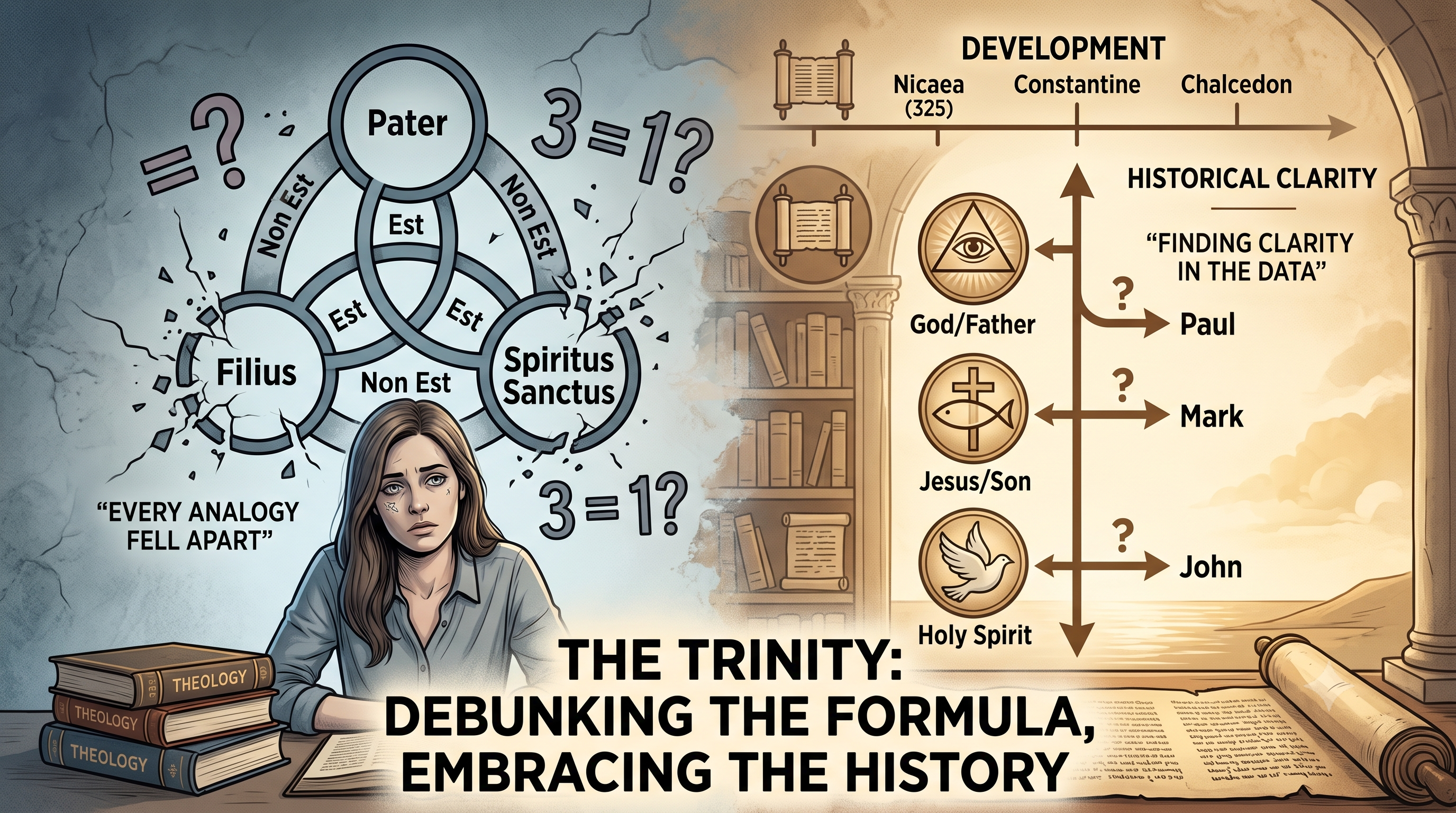
The first time I sat down to really understand the Trinity, I brought three different theology books, a notebook, and what I thought was an open mind. Six hours later, I closed the last book feeling more confused than when I started. Every analogy fell apart under scrutiny. Water, ice, and steam? That’s modalism. The sun with its light and heat? Still doesn’t work. An egg with shell, white, and yolk? Please.
For years, I blamed myself. Maybe I wasn’t smart enough. Maybe I needed more faith. Maybe some truths were just beyond human comprehension.
Then I started digging into the historical development of this doctrine, and everything changed.
The Problem That Started Everything
The early Christian communities faced a genuine puzzle. Their scriptures presented Jesus in contradictory ways. In some passages, Jesus prays to God, distinguishes himself from the Father, and even states that the Father is greater than he is. In others, Jesus receives worship, forgives sins, and gets described in terms reserved for God alone.
This wasn’t a minor interpretive issue. This was foundational. How can Jesus simultaneously be God and not be God?
The Trinity emerged as an attempt to solve this equation. Think of it as theological algebra—trying to make both sides of an impossible equation balance. The formula they developed stated that God exists as three persons in one essence: Father, Son, and Holy Spirit. Distinct but not separate. Co-equal and co-eternal.
On paper, it looked like a solution. In practice, it created more problems than it solved.
Why the Math Never Added Up
Two fundamental issues doomed this project from the start.
First, the architects of Trinitarian doctrine assumed the Bible spoke with one voice. They believed every biblical author shared the same perspective on God and Jesus, just expressed differently. This assumption forced them to harmonize texts that were never meant to agree. Mark’s Jesus differs from John’s Jesus because Mark and John had different understandings, not because they were describing different aspects of the same unified truth.
When you force diverse perspectives into artificial agreement, you get contradictions. The framework couldn’t contain the actual diversity of biblical thought.
Second, the philosophical tools available in the fourth and fifth centuries couldn’t handle the conceptual load. The categories of substance, essence, and person came from Greek philosophy, not Hebrew thought. These concepts worked well enough for discussing physical objects or abstract ideas, but they broke down when applied to questions about divine agency and personhood.
The intuitions people had about deity exceeded what the philosophical vocabulary could express. Like trying to perform surgery with stone tools, the instruments weren’t precise enough for the operation.
When Power Replaces Persuasion
By the fourth century, the debate had reached an impasse. Different camps had formed, each with their own solution to the Jesus problem. Arians said Jesus was created by God. Docetists claimed Jesus only appeared human. Modalists argued the Father, Son, and Spirit were just different modes of one person.
Then Emperor Constantine entered the picture. He needed religious unity to maintain political unity. The Council of Nicaea in 325 CE wasn’t convened to discover truth through dialogue. It was convened to establish an official position.
The resulting creed didn’t resolve the philosophical problems. It declared them resolved. Bishops who refused to sign faced exile. The same pattern repeated at Constantinople, Ephesus, and Chalcedon. Each council added more technical language, more precise definitions, but the core contradictions remained.
After the emperors came the institutions. Churches maintained orthodoxy through excommunication, social pressure, and in darker periods, violence. The enforcement mechanism reveals the weakness of the doctrine itself. Coherent ideas spread through persuasion. Incoherent ones require coercion.
The Mystery That Isn’t
Modern defenders of the Trinity often retreat to mystery. “God’s nature transcends human understanding,” they say. “We must accept what we cannot comprehend.”
But there’s a difference between mystery and contradiction. A mystery is something we don’t yet understand—like consciousness or quantum mechanics. A contradiction is when we claim two mutually exclusive things are simultaneously true—like saying a bachelor is married.
The Trinity isn’t mysterious. It’s contradictory. One person cannot be three persons. Three persons cannot be one person. Playing word games with “essence” and “substance” doesn’t resolve this. It just pushes the contradiction back a step.
The constant appeal to mystery serves a function: it shifts blame from the doctrine to the questioner. If you don’t understand, the problem is your limited human reason, not the incoherent teaching. This protects the doctrine from scrutiny while making critics seem arrogant or faithless.
Finding Clarity in the Data
Once I stopped trying to make the Trinity work and started examining what the biblical texts actually say, patterns emerged.
Paul, writing in the 50s CE, subordinates Jesus to God consistently. Jesus is Lord, but God is the Father. Jesus is the image of God, the firstborn of creation, but not God himself.
Mark, the earliest gospel, presents Jesus as a human prophet adopted by God at baptism. Jesus has authority but prays to God, experiences limitations, and dies feeling abandoned.
Matthew and Luke elevate Jesus’s status, making him divine from birth through virgin conception, but still maintain distinction between Jesus and God.
John, writing decades later, goes furthest in divinizing Jesus. The Word was God. Jesus and the Father are one. Yet even John’s Jesus prays to the Father and speaks of being sent.
These aren’t pieces of one puzzle waiting to be assembled correctly. They’re different puzzles entirely. Each author had their own understanding of Jesus’s relationship to God, shaped by their community’s needs and experiences.
The development becomes clear when you read the texts chronologically. Early Christians didn’t start with the Trinity and work backward. They started with a human teacher they believed God had vindicated through resurrection. Over time, as they reflected on what this meant, Jesus’s status grew. Each generation pushed the boundaries a bit further, until by the second century, some Christians were calling Jesus God outright.
This evolution makes perfect sense historically. What doesn’t make sense is pretending all these different stages were actually saying the same thing all along.
The Cost of Maintaining the Impossible
Living with cognitive dissonance takes a toll. I spent years in churches where questioning the Trinity marked you as suspicious at best, heretical at worst. Smart, thoughtful people would twist themselves into intellectual pretzels trying to explain how something obviously contradictory wasn’t actually contradictory.
I watched pastors dodge direct questions with practiced ease. “It’s a divine mystery.” “We see through a glass darkly.” “God’s ways are higher than our ways.” These aren’t answers. They’re conversation enders.
The energy spent defending the indefensible could be spent on so many better things. Understanding the historical Jesus. Exploring the diverse ways early Christians understood their experience. Examining how religious ideas develop and change over time.
Instead, churches police boundaries, ensuring no one colors outside the lines drawn sixteen centuries ago by bishops and emperors most Christians couldn’t name.
The Freedom in Letting Go
Releasing the Trinity didn’t destroy my appreciation for Christian tradition or biblical literature. It enhanced it. I could finally read each text on its own terms, appreciate each author’s unique perspective, and trace how ideas about Jesus developed over time.
Mark’s very human Jesus speaks to experiences of suffering and abandonment. John’s cosmic Christ addresses questions about meaning and purpose. Paul’s apocalyptic Lord offers hope for transformation. Each vision has value without being forced into artificial harmony.
The texts become more interesting when you stop trying to harmonize them. The debates become more understandable when you see what problems they tried to solve. The history becomes more human when you recognize the role of power in shaping doctrine.
This approach opens space for honest investigation. You can acknowledge tensions without explaining them away. You can appreciate diverse perspectives without choosing sides. You can engage with the tradition without being bound by its contradictions.
Moving Forward
The Trinity tried to solve an unsolvable problem because it misidentified the problem itself. The question isn’t “How can Jesus be both God and not God?” The question is “Why did different early Christians understand Jesus in such different ways?”
That’s a historical question with historical answers. And those answers tell us something valuable about how humans create meaning, how communities develop identity, and how power shapes belief.
We don’t need to pretend ancient formulas make sense when they don’t. We don’t need to defend positions that require mental gymnastics to maintain. We can appreciate the tradition for what it is: a very human attempt to understand experiences that felt divine.
The early Christians were wrestling with real questions that mattered deeply to them. Their answers don’t have to be our answers. But understanding their struggles helps us understand our own.
When you stop trying to solve impossible equations, you free yourself to ask better questions. And better questions lead to better understanding—of the texts, of history, and of ourselves.