Growing up, I spent countless Sunday mornings listening to scripture readings without ever wondering when someone actually wrote these words down. Years later, while researching ancient texts, I stumbled upon something that shifted my entire perspective: the biblical books weren’t written in the order they appear, and they span over a thousand years of composition.
The Oldest Pieces Aren’t What You’d Expect
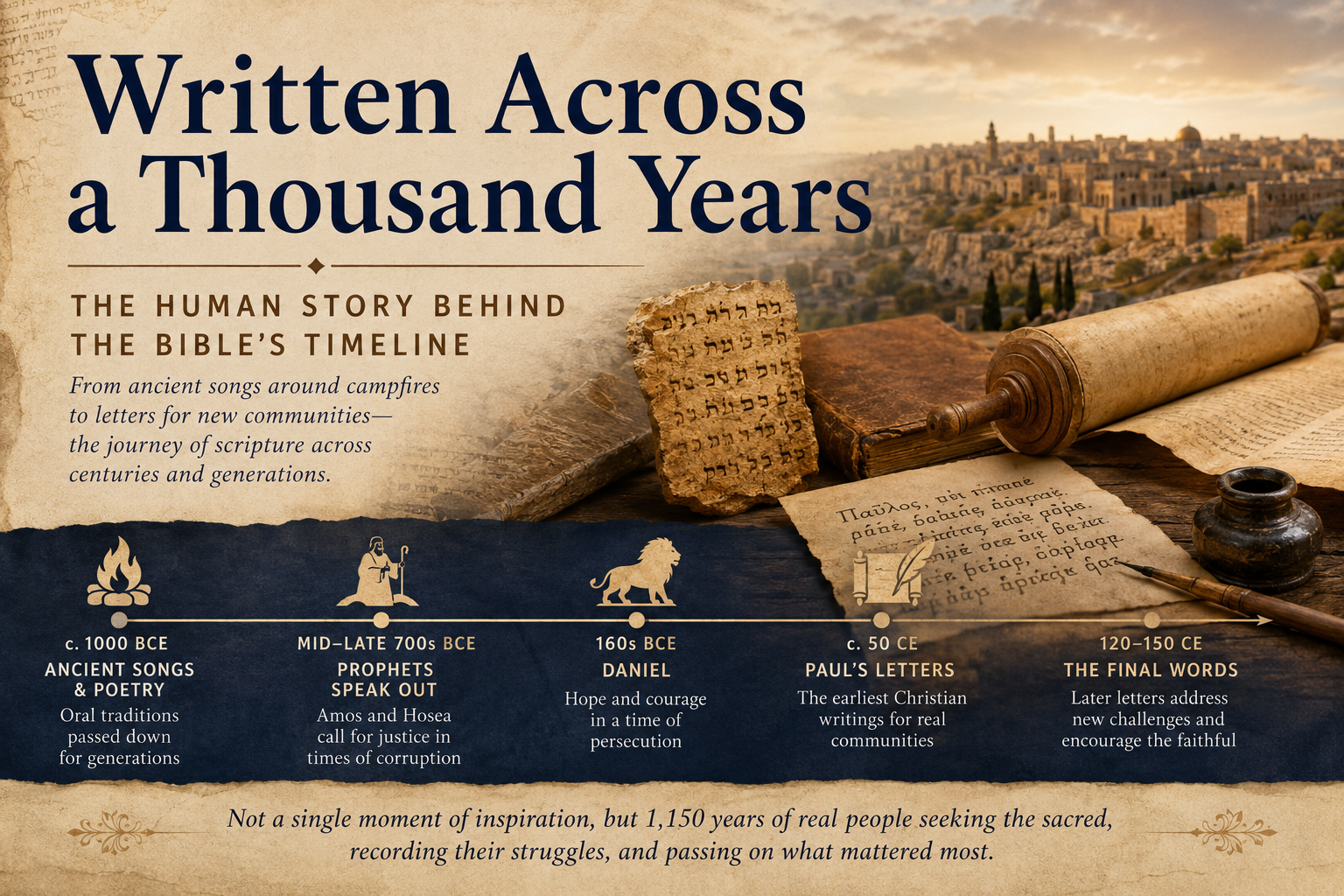
The Hebrew Bible contains fragments that predate any complete book by centuries. These ancient poems and songs go back to around 1000 BCE—pieces like the Song of Deborah in Judges 5 and the Song of the Sea in Exodus 15. Picture ancient Israelites singing these verses around campfires, passing them down through generations before anyone thought to write them down.
These fragments fascinate me because they preserve the oldest forms of biblical Hebrew. The language itself tells a story—archaic verb forms and vocabulary that disappeared from later Hebrew writing. When you read the Song of Moses in Deuteronomy 32 or the Blessings of Jacob in Genesis 49, you’re encountering words that ancient peoples sang long before Jerusalem became Israel’s capital.
The First Complete Books: Social Critics of the 8th Century
The earliest complete biblical books come from the prophets Amos and Hosea, both writing in the mid to late 700s BCE. These weren’t mystics hiding in caves—they were social critics addressing the corruption and inequality of their time.
Amos particularly strikes me as remarkably contemporary. Here’s a prophet condemning wealthy elites who “trample on the poor” while performing empty religious rituals. Sound familiar? Hosea took a different approach, using his own troubled marriage as a metaphor for the relationship between God and Israel. Both books reached essentially their current form within the same century they were written, though later scribes made minor edits.
Daniel: The Hebrew Bible’s Final Addition
The book of Daniel earns the distinction of being the last book written for the Hebrew Bible, composed during intense persecution in the 160s BCE. This timing explains something that puzzled me for years—why Daniel appears in different places in Jewish and Christian Bibles, and why it switches between Hebrew and Aramaic.
Daniel wasn’t predicting distant future events. The author was writing in coded language about contemporary political crises, offering hope to Jews facing religious oppression under foreign rule. The book reached its final form around 150 BCE, closing out nearly 850 years of Hebrew Bible composition.
Paul’s Letters: Christianity’s First Writings
Here’s what surprised me most: the New Testament’s first written text wasn’t a Gospel. Paul’s letter to the Thessalonians, written around 50 CE, predates the earliest Gospel by about twenty years. Think about that—only two decades after Jesus died, Paul was already writing to established Christian communities dealing with practical problems.
Reading 1 Thessalonians feels like intercepting someone else’s mail. Paul addresses specific concerns: What happens to believers who die before Jesus returns? How should the community handle members who won’t work? These aren’t abstract theological treatises but responses to real questions from real people trying to figure out this new faith.
The New Testament’s Last Word
The New Testament’s composition wrapped up with several pseudepigraphic letters—texts written in the names of apostles but composed by later authors. This practice seems deceptive to modern readers, but ancient audiences understood and accepted it as a way to preserve and extend a teacher’s legacy.
Second Peter stands as the final New Testament book, written between 120 and 150 CE. By this time, Christian communities faced different challenges than Paul’s generation. False teachers had emerged, and believers struggled with the delayed return of Christ. The author references other Christian writings, including Jude and possibly Paul’s letters, showing how these texts were already gaining authoritative status.
What This Timeline Reveals
The numbers alone tell a remarkable story. The Hebrew Bible developed over approximately 850 years, while the entire New Testament emerged within a single century. This compressed timeframe for Christian scripture reflects the explosive growth of the early church and the urgent need to preserve apostolic teaching.
But beyond the numbers, this timeline reveals something profound about how sacred texts develop. These aren’t documents that fell from the sky fully formed. They emerged from communities wrestling with real problems, preserving their insights and struggles for future generations.
Take the prophetic books. Knowing that Amos wrote during actual 8th-century social upheaval—not centuries before—changes how you read his condemnations of economic injustice. Understanding that Daniel wrote during the persecution it describes transforms it from mystical prediction into powerful resistance literature.
Reading with Fresh Eyes
This chronological perspective has transformed how I read these texts. When I encounter the Song of Deborah, I’m hearing echoes from three thousand years ago—words that survived through oral tradition before anyone imagined a complete Bible. Reading Paul’s letters, I’m witnessing Christianity’s birth pangs, watching communities figure out what it means to follow a crucified messiah in a Roman world.
The editorial process itself tells a story. These texts weren’t frozen in time at the moment of composition. Scribes updated archaic language, added explanatory notes, and sometimes inserted new material to address contemporary concerns. The Bible on my shelf represents not a single moment of inspiration but centuries of communities carefully preserving, transmitting, and interpreting their sacred traditions.
The Human Story Behind Sacred Text
What strikes me most forcefully is how human this all is. Real people in real historical moments wrote these texts. Amos watched wealthy landowners exploit day laborers and couldn’t stay silent. Paul heard that his friends in Thessalonica were confused and worried, so he dictated a letter. The author of 2 Peter saw believers losing faith as years passed without Christ’s return and felt compelled to offer encouragement.
This doesn’t diminish the texts’ significance—it amplifies it. These aren’t abstract philosophical treatises but the preserved wisdom of communities facing war, exile, oppression, and uncertainty. They wrote to encourage, correct, comfort, and challenge their contemporaries, never imagining their words would be read thousands of years later on different continents in languages that didn’t yet exist.
The chronological span—from those ancient Hebrew fragments around 1000 BCE to 2 Peter around 150 CE—encompasses roughly 1,150 years of human beings reaching toward the divine and recording what they found. That’s longer than the time between the Norman Conquest and today. These texts emerged from radically different contexts: tribal confederations, monarchies, exile, foreign occupation, and the cosmopolitan Roman Empire.
Yet somehow, these diverse writings from across the centuries came together into the collections we call the Bible. Communities recognized something essential in these texts, something that transcended their immediate historical contexts while remaining grounded in human experience. They preserved them, copied them, studied them, and passed them on until they reached us.
Understanding this timeline has given me deeper respect for both the texts themselves and the communities that preserved them. Every time I open these ancient books, I’m joining a conversation that’s been going on for three millennia—a conversation about justice and mercy, faith and doubt, human failure and divine possibility. The timeline of biblical composition isn’t just academic trivia. It’s the story of how human communities across centuries preserved their deepest insights about what it means to seek the sacred in the midst of ordinary life.