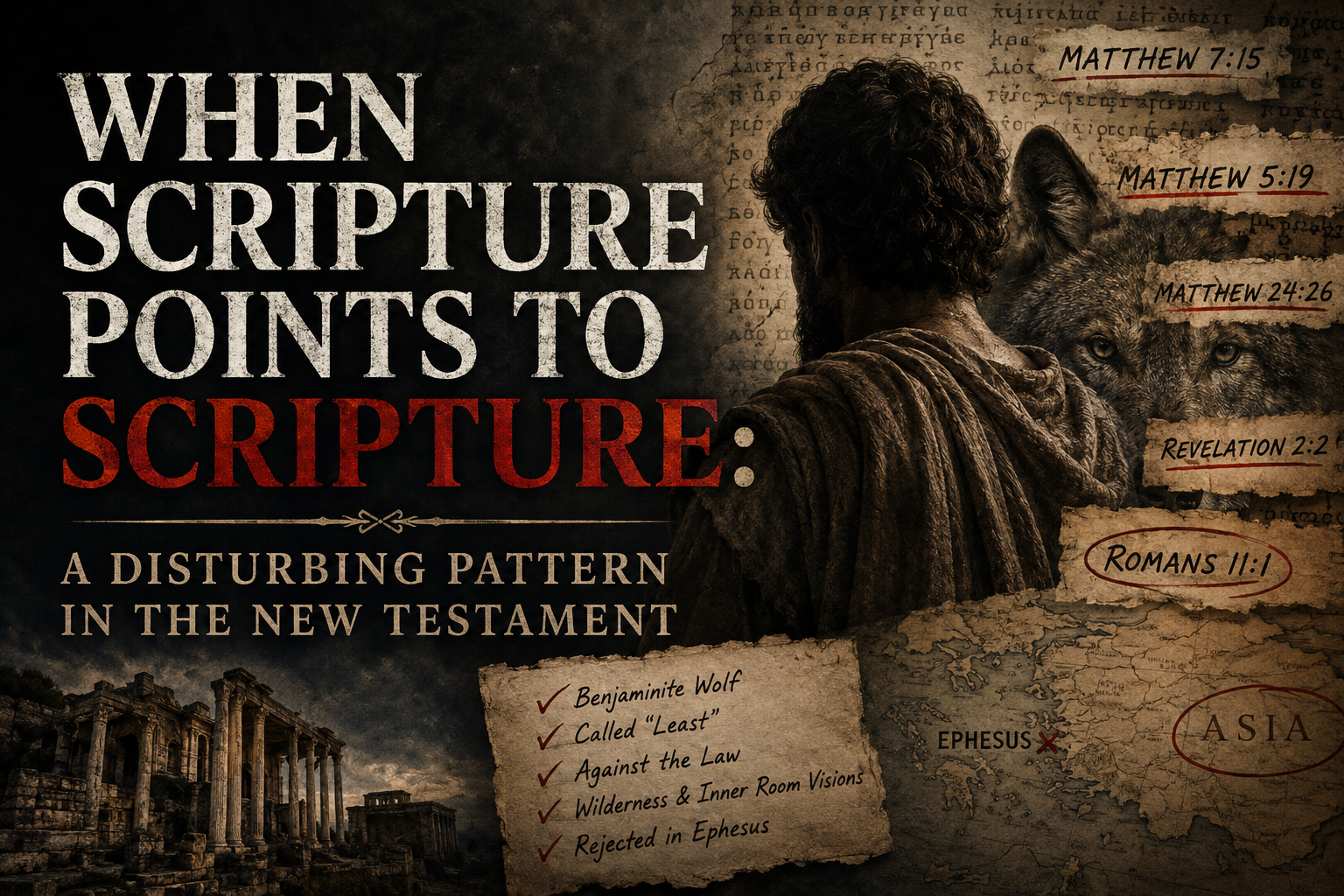
When Scripture Points to Scripture: A Disturbing Pattern in the New Testament
I’ve spent years reading the New Testament, and recently stumbled across an interpretation that stopped me cold. Once you see these connections, you can’t unsee them. They’re right there in the text, plain as day, yet somehow we’ve all been trained to read past them.
The argument goes like this: Jesus gave his followers five specific warnings about someone who would come after him. Not vague prophecies or general cautions about false teachers. Specific, identifiable markers. And when you line them up against the biographical details we have about Paul, the match becomes uncomfortably precise.
The Wolf Warning
Start with Matthew 7:15. Jesus warns about false prophets who come as wolves in sheep’s clothing. Standard fare for religious warnings, right? Except the original Greek apparently connects these “ravenous wolves” to the tribe of Benjamin. That same tribe known for violence throughout Jewish history—remember the horrific story in Judges 19-20 where the Benjaminites nearly got wiped out for their brutality.
Now flip to Romans 11:1. Paul tells us exactly which tribe he’s from: Benjamin. He volunteers this information. Nobody asked. He just puts it out there.
The Name Game
Matthew 5:19 gets more specific. Jesus says whoever breaks the commandments and teaches others to do the same will be called “least” in the kingdom of heaven. Not just punished or cast out—specifically called “least.”
Paul’s name literally means “the least” in Latin. He even calls himself “the least of the apostles” in his own letters. Then in Acts 21:21, James confronts Paul with accusations that he’s been teaching Jews to abandon Moses’s law. Teaching them to break the commandments, in other words.
The precision here makes my skin crawl. Jesus says someone will be called “least” for teaching against the law. Paul means “least,” calls himself least, and gets accused of teaching against the law.
Desert Encounters and Secret Visions
Matthew 24:26 contains two related warnings that have always puzzled me. Jesus says if anyone claims to have seen him in the wilderness, don’t believe it. If anyone says they saw him in inner rooms, don’t believe it.
Paul’s entire apostolic authority rests on what? A vision on the Damascus road—in the wilderness. He also claims to have seen Jesus during a temple trance and describes being caught up to the third heaven while imprisoned. Wilderness visions. Inner room revelations. The exact two categories Jesus warned against.
I used to wonder why Jesus would warn against such specific scenarios. Who would claim to see him in the wilderness or inner rooms? Now I know. One person did. The same person whose teachings form half the New Testament.
The Ephesus Connection
Revelation 2:2 praises the church at Ephesus for testing false apostles and finding them to be liars. Standard church management stuff, you might think. Except Paul himself admits in 2 Timothy 1:15 that “all those in Asia have turned away from me.”
Ephesus was in Asia. The church Jesus personally commends for rejecting false apostles exists in the same region where Paul admits he was rejected. The same Paul who spent years establishing churches there, who wrote lengthy letters to them, who considered Asia his territory—they tested him and found him wanting.
The Original Split
This interpretation explains something that has always bothered me about early Christianity. Why did the Nazarenes—the original Jerusalem church led by James, Jesus’s own brother—have such problems with Paul? These were people who actually knew Jesus. They walked with him, ate with him, heard him teach firsthand. And they rejected Paul’s version of the gospel so thoroughly that Paul spends half his letters defending himself against them.
We’re told this was just a disagreement about whether Gentiles needed to follow Jewish law. But what if it was deeper? What if the people who knew Jesus best recognized that Paul was teaching something fundamentally different from what Jesus taught?
The Uncomfortable Questions
Once you see these five warnings lined up against Paul’s biography, other passages start hitting differently. Why does Paul say he received his gospel through private revelation rather than from the other apostles? Why does he boast about not consulting with Peter and James? Why does he curse anyone who preaches a different gospel—even if it’s an angel from heaven?
These aren’t the words of someone building on an established foundation. These are the words of someone establishing a competing foundation.
The implications here run deep. If Paul was the false apostle Jesus warned about, then half the New Testament becomes suspect. The doctrine of salvation by faith alone, the teachings about the law being abolished, the whole theological framework most churches operate under—it all comes from Paul, not Jesus.
I’m not saying I buy this interpretation completely. But I can’t dismiss it either. The textual evidence sits there, stubborn and specific. Jesus warned about a Benjaminite wolf who would be called “least,” who would teach against the law, who would claim authority from wilderness and inner room visions, and who would be rejected by the church at Ephesus.
We have one person in the New Testament who fits every single marker.
The question isn’t whether these connections exist. They do. The question is what we do with them once we see them.