The first time I read the Old Testament straight through, I kept waiting for hell to show up. Page after page, story after story, I searched for the lake of fire that had haunted my childhood imagination. Abraham, Moses, David—surely one of them would mention the eternal torture chamber I’d heard about every Sunday. But it never came.
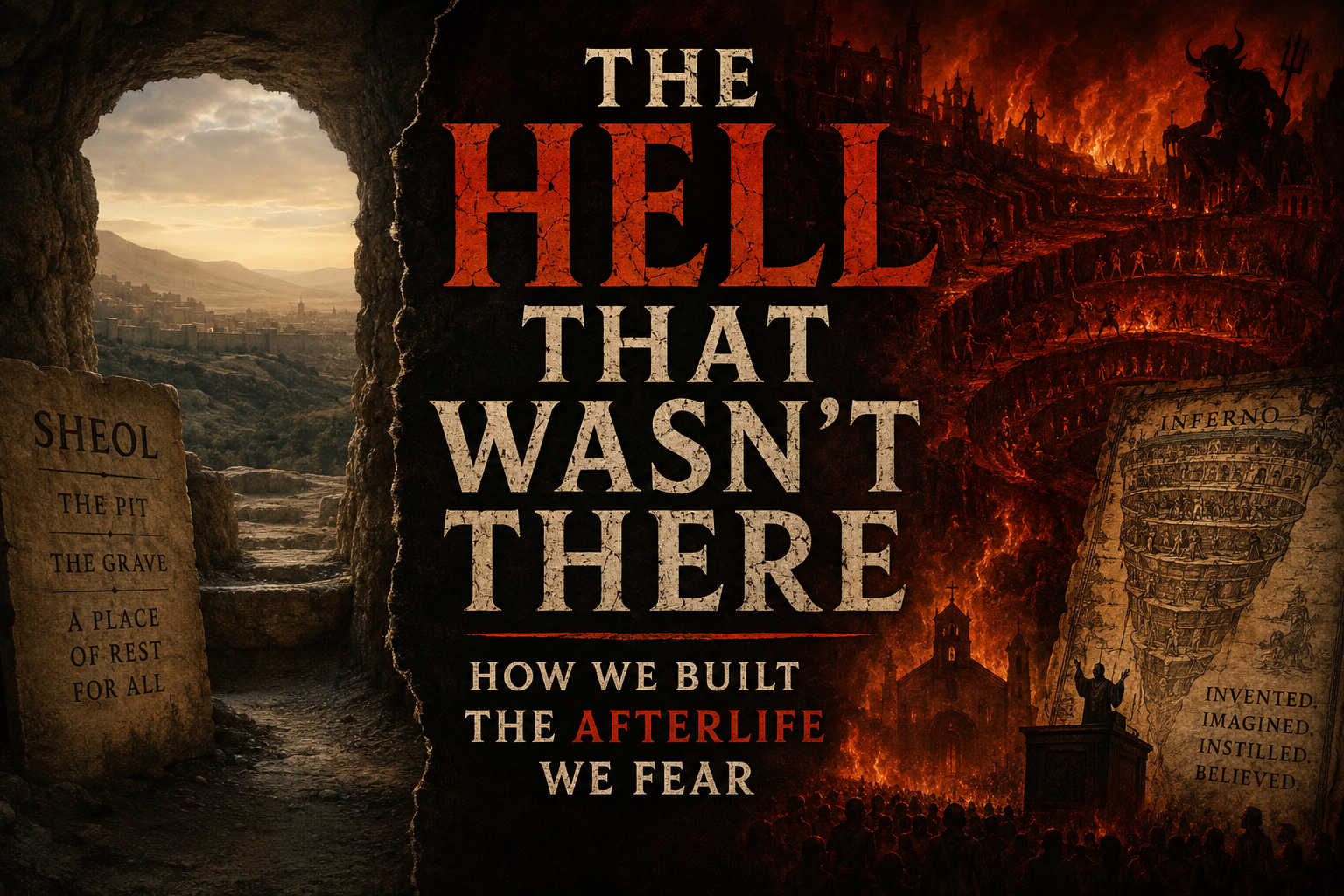
What I found instead was Sheol. Everyone went there when they died. The righteous patriarch Jacob spoke of going down to Sheol in his grief. Job, despite his suffering and righteousness, expected to end up there. When King Saul had the witch of Endor summon the prophet Samuel from the dead, where did Samuel come from? Sheol. The same place everyone else went.
The ancient Hebrew texts paint Sheol as a shadowy place of rest beneath the earth. Sometimes they called it “the pit” or simply “the grave.” No fire. No demons. No screaming. Just a quiet gathering place for the dead, like a vast underground dormitory where everyone—saint and sinner alike—waited in the darkness.
This wasn’t the hell I knew. Where were the demons? The pitchforks? The eternal flames that never consumed but always burned? For the first thousand years of biblical history, these things simply don’t exist in the text.
When I moved to the New Testament, expecting finally to encounter the hell of my nightmares, I hit another wall. The word “hell” doesn’t appear in the original Greek. Jesus spoke of Gehenna, which sent me to the history books. Turns out Gehenna wasn’t a spiritual realm at all—it was the Valley of Hinnom, Jerusalem’s literal garbage dump. Fires burned there constantly, consuming the city’s waste. Wild animals fought over scraps. Smoke rose day and night from the refuse.
When Jesus warned his followers about being “cast into Gehenna,” his audience would have pictured that actual valley outside their city walls. They knew the smell of it, had probably tossed their own garbage there. This was his metaphor for destruction—not a cosmic torture dimension, but the city dump where worthless things were destroyed.
The translation history revealed even more surprises. When Jewish scholars translated the Hebrew scriptures into Greek, they needed a word for Sheol. They chose Hades, borrowing from Greek mythology. Suddenly, the neutral Hebrew afterlife merged with the Greek underworld, complete with its mythological baggage. One translation decision, and biblical text became entangled with pagan stories of underground rivers and multi-headed guard dogs.
But the real construction of modern hell happened centuries later. Early church fathers began combining elements: the Greek Hades, the burning imagery of Gehenna, Roman ideas about justice and punishment, and their own theological interpretations. They built something new—a comprehensive system of eternal punishment that would have been unrecognizable to Abraham or Moses.
By the medieval period, this constructed hell had evolved into an elaborate realm. Dante gave it nine circles, each with specific torments for specific sins. Artists painted it in grotesque detail on church walls and ceilings. These vivid depictions—not biblical text—became what ordinary people pictured when they thought about the afterlife. Dante’s fiction became more real than scripture itself.
What really shifted my perspective was discovering what many early Christians actually believed. A significant number embraced annihilationism—the idea that the unrighteous would simply cease to exist after judgment. No eternal torture. The punishment was non-existence itself. Others believed in universal reconciliation, that eventually all souls would be restored to God. These weren’t fringe views. They were mainstream positions in early Christianity.
The early church father Origen argued that God’s love would eventually redeem everyone. Gregory of Nyssa believed the fires of judgment were purifying, not punishing. These were major Christian thinkers, not heretics, and they saw no biblical mandate for eternal conscious torment.
So how did we get from Sheol to the medieval torture chamber? The answer lies in power, control, and human psychology. A terrifying afterlife motivates obedience. Fear fills churches. The threat of eternal punishment keeps people in line when promises of reward fail. Religious institutions discovered that hell was useful—perhaps more useful than heaven itself.
The concept also solved theological problems. If God is just, how do evil people escape punishment? If God is powerful, why does evil exist? Hell provided a neat answer: justice would come later, in another realm, with interest. The worse the earthly evil, the more elaborate the eternal punishment needed to balance the scales.
But this solution created new problems. How does finite sin deserve infinite punishment? Can a loving God really torture people forever? Why would God create beings knowing they were destined for eternal suffering? These contradictions have plagued theology ever since we invented this version of hell.
Looking at the historical record, I see a concept that evolved to meet human needs, not divine revelation. The hell that terrorizes people today would be unrecognizable to Moses, who never mentioned it. It would puzzle King David, who wrote psalms about going to Sheol. It would surprise many early Christians, who expected the unrighteous to simply perish.
Even the imagery we associate with hell comes from non-biblical sources. The pitchfork-wielding devils? Medieval art. The nine circles? Dante’s imagination. The specific tortures for specific sins? More Dante, plus centuries of creative theological speculation. We’ve been scared by a collage of human inventions, mistaking cultural evolution for divine truth.
This doesn’t mean death isn’t serious or that actions don’t have consequences. The biblical texts take both very seriously. But the specific doctrine of eternal conscious torment in a fire-filled torture chamber? That’s a human construction, built gradually over centuries, influenced by politics, psychology, and cultural exchange.
When I share this history with people, reactions vary wildly. Some feel liberated, as if a massive weight has lifted. Others feel angry, betrayed by institutions that taught them to fear something that wasn’t even in the original text. Still others refuse to consider it, too invested in their current beliefs to examine their origins.
I understand all these reactions. Letting go of hell means reconsidering everything built on its foundation. How do we think about justice without eternal punishment? How do we motivate good behavior without ultimate consequences? How do we make sense of evil if there’s no cosmic torture chamber waiting for evil people?
These are hard questions, but they’re worth asking. Because millions of people live in genuine terror of a place that didn’t exist in the texts they claim to follow. Children have nightmares about fires that were never described in scripture. Adults make life decisions based on avoiding a punishment that human beings invented and refined over centuries.
The garbage dump outside Jerusalem still exists, though it’s not used for refuse anymore. You can visit the Valley of Hinnom today, walk through it, see that it’s just a valley. No portal to another dimension. No lake of fire. Just an ordinary place that became an extraordinary metaphor, which human imagination transformed into something else entirely.
Understanding this history changed how I read religious texts and how I think about fear-based belief systems. It revealed how human creativity and institutional needs can transform simple concepts into elaborate doctrines. Most importantly, it freed me from a fear that had been constructed, piece by piece, over two thousand years of human history.
The hell that haunts modern imagination is real—but only as real as we make it. It exists in our minds, our art, our culture, shaped by centuries of human hands adding details that were never there to begin with. Once you see the construction process, you can’t unsee it. And perhaps that’s the beginning of a different kind of freedom.