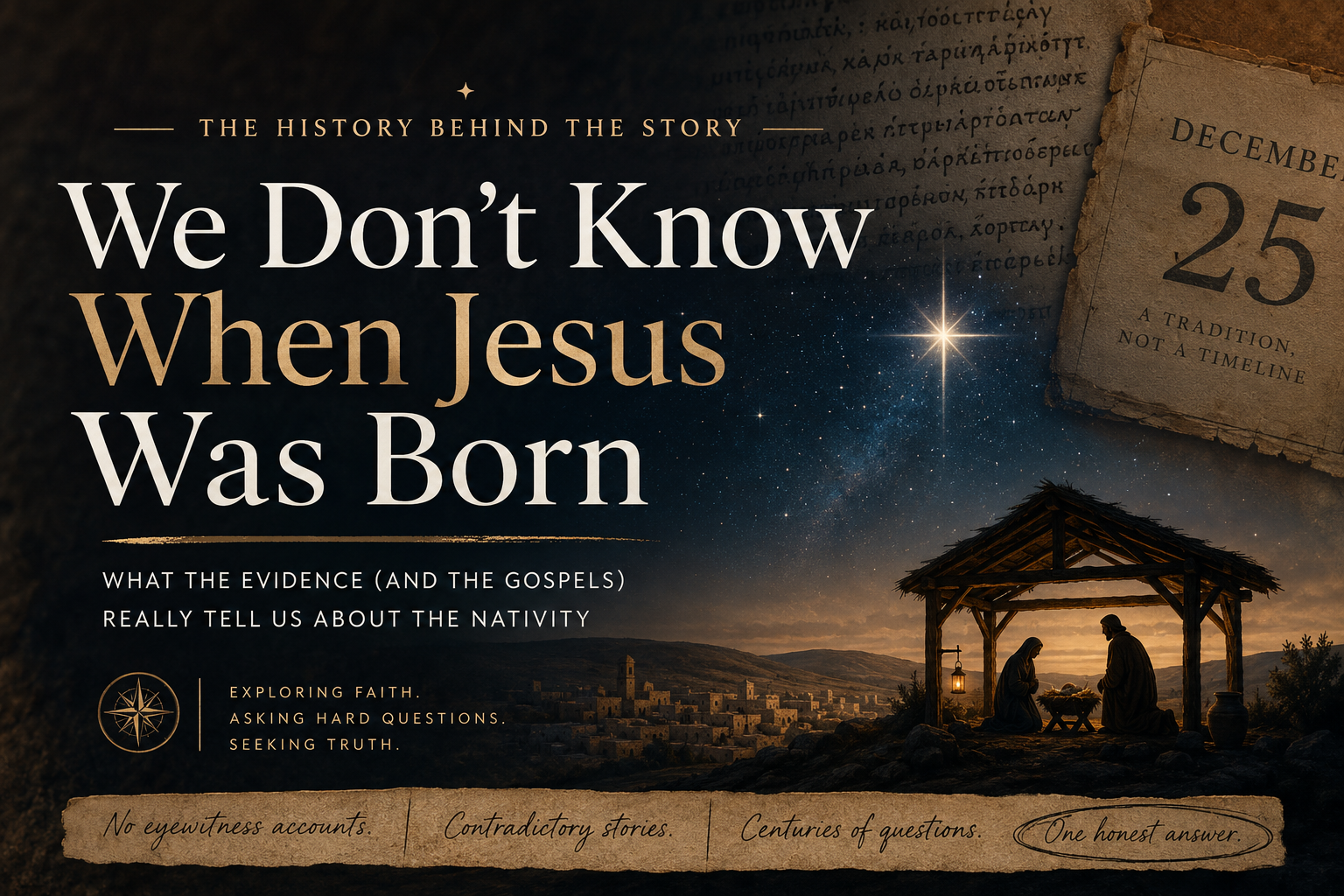
I’d been raised with the Christmas story as bedrock truth—angels, shepherds, wise men, all of it happening on a specific night in history. But one afternoon, reading scholarly analysis of the nativity accounts, something shifted. The more I read, the more I understood that we have absolutely no idea when Jesus was actually born.
Not December 25th. Not in winter. Not in spring. Nothing.
This wasn’t some conspiracy theory or radical revisionist history. This was the consensus among serious biblical scholars, and once I saw the evidence, I couldn’t unsee it.
The silence starts with our earliest sources. Paul wrote his letters within twenty to thirty years of Jesus’s death—close enough that eyewitnesses were still alive. He mentions the crucifixion constantly, quotes Jesus’s teachings, describes resurrection appearances. But Jesus’s birth? Not a word. The entire subject doesn’t exist in Paul’s writings.
Mark’s Gospel, written around 70 CE and likely our oldest narrative about Jesus, begins with John baptizing Jesus as an adult. No pregnancy announcement, no manger, no star. The author either didn’t know birth stories or didn’t think them important enough to include.
This pattern holds for most early Christian writings. The communities that first preserved and transmitted memories of Jesus focused on his teachings, his confrontations with authorities, his death, and resurrection. For decades after Jesus died, Christians apparently gathered, worshiped, and spread their faith without ever discussing when their founder was born.
Only Matthew and Luke give us birth stories, and once you examine them closely, the problems become overwhelming. I spent months comparing these accounts, hoping to harmonize them somehow. Instead, I found contradictions that cannot be resolved.
Matthew presents Mary and Joseph as residents of Bethlehem. They live in a house there. After Jesus is born, wise men arrive from the east, having seen his star. King Herod, threatened by prophecies of a new king, orders the massacre of all boys under two in Bethlehem. Joseph, warned in a dream, flees with his family to Egypt. Only after Herod dies do they return, settling in Nazareth because Judea remains dangerous.
Luke tells a completely different story. Mary and Joseph live in Nazareth. They travel to Bethlehem for a census, find no room at the inn, and Jesus is born in a stable. Shepherds visit that same night. Eight days later, they circumcise Jesus. After forty days, they present him at the Jerusalem temple, where two prophets recognize him. Then they simply return home to Nazareth.
These aren’t minor discrepancies. In Matthew, the family flees to Egypt for potentially years. In Luke, they go to Jerusalem—exactly where Herod would be watching—and peacefully return home. Matthew’s timeline requires Herod the Great to be alive, placing Jesus’s birth before 4 BCE when Herod died. Luke specifically mentions the census under Quirinius, which Roman records date to 6 CE. That’s a ten-year gap minimum.
I tried every harmonization I could find. Maybe there were two censuses? Maybe Luke meant a different Quirinius? Maybe the family went to Egypt after returning from Jerusalem? Each solution created new problems, requiring increasingly elaborate explanations that strained credibility.
The breakthrough came when I stopped trying to harmonize and started asking why these stories exist at all. Ancient biography wasn’t modern journalism. Writers routinely created scenes to illustrate character, invented speeches to convey philosophy, and constructed narratives to make theological points. They weren’t lying by their standards—they were using accepted literary conventions to communicate truth as they understood it.
Once I accepted this, the birth narratives made sense in a different way. Matthew, writing for a Jewish audience, crafted parallels to Moses: a wicked ruler killing Hebrew babies, a flight to Egypt, a return to the promised land. His genealogy traces Jesus through David and Abraham, establishing royal and patriarchal credentials. The wise men bring gifts fit for a king.
Luke, emphasizing Jesus’s mission to the marginalized, has shepherds—among the poorest workers in ancient Palestine—receive the birth announcement. His genealogy goes back to Adam, making Jesus significant for all humanity, not just Jews. Mary’s song celebrates God lifting up the lowly and filling the hungry.
These are theological masterpieces, carefully constructed to convey each author’s understanding of Jesus’s significance. But they tell us nothing about historical dates or events. They were likely created decades after Jesus died, shaped by theological reflection rather than eyewitness memory.
Some scholars attempt to deduce Jesus’s birth date through other means. They calculate backwards from the crucifixion, which we can date somewhat reliably to around 30 CE. If Jesus was “about thirty” when he began his ministry, and if his ministry lasted three years… but each “if” adds uncertainty. Others try to determine when John the Baptist was born based on when his father served in the temple, then use Luke’s statement that Jesus was conceived six months later. But this assumes Luke’s chronology is historical rather than theological, which the evidence doesn’t support.
The December 25th date emerged centuries later. Early Christians didn’t celebrate Jesus’s birth at all. When they finally began to, different communities chose different dates—January 6th, March 25th, May 20th. December 25th probably won because it coincided with existing Roman winter solstice festivals, making conversion easier.
Accepting this uncertainty changed how I think about religious history. We want concrete facts—dates we can circle on calendars, events we can map precisely. But the past resists such clarity, especially the ancient past, and especially regarding figures whose importance was recognized only after their deaths.
The early Christians built a movement that transformed the Roman Empire without knowing their founder’s birthday. They developed complex theologies, established communities across the Mediterranean, and created literature that still shapes billions of lives—all without celebrating Christmas. The birth date that now anchors our calendar wasn’t important to them. They found meaning in Jesus’s teachings about compassion and justice, in their belief in his resurrection, in their experience of spiritual transformation.
This historical reality doesn’t diminish the cultural importance of Christmas or invalidate anyone’s faith. Traditions carry their own truth, independent of historical accuracy. The Christmas story has inspired countless acts of generosity, created moments of peace in wartime, and brought families together across centuries. These effects are real regardless of what happened in ancient Palestine.
But when we’re discussing history—what actually happened and when—we need intellectual honesty. We need to acknowledge what we don’t know. And when it comes to Jesus’s birth date, we face a complete absence of reliable historical evidence. The gospels that describe his birth contradict each other and were written too late to be eyewitness accounts. No other ancient source helps us. The date we celebrate was chosen for reasons unrelated to historical investigation.
After years of studying this question, I’ve made peace with not knowing. The uncertainty reminds me that history is messier than we prefer, that ancient people had different priorities than we do, and that some questions simply cannot be answered with the sources available to us.
We don’t know when Jesus was born. We never will. And perhaps that’s exactly the point—that the message matters more than the date, that transformation matters more than chronology, and that some truths transcend the calendar entirely.