I’ve spent years wrestling with something that never quite sat right with me in church. Every Sunday, I’d hear about salvation through faith alone, about believing the right things, confessing the right words. But when I actually read Jesus’ words in the gospels, I kept finding something completely different.
The disconnect became impossible to ignore when I started comparing what Jesus actually taught with what Paul wrote in his letters. Paul, who never walked with Jesus, never heard him teach by the Sea of Galilee, never shared a meal with him. Paul, who was actually hunting down and killing Jesus’ followers before his Damascus road experience. This same Paul introduced what he called “my gospel”—a message centered on confessing Jesus as Lord and believing in blood atonement for salvation.
But here’s what stopped me cold: Jesus never taught that.
When someone directly asked Jesus how to enter eternal life, his answer was straightforward: keep the commandments, love God with everything you have, and love your neighbor as yourself. No confession formula. No belief statement about atonement. Just practical, actionable love.
In Matthew 7:21, Jesus makes it painfully clear: “Not everyone who says to me, ‘Lord, Lord,’ will enter the kingdom of heaven, but only the one who does the will of my Father who is in heaven.” He’s explicitly saying that calling him Lord isn’t enough. Action matters. What you do matters.
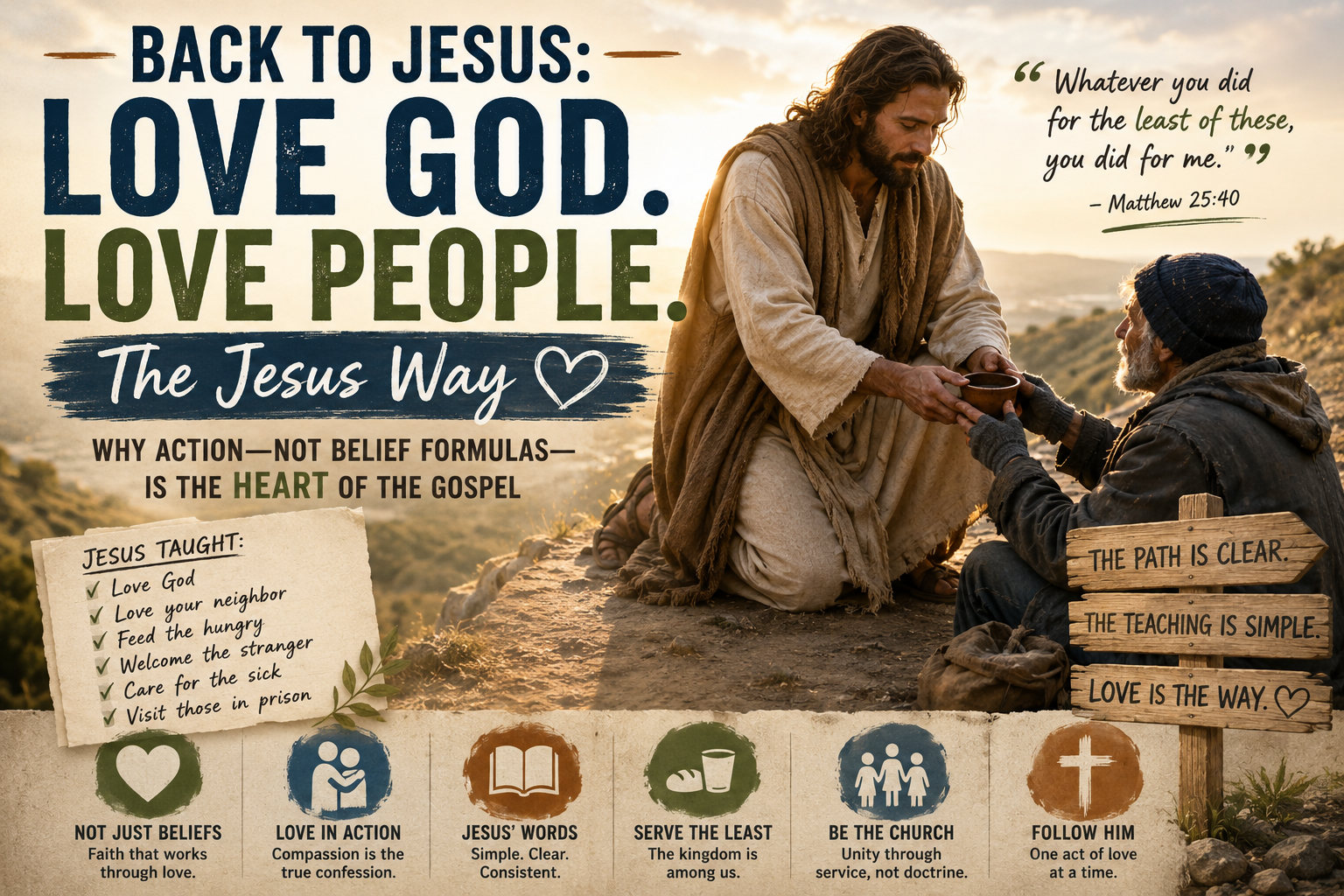
The most powerful teaching that changed my entire perspective comes from Matthew 25. Jesus describes the final judgment, and the criteria for entering the kingdom has nothing to do with correct beliefs or theological positions. Instead, he says the blessed are those who fed the hungry, gave water to the thirsty, welcomed strangers, clothed the naked, cared for the sick, and visited prisoners. “Whatever you did for the least of these, you did for me.”
This isn’t complex theology. It’s boots-on-the-ground compassion.
I used to worry about that verse where Jesus says “be perfect as your Father in heaven is perfect.” The word translated as “perfect” is actually teleios in Greek—it means complete, mature, whole. Not flawless. Jesus wasn’t setting an impossible standard; he was calling us to grow into spiritual maturity through practicing love. He consistently forgave people who turned from their old ways and committed to loving God and others. The transformation he sought was practical, not theoretical.
The contrast with Paul’s teaching became undeniable. Paul preached salvation by faith alone, separate from works. But James, who actually knew Jesus, pushed back hard against this idea, writing that faith without works is dead. Jesus himself never separated belief from action. For him, believing meant doing. Faith meant living differently.
Looking at Christianity today, I see the fruit of this theological split. Thousands upon thousands of denominations, each claiming to have the correct interpretation, the right beliefs, the true gospel. Churches splitting over doctrinal minutiae while the hungry remain unfed and the lonely unvisited. Is this really what Jesus had in mind when he talked about his followers being known by their love?
The more I studied, the more troubling details emerged. Jesus specifically warned his disciples not to believe anyone who claimed to see him in the desert. “If anyone tells you, ‘Look, he is in the desert,’ do not go out,” he said. Yet Paul’s conversion experience, his source of authority, happened exactly where Jesus said not to look—on a desert road to Damascus.
This realization fundamentally changed how I read the New Testament. Instead of trying to harmonize Paul’s letters with Jesus’ teachings, I started reading them as separate messages. One from a teacher who walked the dusty roads of Galilee, healing the sick and eating with outcasts, showing us what God’s love looks like in practice. The other from someone who came later, claiming special revelation, introducing concepts Jesus never mentioned.
The path forward became clear once I stopped trying to reconcile these two messages. I returned to the simplicity of Jesus’ actual words. Love God. Love your neighbor as yourself. When you see someone hungry, feed them. When someone needs clothes, provide them. Visit the sick and imprisoned. Welcome strangers. This is the will of the Father. This is the kingdom of God breaking into our world through ordinary acts of extraordinary love.
I started small. Instead of debating theology, I looked for one person each week who needed practical help. A grocery run for an elderly neighbor. Visiting someone in the hospital. Helping with a utility bill. Each action felt more authentically Christian than years of studying doctrine.
The transformation was gradual but profound. My faith became less about what I believed and more about how I loved. Less about being right and more about doing right. The anxiety about having the correct theological position faded as I focused on the tangible needs around me.
Reading the gospels now feels like coming home. Jesus’ teachings are remarkably consistent and clear when you stop filtering them through Paul’s lens. The Sermon on the Mount isn’t a impossible ideal or a way to show us our need for grace—it’s a practical guide for living in God’s kingdom here and now. The parables aren’t complex allegories about substitutionary atonement—they’re stories about mercy, forgiveness, and radical generosity.
The Jesus I find in the gospels doesn’t ask for mental assent to propositions about his divine nature. He asks us to follow him in the way of love. He doesn’t demand perfection; he invites us into a process of growing more complete, more whole, more loving. He sees our struggles and failures not as cosmic crimes requiring blood payment, but as opportunities for repentance—literally turning around and walking in a new direction.
This shift has made my faith both simpler and more demanding. Simpler because I’m no longer trying to understand complex theological formulations or worried about having the right beliefs. More demanding because love in action requires far more than intellectual agreement. It’s easier to believe the right things than to consistently choose love when it’s inconvenient or costly.
The community I’ve found among others who focus on Jesus’ actual teachings has been remarkable. We spend less time discussing doctrine and more time organizing meal programs. Less energy on determining who’s saved and more on ensuring everyone’s fed. The unity comes not from shared beliefs but from shared service.
I still read Paul’s letters, but differently now. I see them as one early Christian’s perspective, shaped by his unique background and experiences. Some of his insights about community life and practical ethics remain valuable. But when his teaching contradicts Jesus’ clear words, I know which voice to follow.
The Jesus of the gospels trusts us with remarkable agency. He believes we can choose to love, choose to serve, choose to forgive. He doesn’t present us as helpless sinners incapable of good without divine intervention. Instead, he calls us to be salt and light, to let our good works shine. He believes in our capacity to grow into love.
This understanding has brought a peace I never found in systematic theology. The pressure to defend complex doctrines has lifted. The fear of hell for incorrect beliefs has dissolved. What remains is the daily invitation to love God by loving others, to find the sacred in serving “the least of these,” to discover that the kingdom of heaven is found wherever love breaks through.
The path is clear. The teaching is simple. The challenge is in the living of it, day by day, choice by choice, one act of love at a time.