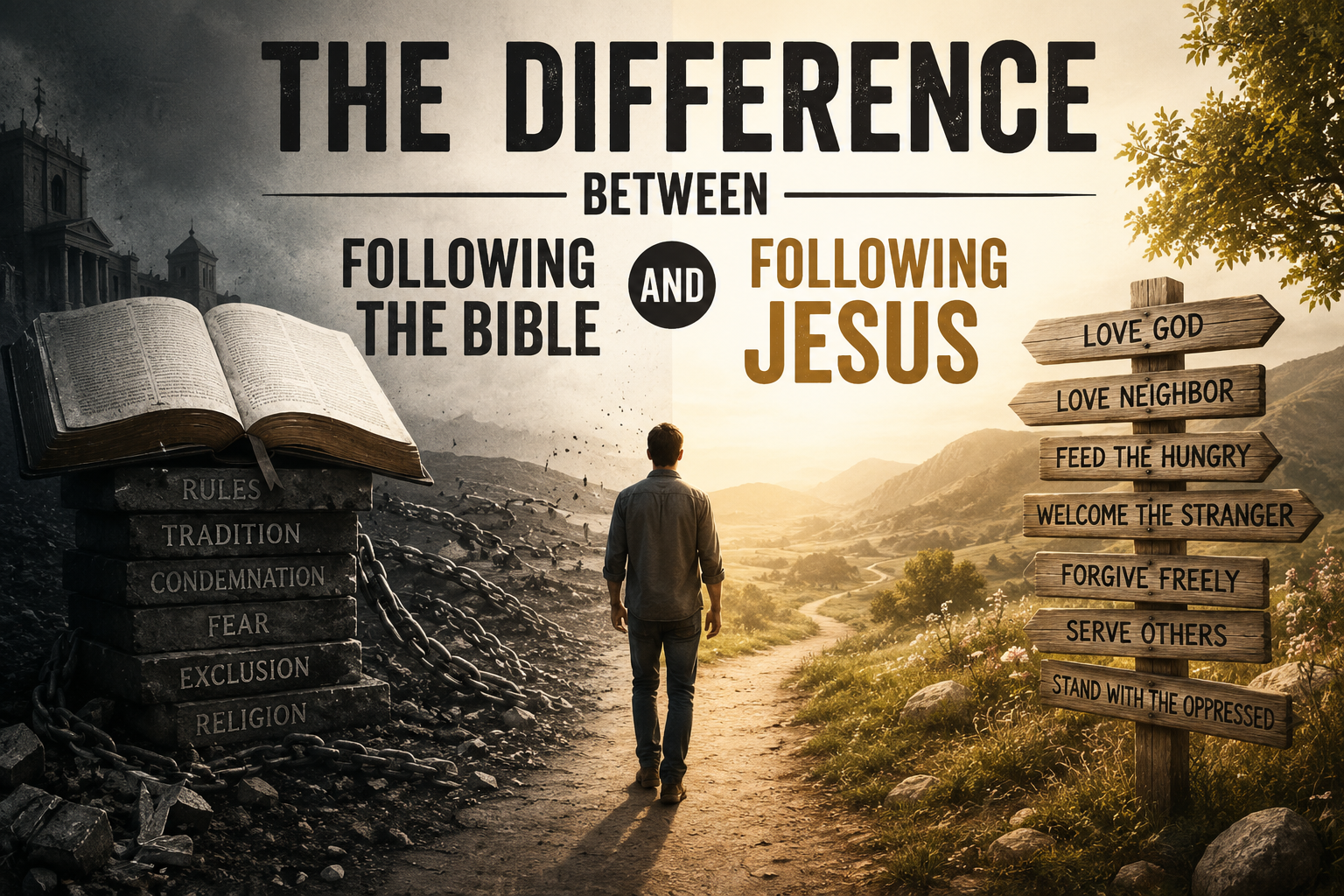
I spent twenty years reading the Bible the way I was taught—as the perfect, infallible word of God. Every Sunday, I’d sit in church accepting explanations for passages that made no sense, watching pastors twist themselves into knots trying to explain away obvious contradictions. Then I started actually reading the text myself, really reading it, with a critical eye instead of predetermined reverence.
What I found shook my faith to its core, then rebuilt it into something stronger.
The Contradictions You Can’t Ignore
The problems start immediately. Genesis gives us two different creation accounts that disagree on the order of events. Did God create animals before humans or after? Depends which chapter you read. The gospels can’t agree on basic facts about Jesus’s life. Was he born when Herod was king (died 4 BCE) or during Quirinius’s census (6 CE)? Both, apparently, despite the ten-year gap.
These aren’t copying errors. They’re fundamental disagreements about reality.
I remember the moment this really hit me. I was preparing to teach a Bible study on David and Goliath. Simple story, right? Except 2 Samuel 21:19 says Elhanan killed Goliath, not David. My study Bible had a footnote trying to explain it away—maybe there were two Goliaths, maybe it was Goliath’s brother. The mental gymnastics were exhausting.
Once you see one contradiction, you see them everywhere. God is unchanging, except when he changes his mind. God is love, except when he commands genocide. Salvation is by faith alone, except when James says faith without works is dead. Paul says women should be silent in church, then praises female deacons and apostles.
The Business of Forgiveness
The deeper I dug into history, the clearer the pattern became. Starting around the 6th century BCE, Hebrew scribes rewrote huge portions of what became the Old Testament. They inserted laws, genealogies, and requirements that hadn’t existed before. Why? Follow the money.
The temple sacrifice system was brilliant economics disguised as theology. You sin, you bring an animal to the temple. The priests sacrifice it, keep the best parts, and sell the rest in the temple markets. Every person’s guilt became revenue. Every failure became profit.
Think about what this system actually meant. Poor farmers had to buy animals they couldn’t afford to receive forgiveness they desperately needed. City dwellers had to travel to Jerusalem, pay inflated temple prices, and participate in this religious economy just to feel clean before God. The texts were edited to make this system appear divinely ordained when it was purely human exploitation.
I used to wonder why Leviticus goes into such detail about which parts of the animal the priests get to keep. Now I know—someone was protecting their business model.
What Jesus Actually Fought Against
This context makes Jesus’s temple incident mean something completely different. He wasn’t just upset about money changers. He was attacking the entire system that monetized forgiveness. His whole ministry opposed this transactional relationship with God.
Jesus ate with tax collectors and prostitutes—people who couldn’t afford temple sacrifices. He declared sins forgiven without requiring payment. He healed on the Sabbath, breaking religious law to serve human need. Every action challenged the religious economy that enriched priests while impoverishing believers.
His message was devastatingly simple: Love God. Love your neighbor. That’s it. No complex theological systems, no payment plans for salvation, no hierarchies of holiness. Just love in action.
The religious authorities killed him for it. Not for claiming to be God—they killed him for threatening their income stream.
Paul’s Revision Project
Then Paul appeared. A man who never met Jesus, never heard him teach, never saw him heal anyone. Paul’s entire knowledge came from his own visions and interpretations. And what did Paul do? He rebuilt the same system Jesus had torn down, just with different vocabulary.
Instead of bringing animals to the temple, Jesus became the ultimate blood sacrifice. Instead of priests mediating forgiveness, you needed to accept Paul’s specific interpretation of Jesus’s death. The transaction returned, just spiritualized. Forgiveness still required bloodshed. God still demanded payment. The temple system got repackaged as substitutionary atonement.
I struggled with this realization for months. Paul’s letters dominate the New Testament. Most of Christian theology comes from Paul, not Jesus. We follow a Christianity that Jesus wouldn’t recognize, built by a man who never knew him.
The Anonymous Gospel Writers
The gospels themselves present their own problems. Matthew, Mark, Luke, and John weren’t written by anyone named Matthew, Mark, Luke, or John. They’re anonymous Greek texts, written 30-70 years after Jesus died by people who never met him. They relied on stories passed down through decades of oral tradition, each telling shaped by the teller’s agenda and audience.
I used to imagine the gospel writers as eyewitnesses carefully recording events. The reality? They were more like journalists working from second and third-hand sources, decades after the fact, each with their own theological agenda. Matthew desperately tries to prove Jesus fulfilled Jewish prophecy, often twisting Old Testament quotes out of context. John presents a completely different Jesus than the other three, one who speaks in long philosophical discourses instead of simple parables.
These aren’t historical documents. They’re theological arguments dressed up as biography.
Finding Truth in the Mess
So what do you do when the foundation of your faith cracks? Some people abandon belief entirely. Others double down, refusing to see what’s right in front of them. I chose a third path.
I developed a simple test for any biblical passage: Does this help me love God and my neighbor better? If yes, there’s wisdom here worth preserving. If no—if it promotes violence, exclusion, or institutional power—then humans probably corrupted it.
This approach requires taking responsibility for your own spiritual growth. No more hiding behind “the Bible says” to justify cruelty or prejudice. No more turning off your brain because questioning feels dangerous. You have a conscience. You have reasoning abilities. Use them.
When I read about Jesus feeding the hungry, I see truth. When I read about God commanding genocide, I see human beings putting words in God’s mouth to justify their violence. When Paul writes about love being patient and kind, I hear wisdom. When he tells slaves to obey their masters, I hear a man protecting the social order that benefited him.
The Community of Questioners
This journey gets lonely. Most churches don’t welcome people who point out contradictions or question traditional interpretations. They want believers who accept what they’re told, not thinkers who examine the evidence.
But I’ve found others on similar journeys. Former evangelicals who couldn’t stomach the cognitive dissonance anymore. Catholics who saw through the church’s power games. Mainline Protestants tired of pretending the Bible makes perfect sense. We gather in living rooms and coffee shops, in online forums and book clubs, working through these questions together.
We read scholars who’ve studied the historical development of scripture. We examine the political contexts that shaped these texts. We compare different traditions and translations, seeing how human hands shaped every word. Most importantly, we support each other in developing a faith that can withstand scrutiny.
What Faith Looks Like Now
My faith today looks nothing like what I grew up with, and I’m grateful for that. I don’t worship a book compiled by committees with political agendas. I don’t defend genocide because “God commanded it.” I don’t twist myself into theological knots trying to harmonize contradictions.
Instead, I focus on what Jesus actually taught—not what Paul said about him or what church councils decided centuries later. Love your neighbor. Feed the hungry. Welcome the stranger. Forgive without requiring payment. Stand with the oppressed against their oppressors. This message doesn’t need 66 books to explain it. It doesn’t need complex theology to justify it.
Sometimes people tell me I’m “picking and choosing” from the Bible. Of course I am. So is everyone else—they just won’t admit it. Nobody actually follows everything in the Bible. Nobody stones disobedient children or avoids mixed fabrics or keeps kosher. Everyone picks and chooses. I’m just honest about my selection criteria: love over law, compassion over control, justice over judgment.
The Hard Work of Honest Faith
This path requires more work than blind acceptance. Every passage needs evaluation. Every teaching needs scrutiny. Every tradition needs questioning. You can’t just memorize answers anymore—you have to wrestle with questions.
But this wrestling produces something beautiful: a faith that actually makes sense. A spirituality grounded in love rather than fear. A relationship with the divine that doesn’t require you to defend the indefensible or believe the unbelievable.
I still read the Bible. I just read it differently now. When I find wisdom, I embrace it. When I find corruption, I name it. When I see humans putting words in God’s mouth to justify their power, I call it out. This isn’t disrespect—