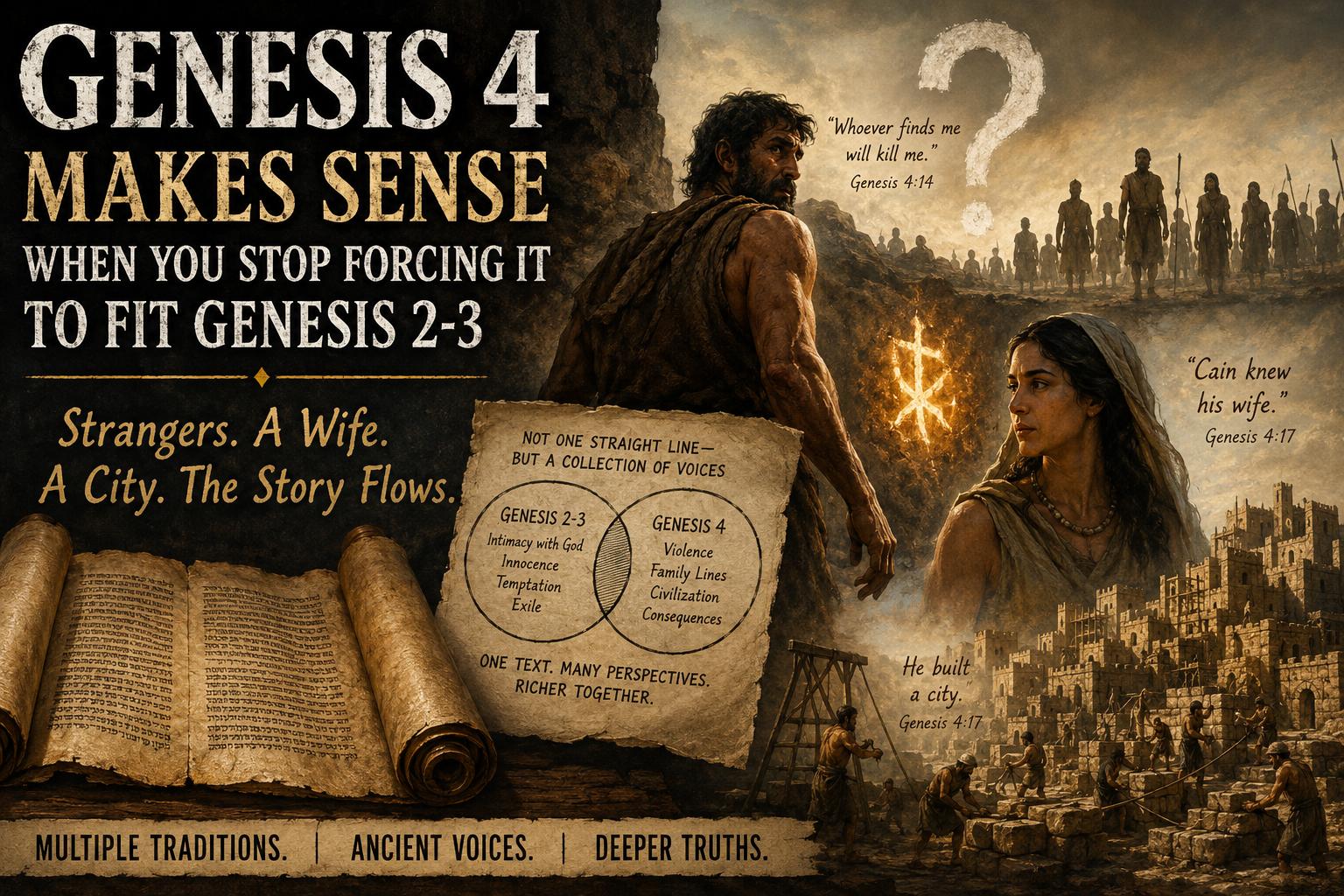
The first time I really sat down with Genesis 4, something struck me as odd. Here was Cain, having just killed his brother Abel, suddenly terrified that strangers would find him and kill him in revenge. I remember putting down my Bible and thinking: what strangers? If Adam and Eve were the first humans, and they’d only had Cain and Abel at this point, who exactly was out there to take revenge?
This single question changed everything about how I approach these ancient texts.
The story starts simply enough. Cain kills Abel out of jealousy over God’s favor. God confronts him. Cain gets banished. Standard biblical narrative. But then Cain says something that should make every careful reader pause: “whoever finds me will kill me.” God even puts a protective mark on him to ward off these potential attackers.
The text treats this as completely unremarkable. No explanation of who these people are. No genealogy filling in the gaps. The narrative just assumes a populated world exists beyond Adam and Eve’s family.
Then verse 17 drops another bombshell: “Cain knew his wife.”
She appears without introduction or explanation. One verse Cain is banished, the next he has a wife. Where did she come from? The text shows no interest in answering this question. It continues on as if her existence requires no justification.
And it gets stranger. Cain builds a city. A city. Not a house or a small settlement—a city, which he names after his son. Who lives in this city? Who does the building? Who are the future inhabitants? The text assumes we know, but if humanity consists only of Adam, Eve, Cain, and his mysteriously-appearing wife, none of this makes sense.
I grew up hearing the standard explanation for these puzzles. Adam and Eve had many unmentioned children—daughters who became wives for their sons, and additional sons who populated the earth. By this reading, Cain married his sister, and the people he feared were his future nephews and nieces who would eventually seek blood revenge for Abel’s death.
This explanation demands we insert massive amounts of information into the text. We need to imagine decades or centuries passing without mention. We need to posit huge populations arising from unnamed siblings. We need the narrative to jump forward and backward through time without any textual signals that it’s doing so.
I spent years trying to make this work, drawing family trees and working out timelines. The mental effort required to smooth over these issues eventually exhausted me. I realized I was spending more energy defending the text’s supposed consistency than actually reading what it said.
Then I tried something different. What if Genesis 4 comes from a different tradition than Genesis 2-3? What if ancient editors preserved multiple origin stories, each with different assumptions about the early world?
Read this way, Genesis 4 suddenly makes perfect sense. It’s a story about the first murder, not necessarily a story about the literal third and fourth humans ever born. Cain fears strangers because strangers exist. He finds a wife because other people exist. He builds a city because there are people to inhabit it.
The narrative flows naturally once you stop forcing it to align with the previous chapters. Every supposedly problematic detail falls into place.
This reading doesn’t diminish the text’s power or meaning. If anything, it enriches our understanding. We get multiple perspectives on humanity’s origins and early development. Genesis 2-3 offers an intimate portrait of humanity’s relationship with God, exploring innocence, temptation, and exile. Genesis 4 examines how violence enters human society and spreads through family lines and into civilization itself.
Both narratives wrestle with profound questions. Why does evil exist? How did violence enter the world? What does it mean to be human in a world containing both beauty and brutality? These stories don’t need to form one seamless historical account to offer wisdom about these questions.
The ancient compilers of Genesis apparently felt comfortable preserving different traditions side by side. They didn’t smooth over every contradiction or force every narrative into perfect alignment. They trusted readers to find meaning in the collection as a whole.
This approach—reading the text as it actually is rather than as we think it should be—revolutionized my understanding of biblical literature. These aren’t simple morality tales or straightforward historical accounts. They’re complex literary works preserving multiple ancient voices, each contributing to a larger conversation about humanity’s nature and destiny.
Try this yourself. Read Genesis 4 without assuming it directly continues the story from chapters 2-3. Let Cain fear actual strangers who already exist. Let his wife simply be a woman from another group. Notice how naturally the narrative flows when you’re not constantly reconciling it with what came before.
The text actually says what it means. Cain fears other people because other people exist. He finds a wife because women from other groups exist. He builds a city because there are people to fill it. The story works perfectly as a tale about how violence spreads through human society—no mental gymnastics required.
This way of reading respects what the ancient authors actually wrote. It takes their words seriously rather than constantly explaining them away. And paradoxically, by acknowledging the text’s complexities and apparent contradictions, we often find deeper truths than any harmonization could provide.
The Bible’s early chapters preserve humanity’s oldest attempts to understand itself. They offer multiple perspectives on where we came from and why we are the way we are. That multiplicity isn’t a problem to solve—it’s the whole point.