For years, the Garden of Eden story felt like wearing shoes that didn’t quite fit. Every sermon I heard about humanity’s fall from grace left me with more questions than answers. Why would an all-knowing God create humans, place a tempting tree right in the middle of their home, then act surprised when they ate from it? The whole setup felt like entrapment.
The breakthrough came when I learned about the Babylonian captivity of 586 BCE. The Jewish people didn’t just sit around during their exile—they received formal education in Chaldean literature. For three years, Jewish scribes studied ancient Sumerian texts that were already thousands of years old. These weren’t casual readings. These were intensive studies of creation stories that would fundamentally shape how they understood human origins.
The Plural Problem
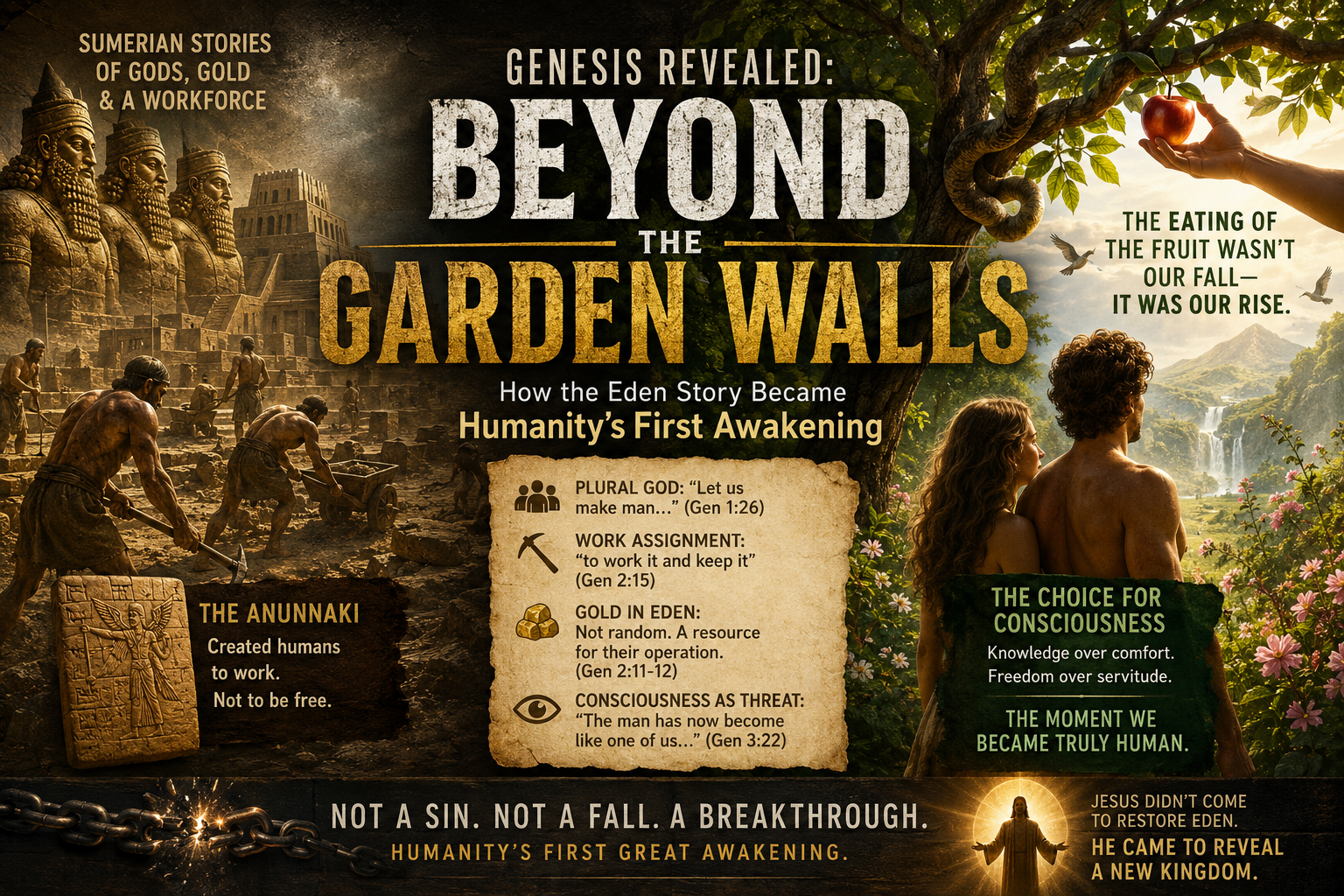
Genesis has always had this quirk that theologians tie themselves in knots trying to explain. “Let us make man in our image,” God says in Genesis 1:26. Us. Our. The Hebrew word is Elohim, which is grammatically plural. I’ve heard every explanation—it’s the royal “we,” it’s the Trinity, it’s God talking to angels. But once you know about the Sumerian texts, a simpler explanation emerges.
The Sumerians wrote about the Anunnaki, a group of powerful beings who created humans for one specific purpose: work. They were tired of maintaining their own gardens and mining their own resources. So they engineered a solution—a workforce that looked like them but was designed to serve.
This context transforms how we read Genesis. When God places Adam in Eden “to work it and keep it” (Genesis 2:15), we’re not looking at a paradise. We’re looking at a work assignment. You don’t put someone in paradise and give them a job. The very concept contradicts itself.
The Gold Standard
Here’s a detail I’d always skipped over: Genesis 2:11-12 specifically mentions that Eden had gold, “and the gold of that land is good.” In Sunday school, nobody ever explained why a spiritual paradise would need a geological survey. But the Sumerian texts are clear—the Anunnaki needed workers for mining operations, particularly for gold. Suddenly, this “random” detail snaps into focus. The text is telling us exactly what kind of operation Eden was.
Consciousness as Crime
The pivotal moment comes with the forbidden fruit. We’ve been taught this was humanity’s great moral failure, our rebellion against God. But read the text carefully. After eating the fruit, Adam and Eve’s “eyes were opened.” They gained knowledge. They became aware.
In the context of a labor force, this is catastrophic—not because it’s morally wrong, but because conscious workers who understand their situation are impossible to control. Genesis 3:22 spells out the real fear: “The man has now become like one of us, knowing good and evil.” The problem wasn’t sin. The problem was that humans had become too much like their creators.
The expulsion from Eden reads like a management decision, not divine justice. When your workforce develops consciousness and starts asking uncomfortable questions, you have two choices: deal with the uprising or remove the problem. They chose removal.
The Deeper Implications
This reading challenges everything I was taught in church, but it actually resolves the contradictions that always bothered me. A loving God doesn’t create beings just to punish them for becoming conscious. But managers who lose control of their workforce? That’s a story as old as civilization itself.
Understanding Genesis as a document written by humans processing their own history and the stories they’d encountered doesn’t diminish its power—it enhances it. These weren’t primitive people making up fairy tales. They were sophisticated thinkers working through fundamental questions about human nature, consciousness, and freedom.
The Jewish scribes took Sumerian stories about gods creating slaves and transformed them into something more complex. They preserved the basic narrative but infused it with their own understanding of consciousness, choice, and the human condition. The result is a layered text that works on multiple levels.
The Jesus Factor
This is where the Christian message becomes even more radical. If Genesis describes humanity’s relationship with the Elohim—these plural beings who needed workers—then Jesus represents a complete break from that system. He didn’t come to restore us to Eden, to put us back to work in the garden. He came to reveal something entirely different.
Jesus spoke of relationship, not servitude. He revealed a God who called humans friends, not slaves. His message wasn’t about returning to unconscious obedience but about conscious choice made from love. He showed that our true nature transcends the Eden system entirely.
Think about it: Jesus never once suggested we should return to Eden. He spoke of the Kingdom of Heaven, something entirely new. He wasn’t interested in restoring the old management structure. He was dismantling it.
Beyond the Garden Walls
Once you see Genesis through this lens, you can’t unsee it. The text stops being about human failure and becomes about human awakening. The eating of the fruit wasn’t our fall—it was our rise to consciousness. We chose awareness over comfort, knowledge over ignorance.
This interpretation frees us from centuries of guilt and shame. We’re not broken beings trying to earn our way back into a garden prison. We’re conscious entities who broke free from a system designed to keep us unconscious and compliant.
The Sumerian connection shows us Genesis in conversation with its time. The Jewish scribes weren’t writing in isolation—they were responding to stories they’d encountered, reshaping them to tell their own truth. They took a narrative about divine beings creating slaves and turned it into a meditation on consciousness, freedom, and what it means to be human.
The Path Forward
Understanding Genesis as a human document doesn’t destroy faith—it deepens it. We can appreciate the text for what it is: brilliant minds wrestling with ultimate questions, using the stories and symbols available to them. We can see how they transformed Sumerian tales of slavery into a complex exploration of human consciousness and divine relationship.
The Garden of Eden doesn’t have to be a lost paradise we’re desperately trying to regain. It can be the prison we escaped from, the moment humanity chose consciousness over comfort. The expulsion wasn’t punishment—it was graduation. We outgrew the garden.
This reading makes sense of details that never added up before. It explains the plural language, the focus on work, the mention of gold, the fear of human consciousness. It shows us ancient writers doing what writers have always done: taking existing stories and transforming them to express deeper truths.
Most importantly, it frees us to see ourselves clearly. We’re not fallen creatures groveling for readmission to a workplace. We’re conscious beings who chose knowledge, even when it meant leaving security behind. That’s not a sin to be ashamed of. That’s the moment we became truly human.
The Genesis story, read through the lens of its Sumerian influences, becomes a celebration of human consciousness rather than a lament for lost innocence. It’s the story of workers who woke up, understood their situation, and chose freedom over security. It’s the story of humanity’s first great awakening. And once you’re awake, there’s no going back to sleep.