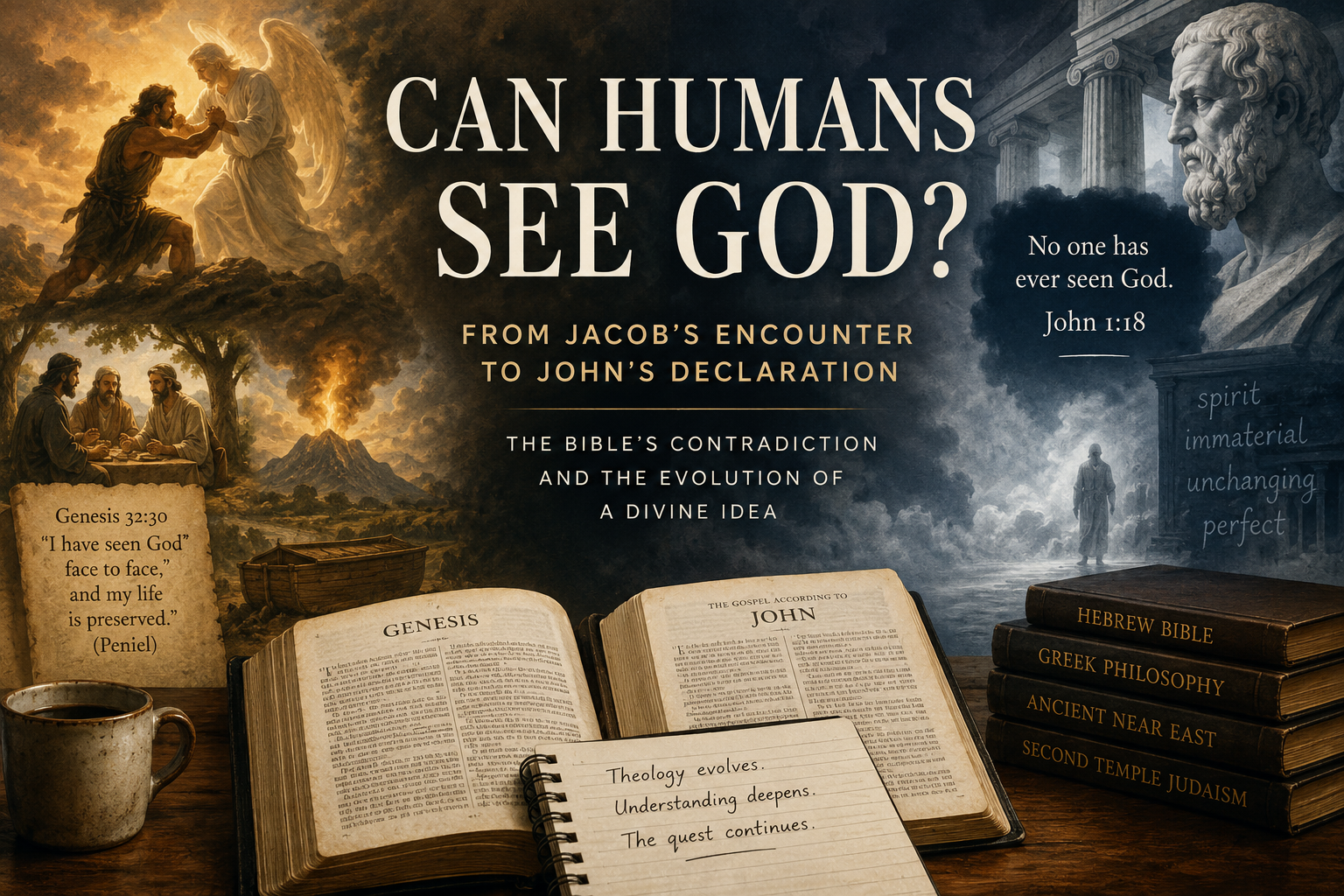
I spent last Tuesday night staring at my bookshelf, two Bibles open on my desk, trying to make sense of something that had been bothering me for weeks. In Genesis, Jacob wrestles with God and afterward declares he saw God face to face. Turn to John’s Gospel, and you read that no one has ever seen God. Period. Full stop.
These aren’t minor discrepancies you can explain away with creative interpretation. Jacob names the place Peniel - “face of God” - specifically because he saw God’s face and survived. Moses gets similar treatment in Exodus. Abraham shares a meal with God under the trees at Mamre. The Hebrew Bible presents these as physical encounters, not dreams or metaphors.
Then John comes along and says none of that happened. Or at least, none of that was what those people thought it was.
The more I dug into this, the more I realized I was looking at something bigger than a simple contradiction. I was seeing the evolution of an idea captured in text.
The Hebrew Bible emerged from a world where gods had bodies. They weren’t always visible, and seeing them was dangerous, but they had forms. The God of Genesis walks through Eden in the evening breeze. He shuts the door of Noah’s ark. He appears as a smoking fire pot passing between sacrificed animals. These stories come from an ancient Near Eastern context where divine beings operated in physical space, even if that physicality was different from human physicality.
By the time John wrote his Gospel, Jewish theology had spent centuries absorbing Greek philosophical concepts. Platonic thought had introduced the idea that true divinity was pure spirit - immaterial, unchanging, perfect. Physical form implied limitation, change, imperfection. A God with a body you could see was, by definition, not really God.
You can track this shift through the biblical texts themselves. In earlier writings, God shows up personally. In later texts, angels increasingly handle divine-human interactions. Visions replace physical encounters. The divine presence becomes something felt rather than seen. God moves from being occasionally visible to categorically invisible.
This transformation makes sense when you consider the intellectual environment. After Alexander’s conquests, Jewish thinkers found themselves engaging with Greek philosophy. They had to articulate their faith in dialogue with Platonic and Aristotelian categories. The anthropomorphic God of their ancestors became philosophically embarrassing. How could the creator of the universe have a body that exists within that universe? How could the infinite be contained in finite form?
So when John writes that no one has seen God, he’s not forgetting about Jacob or Moses. He’s operating from a fundamentally different understanding of what God is. Those earlier encounters must have been something else - theophanies, visions, encounters with divine manifestations or messengers. But not sightings of God’s actual essence, because God’s essence transcends physical sight.
This realization changed how I approach these texts. Instead of trying to harmonize the contradiction, I started reading it as evidence of theological development. The Bible preserves different stages of human thinking about divinity, like geological layers preserving different eras of earth’s history.
The anthropomorphic God of Genesis offers intimacy and accessibility. This God gets angry, changes his mind, argues with Abraham about the fate of Sodom. There’s something deeply comforting about a deity who operates on a scale humans can grasp, even if that deity is vastly more powerful.
The transcendent God of later theology offers mystery and ultimacy. This God exists beyond human categories, beyond space and time, beyond anything we can fully comprehend. There’s something equally powerful about a deity who transcends all limitations, who represents absolute perfection and completeness.
Both visions address real human needs. We want a God who is close enough to care about our individual struggles and distant enough to be worthy of worship. We need divine intimacy and divine transcendence. The Bible’s contradiction about seeing God preserves both impulses.
What strikes me most is how human this all is. The biblical authors weren’t taking dictation from heaven. They were people embedded in particular cultures, influenced by the philosophical currents of their times, trying to make sense of the divine. Their disagreements and contradictions reveal the struggle to understand something that, by definition, exceeds human understanding.
Jacob’s declaration that he saw God face to face tells us something important about how ancient Israelites understood their relationship with the divine. John’s insistence that no one has seen God tells us something equally important about how first-century Hellenistic Jews understood theirs. Neither is wrong. They’re speaking from different conceptual worlds.
This diversity within scripture actually enriches religious thought rather than undermining it. Instead of a single, frozen conception of God, we get a dynamic tradition that adapts and evolves. The contradiction forces us to think more deeply about what we mean when we talk about God, seeing, and encounter.
The question “Can humans see God?” doesn’t have a simple yes or no answer because the meaning of “God” and “see” shifted between the writing of Genesis and John. The contradiction remains unresolved because it reflects a genuine transformation in religious consciousness. And that transformation - that very human struggle to conceptualize the divine - continues today in our own wrestling with these ancient texts.