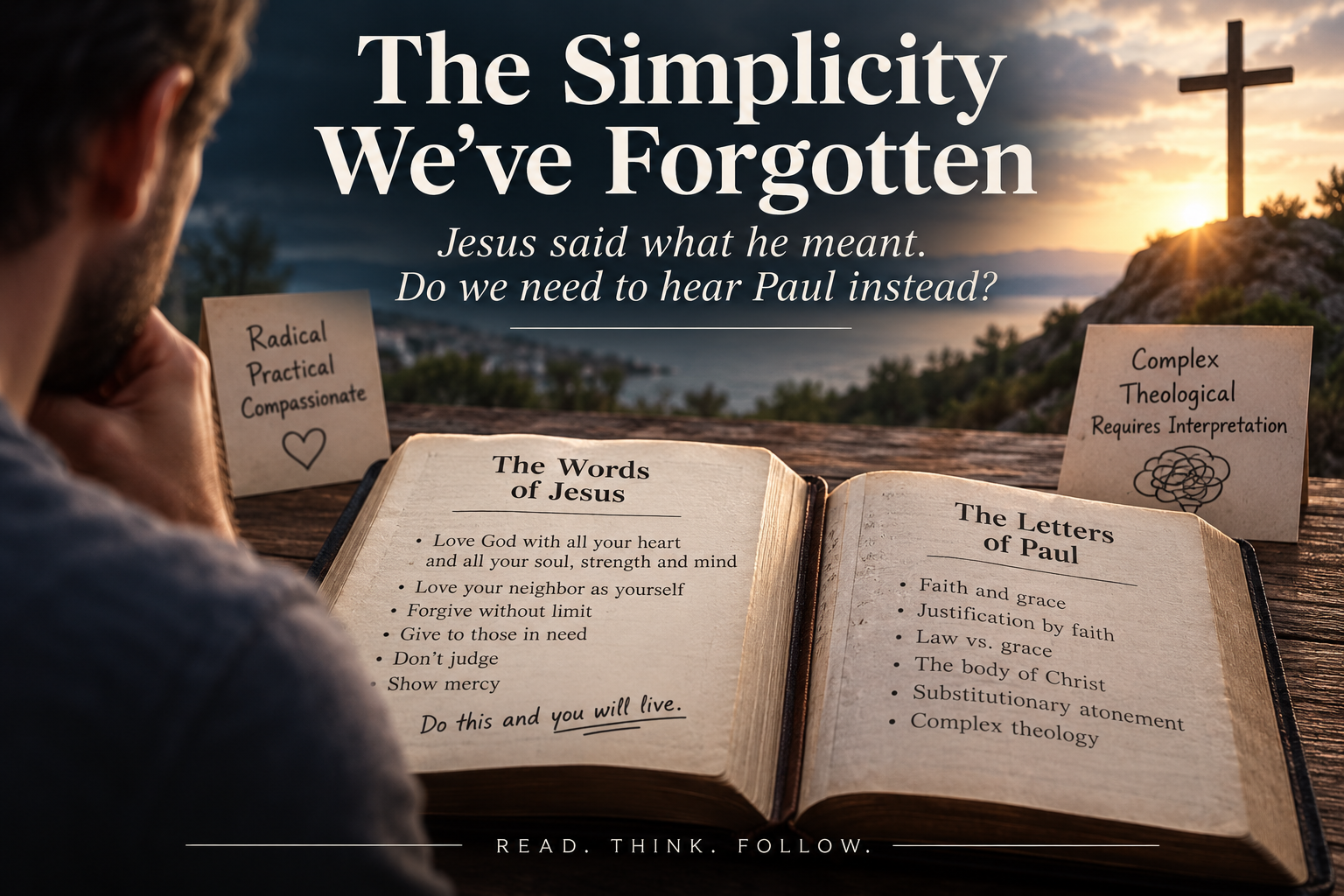
How a Sunday changed how I see my faith. The pastor stood at the pulpit explaining why Paul’s letters are essential to Christianity. Without Paul, he said, we wouldn’t understand salvation by grace, justification by faith, or the true meaning of the cross. As he spoke, something unsettled me.
I’ve been a Christian for years, but I’d never really examined this foundation we build everything on. So I went home and started reading. Not commentaries or study guides—just the gospels themselves, then Paul’s letters, then back to the gospels.
The contrast stunned me.
When someone asked Jesus directly about eternal life, his answer was straightforward: “Love the Lord your God with all your heart and with all your soul and with all your strength and with all your mind, and love your neighbor as yourself. Do this and you will live.”
No theology degree required. No complex formulas about substitutionary atonement. Just love—complete, radical, transformative love for God and neighbor.
A rich young ruler got similar advice. Keep the commandments. Sell your possessions and give to the poor. Follow me. Direct, practical, actionable.
Yet in church, we treat these teachings as incomplete, as if Jesus forgot to mention the most important parts. We say he was speaking to a different audience, a different dispensation, that his words need Paul’s interpretation to make sense for us today.
This creates a bizarre situation. Jesus spent three years training twelve disciples. He taught them daily, explained parables privately, prepared them to spread his message. After his resurrection, he spent forty more days with them discussing the kingdom of God. At Pentecost, the Holy Spirit empowered them to preach.
And what did they preach? Repentance. Baptism. Following Jesus’s teachings. Living as he lived.
But Christianity tells us this wasn’t enough. We needed a thirteenth apostle—someone who never met Jesus during his ministry, who imprisoned Christians, who received what he called “my gospel” through private revelation. This man’s theological framework became more essential than the words of Christ himself.
I started asking uncomfortable questions. If Jesus was divine, omniscient, the perfect teacher—how did he fail to communicate the essential message of salvation to his chosen disciples? Why would God incarnate need someone else to explain what he really meant?
The standard answer involves different gospels for different groups, hidden mysteries revealed to Paul, progressive revelation. But these explanations raise more questions than they answer. We’re essentially saying Jesus’s direct teaching wasn’t sufficient. That when he said “follow me,” he left out crucial information. That the crowds who heard the Sermon on the Mount got an incomplete message.
Reading Paul’s letters, I see sophisticated theology. Complex arguments about law and grace, detailed metaphors about the body of Christ, intricate explanations of justification. Paul was brilliant. But when did the interpreter become more important than the source? When did the explanation overshadow the original?
I think about other areas of life. If I want to understand Gandhi’s philosophy, I read Gandhi. If I want to grasp Marx’s ideas, I read Marx. But in Christianity, if I want to follow Jesus, I’m told to read Paul first. Paul becomes the lens through which I must view Christ.
This feels backward.
The more I sat with the gospels, the more I noticed their simplicity. Not simple as in shallow, but simple as in clear. Love God completely. Love your neighbor as yourself. Forgive without limit. Give to those in need. Don’t judge. Show mercy. These aren’t complicated theological concepts requiring years of seminary to unpack.
Yet we’ve built entire systematic theologies that barely reference these teachings. We’ve created salvation formulas that Jesus never mentioned. We recite creeds he never taught. We’ve made following Christ contingent on accepting Paul’s interpretation of Christ.
I’m not dismissing Paul. His letters address real problems in early churches. His theology has shaped civilization. But I question whether we’ve given his words improper weight. When Paul’s theology contradicts Jesus’s plain teaching, we perform mental gymnastics to harmonize them, always deferring to Paul’s complexity over Jesus’s simplicity.
Consider how we handle Jesus saying “give to everyone who asks” or “sell your possessions.” We immediately run to Paul’s letters to find qualifications, exceptions, alternative interpretations. We use Paul to explain why Jesus didn’t really mean what he clearly said.
The early church offers a different picture. The Jerusalem church, led by James—Jesus’s own brother—and Peter, who walked with Jesus for three years, focused on living out Jesus’s teachings. They shared everything. They cared for widows and orphans. They practiced the way of life Jesus demonstrated.
Paul fought with them constantly. He called Peter a hypocrite to his face. He argued that his gospel superseded their understanding. He claimed special revelation that trumped their lived experience with Jesus.
And Paul won. His version became orthodox Christianity.
Today, you can be a Christian in good standing while ignoring most of what Jesus taught. Don’t sell your possessions? Fine. Don’t love your enemies? Understandable. Don’t forgive seventy times seven? Nobody’s perfect. As long as you accept Paul’s theological framework about salvation by faith alone, you’re good.
But you cannot be a Christian while rejecting Paul’s theology. Question justification by faith? Heresy. Suggest works matter? You’ve lost the gospel. Prefer James’s emphasis on faith proven through deeds? You’re promoting a false gospel.
We’ve created a Christianity where Paul’s letters hold more practical authority than Jesus’s words. Where systematic theology matters more than the Sermon on the Mount. Where accepting correct doctrine about Jesus counts more than following Jesus’s actual instructions.
I keep returning to a simple thought: If Jesus was who Christians claim—God incarnate, the perfect teacher, the way and the truth and the life—then his words should be sufficient. His chosen disciples should have understood the message. His teachings should stand on their own.
The fact that Christianity insists they don’t, that we need Paul’s revelations to make sense of Jesus, suggests two possibilities. Either Jesus failed in his mission to communicate clearly, or we’ve been misunderstanding the mission all along.
I lean toward the second option.
What if Jesus meant exactly what he said? What if the path to eternal life really is loving God completely and loving neighbor as self? What if the kingdom of God really is found in giving to the poor, forgiving enemies, refusing to judge others?
What if Paul’s theology, brilliant as it is, has become a distraction from the radical simplicity of Jesus’s message?
I still consider myself a Christian. But I read the red letters differently now. When Jesus speaks, I try to hear him without Paul’s voice in my head interpreting, qualifying, explaining away the difficulty.
It’s harder than expected. Two thousand years of theological tradition doesn’t disappear overnight. But slowly, I’m discovering a Jesus whose teachings stand on their own. Whose message doesn’t need theological decoder rings. Who said what he meant and meant what he said.
Love God with everything you have. Love your neighbor as yourself. Do this and you will live.
Maybe it really is that beautifully, terrifyingly simple.