Growing up in church, I memorized verses before I could tie my shoes. Sunday school teachers drilled into us that the Bible was perfect—every word, every story, every detail aligned in divine harmony. This wasn’t just a belief; it was the bedrock everything else rested on. Question the Bible’s perfection, and you questioned God himself.
Then I started reading more carefully.
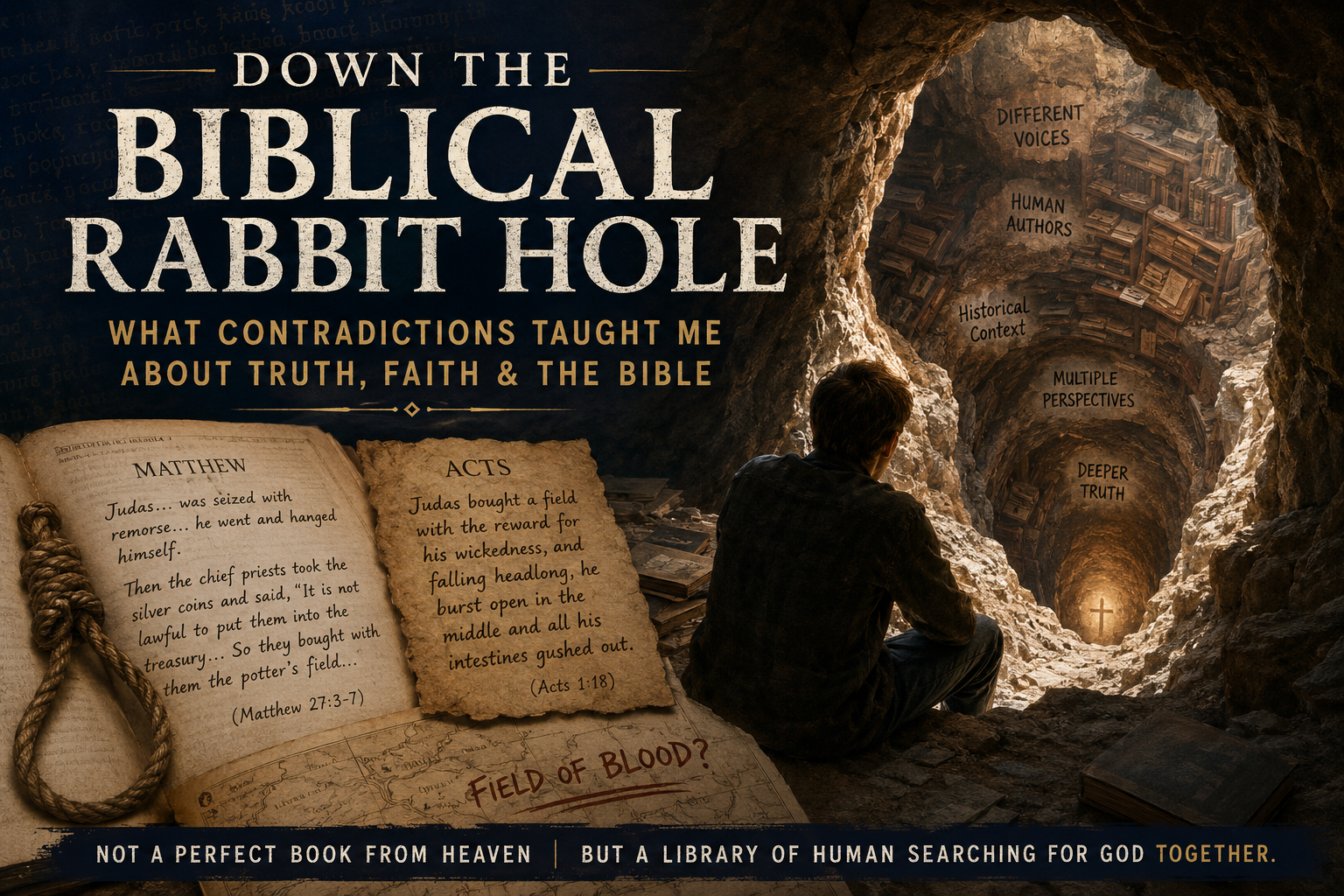
The death of Judas Iscariot cracked everything open for me. Not because I cared particularly about how a betrayer died, but because two different biblical books tell completely incompatible stories about the same event.
Two Books, Two Deaths
In Matthew’s Gospel, Judas feels remorse after betraying Jesus. He returns the thirty silver pieces to the priests, throws the money into the temple when they refuse it, then goes and hangs himself. The priests take that blood money and buy a field for burying foreigners. That field becomes known as the Field of Blood because it was purchased with betrayal money.
Acts tells it differently. There, Judas keeps his reward and buys a field himself. In that field, he falls headlong, his body bursts open, and his intestines spill out. The locals call it the Field of Blood because Judas died there in such a gruesome way.
These aren’t minor discrepancies you can explain away. Did Judas hang himself or fall and burst open? Did the priests buy the field or did Judas? Was it called Field of Blood because of blood money or because blood was literally spilled there?
Both stories cannot be true.
The Unraveling Begins
Once I saw this contradiction clearly, I couldn’t unsee it. I tried the mental gymnastics every inerrantist learns—maybe Judas hung himself and then fell and burst open later. Maybe the priests bought the field in Judas’s name. But these explanations felt desperate, like trying to force two puzzle pieces together that clearly didn’t fit.
So I kept reading, comparing the Gospels side by side for the first time. The contradictions multiplied:
Jesus dies at different times relative to Passover depending on which Gospel you read. John has him dying before the Passover meal; the other three place his death after it.
His last words change completely. In Matthew and Mark, he cries out asking why God has forsaken him. In Luke, he commits his spirit to the Father. In John, he simply says, “It is finished.”
The resurrection stories disagree on basic facts. Who went to the tomb first? One woman, two women, three women, or a group? What did they find there? Who did they tell? The accounts diverge at every turn.
Matthew’s genealogy of Jesus disagrees with Luke’s. They can’t even agree on who Joseph’s father was.
In one particularly strange case, Matthew seems to misread a Hebrew poetic parallel in Zechariah and has Jesus somehow riding two animals at once into Jerusalem, while the other Gospels sensibly have him on one donkey.
What This Meant for My Faith
Discovering these contradictions felt like finding out Santa Claus wasn’t real, except the stakes were infinitely higher. Everything I’d built my worldview on suddenly seemed shaky. If the Bible contained errors and contradictions, what else had I been wrong about?
But something unexpected happened as I wrestled with these discoveries. Instead of losing my faith entirely, I found a different way to approach these texts. I started seeing the Bible not as a divine fax from heaven but as a collection of human attempts to understand and describe encounters with the divine.
The Gospel writers weren’t court reporters taking down exact transcripts. They were people telling stories about events that transformed their lives, each bringing their own perspective, audience, and theological emphasis to the task. Matthew wrote for Jewish readers and constantly referenced Hebrew scriptures. Luke wrote for Gentiles and emphasized God’s concern for outsiders. John wrote decades later with highly developed theological themes.
Understanding this context made the contradictions make sense. Of course different authors telling stories to different audiences decades after the events would remember and emphasize different things. The miracle isn’t that they agree perfectly—it’s that their core message remains remarkably consistent despite their differences.
Finding Truth Beyond Inerrancy
Letting go of biblical inerrancy didn’t destroy my ability to find truth in scripture. It enhanced it. I no longer had to defend the indefensible or perform mental contortions to harmonize the unharmonizable. I could appreciate each Gospel writer’s unique perspective without forcing them into artificial agreement.
More importantly, I could focus on what actually matters in these texts. The specific details of how Judas died pale in comparison to the broader themes of betrayal, remorse, and consequences that both accounts explore. The exact words Jesus spoke from the cross matter less than the profound truth that each Gospel conveys about suffering, abandonment, and trust in God.
This shift also allowed me to engage with difficult passages more honestly. I didn’t have to defend genocide in the Old Testament as God’s perfect will. I could recognize human authors projecting their own violence onto God while still finding profound truths about justice and liberation in the same texts.
The Rabbit Hole Goes Deep
Once you start seeing the Bible as a human document, the entire landscape changes. You notice how Old Testament stories evolved over time—compare the two creation accounts in Genesis, or how Chronicles retells stories from Samuel and Kings with significant changes. You see how New Testament authors sometimes misquote or reinterpret Old Testament passages to make their points.
You also start noticing the fingerprints of editors and redactors who compiled these texts. The book of Isaiah clearly comes from at least two, probably three different time periods. The letters attributed to Paul show different writing styles and theological emphases, suggesting some were written by later followers in his name.
None of this threatens the value of these texts. If anything, it makes them more remarkable. Here we have a library of writings spanning over a thousand years, from different cultures and contexts, all wrestling with ultimate questions about meaning, morality, and the nature of reality. The diversity of voices enriches rather than diminishes the conversation.
A More Honest Faith
Today, I read the Bible differently than I did as a child. I don’t approach it as an error-free instruction manual but as a collection of profound spiritual writings that have shaped human civilization. I can appreciate the poetry of the Psalms without believing David wrote all of them. I can find wisdom in Ecclesiastes without needing it to harmonize with more optimistic biblical texts. I can learn from Jesus’s teachings without requiring every Gospel quote to be verbatim.
This approach actually allows me to take the Bible more seriously, not less. When you stop treating it as a magical book that fell from heaven, you can engage with the real struggles, doubts, and insights of the human authors who created it. You can wrestle with their ideas instead of simply submitting to them. You can find truth even in the tensions and contradictions.
The death of Judas remains contradictory in the biblical accounts. But that contradiction taught me something more valuable than any harmonization could: that truth isn’t always neat and tidy, that different perspectives can each hold validity, and that spiritual growth often comes not from certainty but from wrestling with complexity.
The rabbit hole of biblical criticism runs deep, and once you start down it, there’s no going back to a simple, unexamined faith. But what you find at the bottom isn’t emptiness—it’s a richer, more nuanced understanding of these ancient texts and the humans who wrote them. And perhaps that’s exactly the kind of understanding we need for grappling with truth in all its messy, contradictory, wonderfully human complexity.