I’ve been wrestling with an uncomfortable realization lately. Growing up, I absorbed the idea that our modern values—human dignity, equality, basic rights—grew out of religious tradition. It made sense. The story felt complete. But the more I dig into history, the more that narrative falls apart.
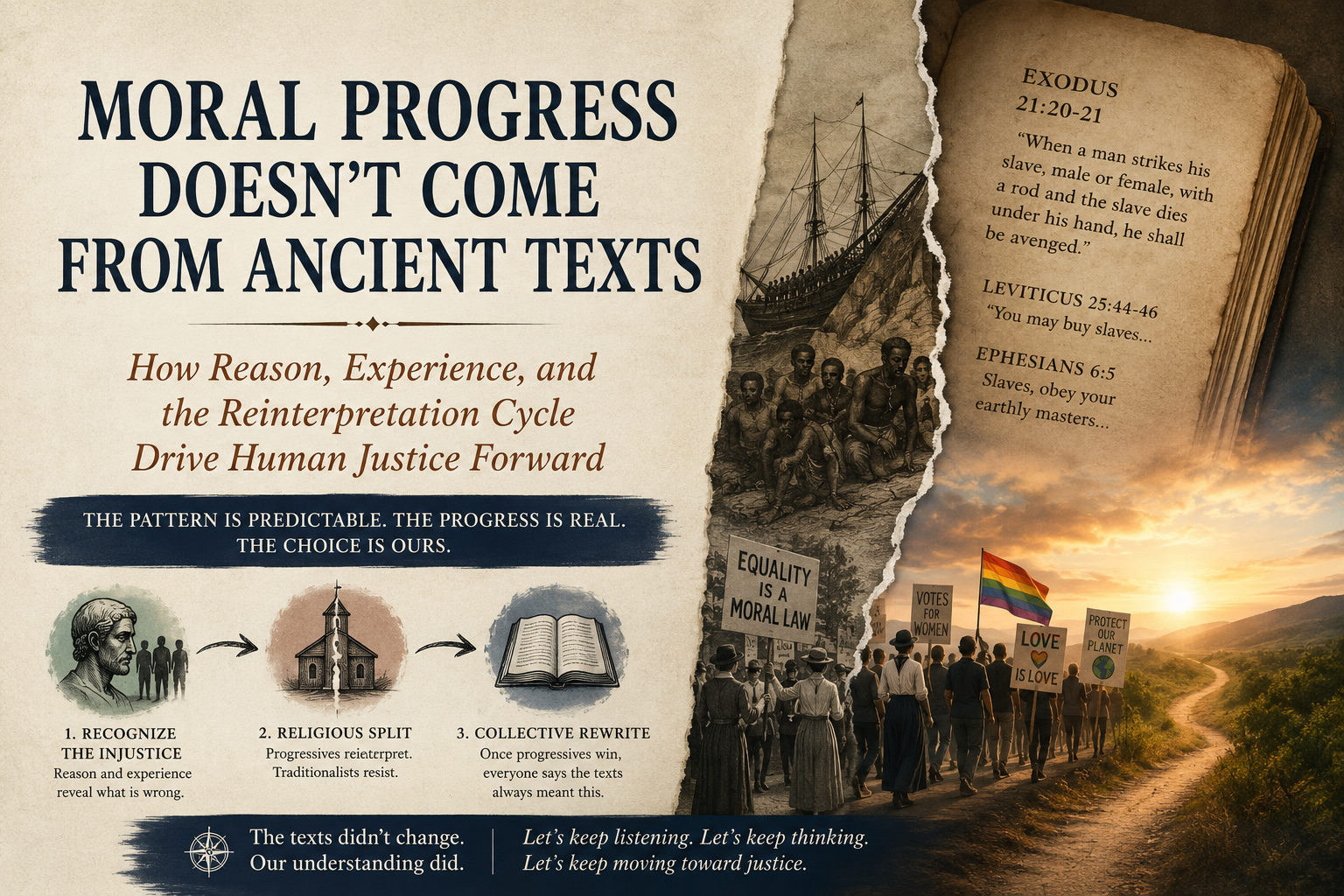
What I’ve discovered is that moral progress happens through a predictable cycle. First, philosophical reasoning or human experience reveals an injustice. Then religious communities split, with progressives reinterpreting ancient texts while traditionalists defend the status quo. Finally, after the progressives win, everyone pretends the texts always said what we now believe they should say.
The Slavery Problem
The clearest example is slavery. For centuries, Christians owned slaves while quoting scripture. They had good textual support. Ephesians tells slaves to obey their masters. Exodus explains how hard you can beat your slave. Leviticus sets prices for buying and selling humans. The New Testament never condemns the practice.
When I first encountered these passages, I assumed I was missing context. Surely there must be some overarching biblical principle that negates these specific instructions. But there isn’t. The abolitionists who fought slavery had to work around these texts, not with them.
Gregory of Nyssa opposed slavery in the 4th century, but not because he found a biblical prohibition. He borrowed from Stoic philosophy—the idea that all humans possess rational souls—and retrofitted this Greek concept onto Genesis. His opposition came from philosophy, then got dressed up in theological language.
This pattern repeats throughout history. The Quakers who opposed slavery drew heavily on Enlightenment concepts of natural rights. These ideas about inherent human dignity don’t appear in biblical texts. They emerged from secular philosophical traditions and got imported into religious thought.
Watching Reinterpretation in Real Time
What fascinates me is how quickly collective memory adjusts. Today, you’ll hear people claim the Bible always opposed slavery. They’ll point to Galatians saying there’s neither slave nor free in Christ, ignoring that Paul sent an escaped slave back to his master. They’ll cite the Exodus story while overlooking that the Israelites immediately established their own slave system.
The texts haven’t changed. Our reading has. Once slavery became morally unthinkable, interpreters scrambled to find anti-slavery messages in pro-slavery texts. The mental gymnastics required are impressive, but they’re also transparent to anyone reading the passages without predetermined conclusions.
I see this same process happening today with other issues. The verses once used to oppose interracial marriage now get deployed against same-sex relationships. The passages that justified excluding women from leadership get carefully reexamined and explained away by progressive denominations while conservative ones hold the line. Environmental stewardship suddenly becomes a biblical mandate for some, while others find divine permission for unlimited resource extraction.
The Engine of Change
Here’s what really drives moral progress: people thinking carefully about ethics, combined with lived experience of injustice. The Stoics developed sophisticated arguments about human nature and dignity. The Enlightenment created frameworks for individual rights. Modern philosophy continues building new tools for moral reasoning.
These intellectual developments, not ancient texts, push humanity forward. When enough people recognize an injustice through reason and experience, religious communities eventually follow. The progressive wing reinterprets scripture to align with new understanding. The traditional wing resists. Eventually, the progressives win, and everyone pretends the texts always meant what we now need them to mean.
I watched this happen in my own lifetime with women’s ordination. Churches that excluded women from leadership for centuries suddenly discovered that Junia was actually an apostle, that Phoebe was really a deacon, that cultural context explains away Paul’s restrictions. The arguments are creative, even persuasive if you want to be persuaded. But let’s be honest: these interpretations emerged because our values changed, not because someone discovered new manuscript evidence.
Why Historical Honesty Matters
Acknowledging this pattern doesn’t attack faith or diminish the courage of religious reformers. Many believers have fought heroically for justice. But they succeeded by bringing external moral insights to their traditions, not by discovering those insights within ancient texts.
The danger in misremembering history is that we lose the tools that created progress. If we pretend our advances came from better biblical interpretation rather than philosophical development, we abandon the very process that moves us forward. We stop examining and questioning because we think all wisdom already exists in texts written millennia ago.
I’ve noticed something else. The people quickest to claim their values come straight from scripture often seem least familiar with what scripture actually says. They know the verses that support their existing beliefs but remain blissfully unaware of the passages that complicate their position. This selective reading feels comfortable but blocks genuine moral growth.
The Predictable Path Ahead
Based on historical patterns, I can predict what comes next. Current religious objections to LGBTQIA equality will gradually soften. Environmental protection will become a sacred duty. Economic justice will get renewed emphasis. Not because anyone will find new biblical manuscripts, but because reason and experience will shift the cultural consensus.
Future Christians will explain how the Bible always supported these positions. They’ll develop elaborate interpretations showing how previous generations misread obvious truths. And most people will believe them, just as many now believe the Bible always opposed slavery.
This isn’t cynical. It’s simply what happens. Moral progress occurs through philosophy and experience, then gets absorbed into religious tradition through reinterpretation. Understanding this process lets us engage more honestly with ethical questions.
Moving Forward with Clear Eyes
Recognizing how moral progress actually works has changed how I think about ethics. I still value ancient wisdom traditions. They preserve important insights about human nature and community. But I no longer expect them to provide ready answers to modern moral questions.
Instead, I look to ongoing philosophical work, scientific understanding, and human experience. These sources have consistently pushed humanity toward greater justice and compassion. They’ve revealed moral blindness in every generation, including our own.
The texts that once justified slavery remain unchanged. What changed was our capacity to recognize slavery as evil despite textual justification. That same capacity—human reason engaged with lived experience—continues revealing injustices we’ve normalized. Our job is to keep listening, keep thinking, and keep pushing forward, even when that means leaving behind comfortable interpretations of cherished texts.
Real moral courage means admitting when we’ve been wrong, not pretending we were always right. It means recognizing that progress comes from honest engagement with difficult questions, not from creative reinterpretation of ancient answers. Most importantly, it means accepting that moral growth is an ongoing project, not a return to some perfect past that never actually existed.
The next time someone claims our modern values come directly from religious texts, I remember the abolitionists who had to fight those very texts to end slavery. I remember the suffragettes who overcame biblical arguments for women’s subjugation. I remember all the moral pioneers who succeeded not because of what ancient texts said, but in spite of it.
That’s the honest history of moral progress. And understanding it might be the key to continuing that progress into the future.