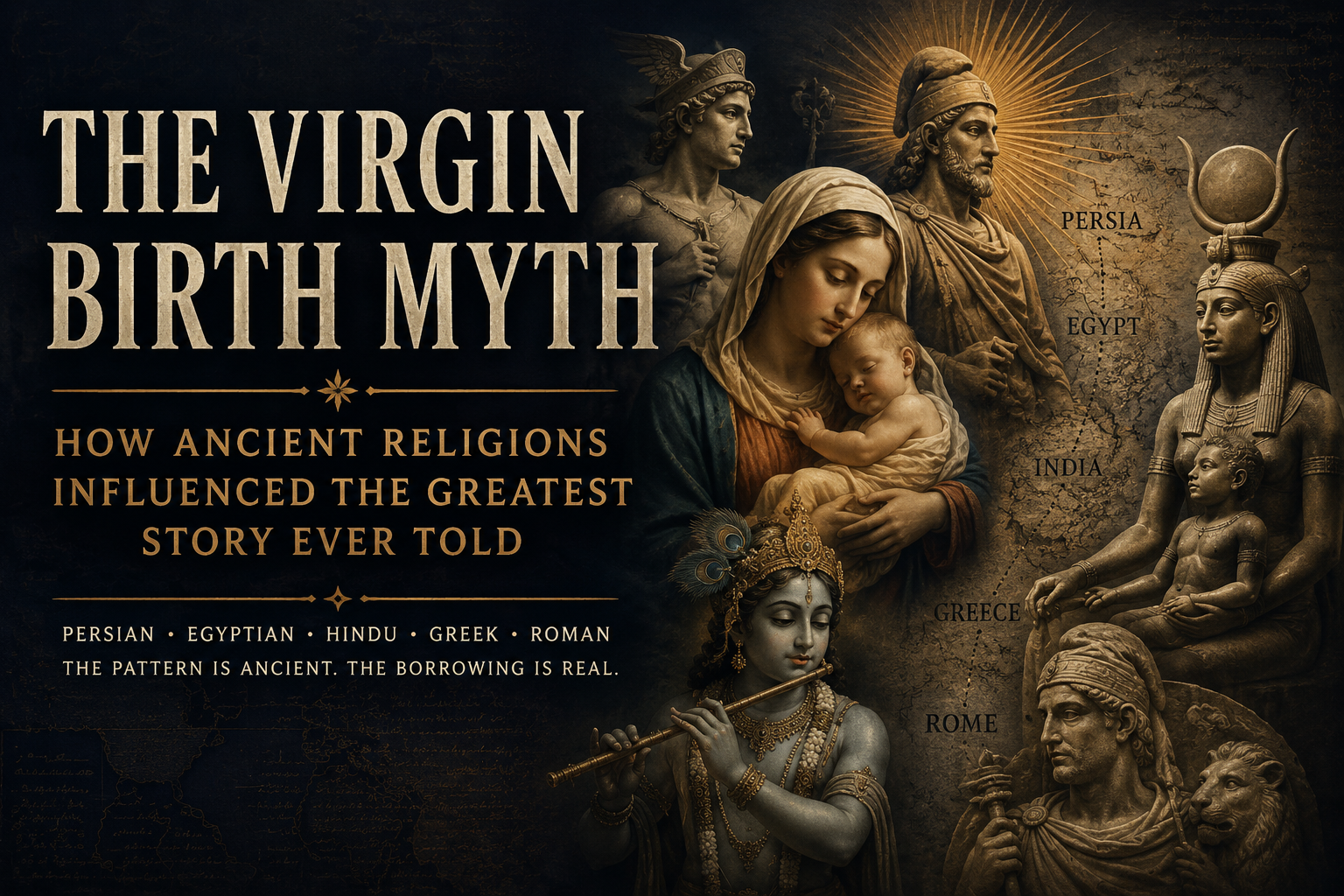
I’ve been reading religious texts for the better part of two decades. Started with the Bible, moved to the Quran, then found myself ordering obscure translations of Persian manuscripts from university libraries. What began as intellectual curiosity became something more when I noticed the same story appearing everywhere.
The virgin birth narrative shows up across the ancient world, always with the same basic structure. A divine being impregnates a virgin. The child is born under miraculous circumstances. Earthly powers try to destroy the infant. The child grows up to become a savior figure.
When I first mapped out these stories chronologically, the pattern became undeniable. This wasn’t convergent evolution of religious thought. This was direct borrowing.
The Persian Connection
My research into Mithraism opened the first door. Born six centuries before Christianity, Mithras entered the world through the virgin Anahita. The birth took place in a cave on December 25th, witnessed by shepherds who brought gifts. Roman soldiers worshipped Mithras throughout the empire. Every military camp had a Mithraeum—an underground temple where initiates gathered for sacred meals of bread and wine.
The similarities bothered me at first. I’d grown up assuming the nativity story was unique. But Mithras was just the beginning.
Egyptian Precedents
The Horus narrative goes back to 3000 BC. Isis, his virgin mother, conceived through the spirit of Osiris. Egyptian temple walls show Isis holding the infant Horus in poses that would later become the template for Madonna and child imagery. The Egyptians even had their own version of the three wise men—gods who brought gifts to the newborn Horus.
I spent months with Egyptian texts, cross-referencing hieroglyphic inscriptions with later Greek translations. The virgin birth theme appeared consistently across three millennia of Egyptian religion. By the time Christianity emerged, this story pattern was already ancient.
The Krishna Parallel
The Hindu tradition gave me Krishna, born around 900 BC to the virgin Devaki. His birth triggered a massacre—King Kamsa ordered all male infants killed after prophecies warned that Devaki’s child would overthrow him. Krishna’s father carried him to safety across a river, hiding him with foster parents who raised him in obscurity.
Reading the Bhagavata Purana alongside Matthew’s gospel felt surreal. The narrative beats matched perfectly: virgin birth, angelic announcements, murderous king, infant massacre, flight to safety, hidden childhood. Only the names and locations changed.
Greek and Phrygian Models
Dionysus came from Zeus and the mortal woman Semele—technically a virgin when Zeus appeared to her. Perseus had a similar origin story, born to Danae after Zeus visited her as golden rain while she was locked in a tower. The Greeks had been telling virgin birth stories for a thousand years before Christianity.
Attis, worshipped in Phrygia and later Rome, provided another December 25th birth from the virgin Nana. His death and resurrection after three days prefigured the Easter narrative. Roman citizens celebrated the resurrection of Attis every spring equinox, carrying his image through the streets in procession.
The Roman Religious Marketplace
Understanding the context changed everything for me. First-century Rome was a religious bazaar. Egyptian merchants brought Isis worship. Persian soldiers spread Mithraism. Greek philosophy schools taught mystical interpretations of Olympic gods. Jewish communities maintained their temples. Into this crowded marketplace came Christianity.
Early Christians faced a specific challenge. They needed to establish credibility for a crucified Jewish preacher in a world where gods had resumes stretching back millennia. Their solution was practical: adopt the established markers of divinity.
Virgin birth was non-negotiable. Every serious deity had one. Without it, you were just another wandering teacher or philosopher. With it, you entered the category of divine savior—someone worth building temples for, worth dying for.
Strategic Adaptation
The gospel writers understood their assignment. Mark, the earliest gospel, contains no birth narrative at all. It starts with Jesus as an adult. But Mark was writing for a Jewish audience who didn’t require virgin birth credentials.
Matthew and Luke, writing later for mixed Jewish-Gentile audiences, added detailed nativity stories. They knew their Greek and Roman readers expected certain elements: miraculous conception, divine parentage, prophetic announcements, hostile earthly powers, and cosmic signs. They delivered all of it.
The December 25th date came even later. The gospels never specify when Jesus was born. But that date was already the biggest religious holiday in Rome—Dies Natalis Solis Invicti, the Birthday of the Unconquered Sun. It celebrated Sol Invictus, Mithras, Attis, and other solar deities. Christians simply claimed the date for themselves.
Early Christian Acknowledgment
What surprised me most was how openly early Christians acknowledged these parallels. Justin Martyr, writing around 150 AD, admitted that the virgin birth of Jesus resembled the stories of Perseus and other Greek gods. His explanation? Satan had created these pagan myths as advance counterfeits to confuse people when the real virgin birth occurred.
Origen, another early Christian writer, argued similarly. He claimed that divine providence had spread virgin birth stories throughout pagan cultures to prepare them to accept the truth when it finally arrived in Christ.
These weren’t modern scholars making connections. These were founding fathers of Christianity explicitly acknowledging that their central narrative matched existing pagan stories.
The Syncretistic Process
Religious syncretism—the blending of different traditions—is how religions actually develop. Buddhism absorbed Hindu concepts. Islam incorporated Jewish and Christian narratives. Christianity mastered this process.
They took the virgin birth from Persian and Egyptian tradition. They borrowed the December 25th date from sun god cults. They adapted mystery religion practices like sacred meals and baptism. They transformed the Jewish Passover into Easter, timing it with existing spring resurrection festivals.
This wasn’t deception. It was translation. They were taking universal religious concepts and expressing them through a new lens. The genius lay not in invention but in synthesis.
Forgetting the Origins
Christianity succeeded so completely that it erased its sources. Today, Mithras is a footnote in history books. Attis is forgotten. Horus lives on only in museum displays. The virgin birth narrative became so identified with Christianity that its pagan precedents disappeared from cultural memory.
I’ve shown educated people the parallels between Krishna and Jesus, between Horus and Christ. The usual response is disbelief, followed by discomfort. The virgin birth feels uniquely Christian because Christianity won the religious competition so decisively.
Understanding Religious Evolution
Studying these connections taught me how religions actually work. They don’t spring fully formed from divine revelation. They evolve through cultural exchange, borrowing successful elements from existing traditions while adding new interpretations.
The virgin birth narrative succeeded because it addressed a universal human need—the desire for a sacred origin story that elevates the divine figure above ordinary mortality. Every culture that adopted this narrative was saying: our god is special, set apart from birth, marked by destiny.
Christianity’s innovation wasn’t the virgin birth itself but how they embedded it in a larger narrative of universal salvation. They took an aristocratic concept—divine birth was usually reserved for emperors and heroes—and democratized it. Their virgin-born god came for everyone, not just the elite.
The Power of Synthesis
The more texts I studied, the clearer the pattern became. Christianity succeeded through synthesis, not isolation. It absorbed the best elements from competing religions while maintaining its own distinct message.
The virgin birth gave them credibility with pagans. Jewish prophecy gave them historical depth. Greek philosophy gave them intellectual sophistication. Roman organizational structure gave them institutional power. They built something new from existing pieces.
This process continues today. Christianity constantly adapts, absorbing local traditions wherever it spreads. Latin American Catholicism incorporates indigenous elements. African Christianity blends with traditional spiritual practices. The religion succeeds by being flexible enough to accommodate local beliefs while maintaining core narratives.
Personal Reckoning
This research journey changed my relationship with religious texts. I stopped reading them as historical documents and started seeing them as evolved narratives, shaped by centuries of cultural exchange and adaptation.
The virgin birth story remains powerful not because it’s historically unique but because it speaks to something deep in human psychology. We want our sacred figures to be special from the very beginning. We want divine intervention in human affairs. We want to believe that gods can break natural law to enter our world.
Understanding where these stories come from doesn’t diminish their psychological or cultural importance. If anything, it reveals how sophisticated early Christians were as cultural synthesizers. They created a religious system that could compete in any market, appeal to any audience, adapt to any culture.
The virgin birth narrative succeeded because it was already successful. It had been tested across cultures and centuries. Christianity’s genius was recognizing its power and adapting it for their own purposes. They took a proven religious formula and executed it better than anyone before or since.