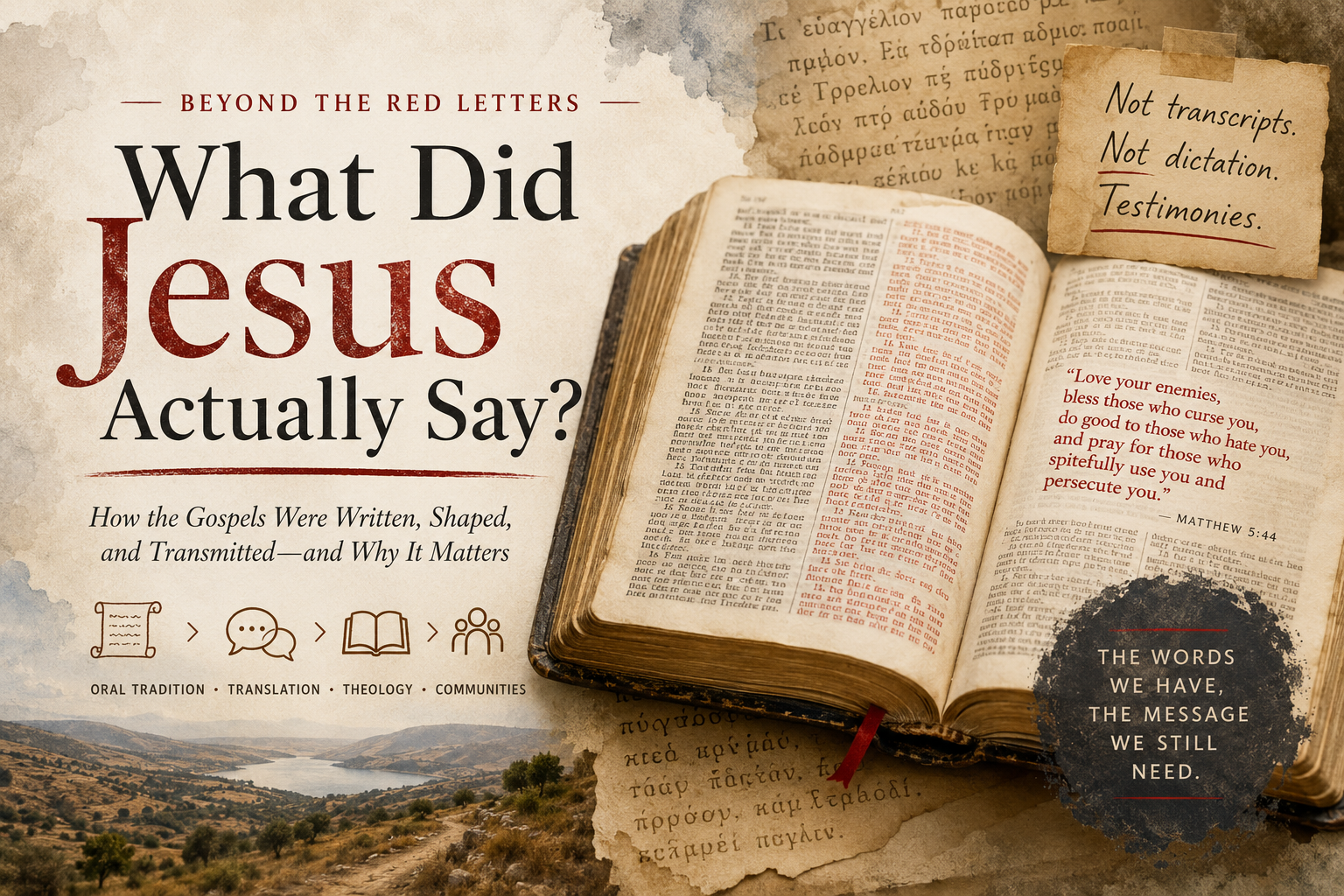
The red letters in my Bible used to feel sacred—Jesus’s exact words preserved like amber across two thousand years. That certainty dissolved during a lecture that forced me to confront what biblical scholars have known for decades: we cannot know which words Jesus actually spoke.
The timeline alone should have tipped me off. The Gospel writers composed their accounts thirty to seventy years after Jesus died. None knew him personally. They inherited stories filtered through decades of retelling, translated across languages, adapted for different communities. These weren’t court reporters taking dictation. They were authors crafting narratives for specific audiences with specific theological needs.
Consider what happens to any story over time. My grandfather’s war stories changed subtly each telling—a detail added here, timing shifted there. Now multiply that by thousands of retellings across different cultures and languages. Jesus spoke Aramaic to Galilean peasants. The Gospels come to us in Greek, written for urban communities scattered across the Roman Empire. Every translation requires choices. Wordplay that works in Aramaic vanishes in Greek. Rural metaphors need explanation for city dwellers. The Gospel writers had no original transcript to check their received traditions against.
I started comparing parallel passages across the Synoptic Gospels, watching the same saying transform. In Mark, Jesus says, “Why do you call me good? No one is good but God alone.” Matthew’s version reads, “Why do you ask me about what is good? There is only one who is good.” A small change, but it shifts the entire theological implication. Luke keeps Mark’s version but adds clarifying details. John presents extensive discourses that sound nothing like the terse aphorisms in the other three Gospels.
These variations aren’t copying errors. Each author shaped the tradition to address their community’s questions. Matthew, writing for Jewish Christians, emphasizes how Jesus fulfills Hebrew prophecy. Luke, addressing Gentile converts, explains Jewish customs and softens potentially offensive sayings. Mark presents an urgent, almost breathless narrative. John offers philosophical meditations on Jesus’s cosmic significance.
Ancient biography operated by different rules than modern historical writing. Putting appropriate words in a subject’s mouth to express their character or essence was standard practice. The Gospel writers weren’t committing fraud by modern standards—they were following the literary conventions of their time. They took received traditions and molded them, sometimes creating new sayings when their narrative or theological purposes required it.
This realization hit hard. When I quote Jesus saying “Love your enemies” or “The last shall be first,” I’m not quoting Jesus directly. I’m quoting Matthew’s or Luke’s presentation of what they believed Jesus taught, filtered through decades of communal interpretation and their own editorial decisions. The distinction matters. It acknowledges the human mediation between us and the historical figure.
Some sayings probably echo authentic teaching. When multiple independent sources preserve similar ideas—like the kingdom of God being near, or blessed are the poor—we glimpse possible historical memory. But even these cases involve layers of transmission that make word-for-word accuracy impossible to verify. The uncomfortable truth: most red-letter words are probably alterations or inventions that emerged in the decades after Jesus died.
I spent weeks grappling with what this means. Scholars have proposed various criteria to identify authentic sayings—multiple attestation, dissimilarity from both Jewish and early Christian thought, coherence with other likely authentic material. But these tools remain subjective and contested. They suggest probability, never certainty. We cannot strip away the layers of interpretation to reach bedrock historical fact.
The linguistic challenges compound the uncertainty. Translating Aramaic idioms into Greek requires more than swapping words—it demands cultural translation. A saying about camels and needle eyes might have meant something specific to Aramaic speakers that Greek translators could only approximate. The Gospel writers worked with Greek traditions that had already lost whatever Aramaic original might have existed.
Reading the Gospels now feels like archaeological excavation. I see layers of tradition, each era’s concerns leaving traces in the text. A saying about divorce might preserve Jesus’s teaching, but filtered through the early church’s struggles with marriage regulations and adapted by Gospel writers addressing communities with different social norms. The text reveals as much about the early church as about Jesus himself.
This doesn’t diminish the Gospels’ value. These texts preserve the impact Jesus had on his followers, even if they don’t preserve his exact words. The consistent themes across the varied Gospel traditions—concern for outcasts, critique of religious hypocrisy, announcement of God’s kingdom—suggest the kind of teacher who inspired these diverse portraits. The early Christians found Jesus’s message transformative enough to preserve, interpret, and apply to their own situations.
Arguments built on precise wording of Jesus’s sayings lose their foundation once we recognize this complex transmission history. Doctrines derived from specific phrasings must account for the likelihood that those phrases emerged from communal tradition rather than Jesus’s mouth. This uncertainty unsettles theological systems that depend on verbal exactitude.
Yet something profound remains. The Gospel writers weren’t writing fiction. They were preserving and interpreting traditions they believed captured something essential about Jesus. Their interpretive work—selecting, shaping, sometimes creating sayings—was their way of making Jesus’s significance clear to their communities. They gave us not transcripts but testimonies, not recordings but reflections on what Jesus meant to those who followed him.
I’ve stopped defending the verbatim accuracy of every red-letter word. Instead, I appreciate the Gospels as what they are: serious attempts by ancient authors to preserve and interpret a tradition they found life-changing. They used every literary tool available—including creating appropriate sayings—to convey what they understood about Jesus’s message and mission.
The red letters still matter, just differently than I once thought. They show how early Christians understood Jesus’s teaching and struggled to apply it to their contexts. When I read “Blessed are the peacemakers,” I hear not only an echo of Jesus’s concern for peace but also the early church’s attempt to live out that concern in a violent world. The interpretive process that produced these texts continues today, with us as participants rather than passive recipients.
This shift has been liberating. I no longer need the Gospels to be something they’re not—perfect recordings of Jesus’s words. I can value them for what they are: windows into how the earliest Christians experienced and interpreted Jesus’s impact. Their Jesus may not speak his exact historical words, but their portraits preserve the transformation his followers experienced.
The quest for Jesus’s authentic words will continue, using increasingly sophisticated analytical tools. But even our best methodologies cannot bridge the gap created by decades of oral tradition, translation across languages, and adaptation to different contexts. We work with probability, not certainty.
What remains certain is that someone extraordinary enough to inspire these diverse literary portraits walked in Galilee two thousand years ago. The exact words may be irretrievable, but the revolution in values—the last being first, the powerful brought low, the marginalized welcomed—echoes through every Gospel despite their differences. That consistent witness to radical transformation may be the most authentic thing we have.
The red letters in my Bible no longer represent direct divine dictation. They represent something more complex but equally valuable: the early church’s attempt to preserve and transmit what they understood about Jesus, using all their creativity and interpretive skill to make his message speak to their world. Their work invites us to continue that same process—not searching for exact words we cannot recover, but wrestling with the transformative vision those words were meant to convey.