I spent years reading everything I could about early Christianity. Academic papers, ancient texts, church histories. At first, I was trying to understand my own faith better. What I found instead turned everything I thought I knew upside down.
The Trinity—Father, Son, and Holy Spirit as three persons in one God—sits at the center of Christian orthodoxy. Churches recite it in creeds. Theologians write volumes defending it. But here’s what stopped me cold: this doctrine that defines Christianity today appears nowhere in the earliest Christian writings. Not in those exact terms. Not even close.
Gods in Threes: The Ancient Pattern
Before Christianity existed, the ancient world was already full of divine triads. I remember the first time I mapped them out on paper, listing civilization after civilization. The pattern was undeniable.
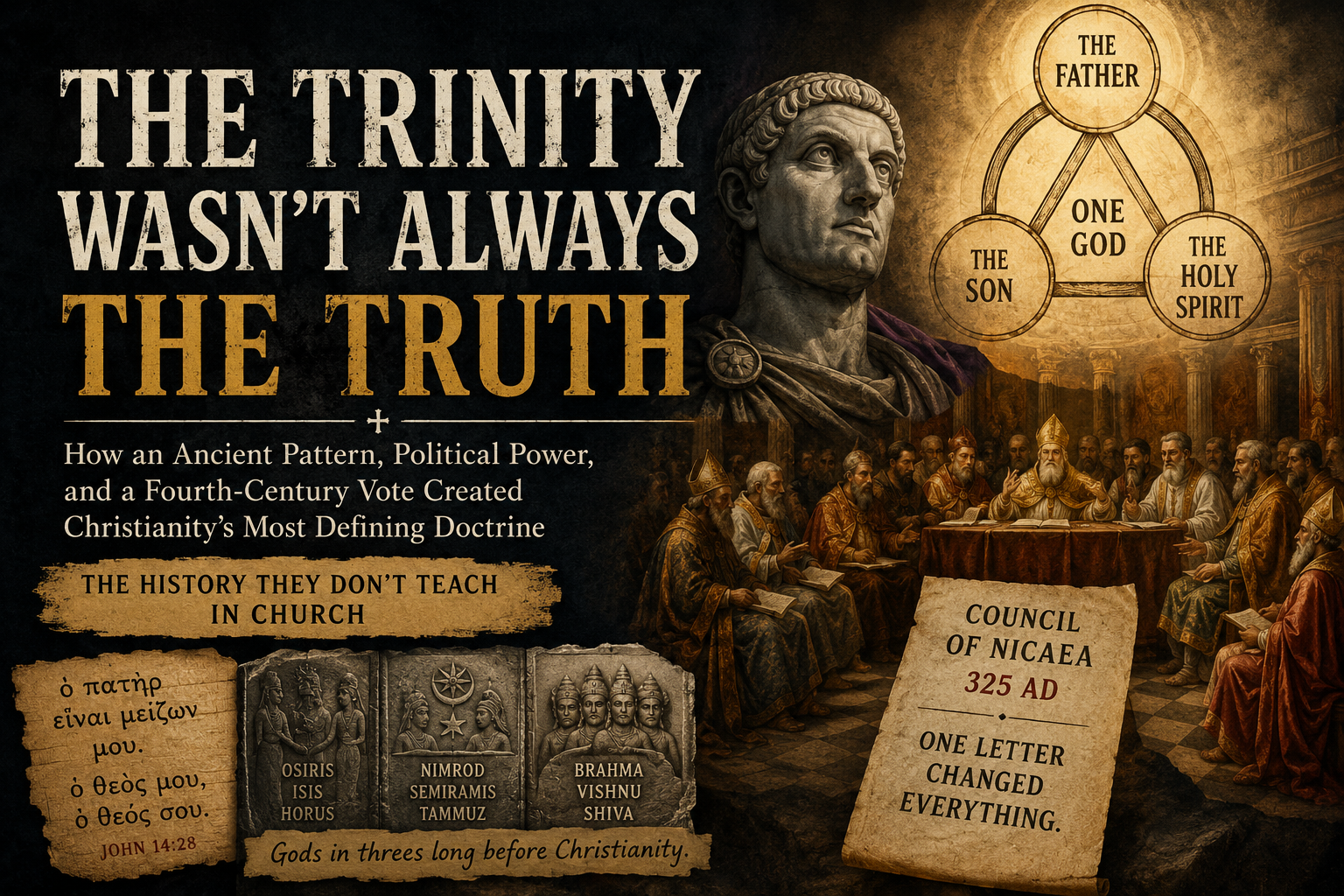
In Egypt, Osiris, Isis, and Horus formed a divine family that Egyptians worshipped for three thousand years before Jesus was born. This wasn’t some minor cult hidden in the desert. This was the state religion, complete with massive temples and elaborate rituals. Father, mother, divine son—a holy family that promised resurrection and eternal life.
The Babylonians had Nimrod, Semiramis, and Tammuz. The Hindus developed Brahma, Vishnu, and Shiva. The Greeks arranged their gods in triads. The Romans followed suit. Wherever you looked in the ancient Mediterranean and Near East, gods came in threes.
This wasn’t coincidence. Something about the number three resonated across cultures. It suggested completeness, balance, perfection. Ancient peoples expected their highest gods to operate in triadic relationships. It was the religious common sense of the time.
The Missing Doctrine
When I started examining what the earliest Christians actually believed about Jesus, I kept waiting to find clear Trinity statements. They never came.
The word “Trinity” doesn’t appear in the Bible. Jesus never explains that he’s part of a three-person godhead. When he prays in the Garden of Gethsemane, sweating blood before his crucifixion, he begs God the Father to “take this cup from me.” He’s not talking to himself. He’s addressing someone else entirely.
Jesus tells his followers to pray to “Our Father in heaven.” He says things like “The Father is greater than I” and “Why do you call me good? Only God is good.” These aren’t the words of someone claiming to be the second person of a coequal Trinity.
For three centuries after Jesus died, Christian communities held wildly different views about his nature. I’ve read the documents. The Ebionites believed Jesus was fully human, chosen by God but not divine. The Docetists claimed he only appeared human but was purely divine. The Adoptionists thought Jesus became divine at his baptism when God adopted him as a son.
The Arians—and they were huge, with churches across the Roman Empire—taught that Jesus was God’s first and greatest creation, divine but not eternal like the Father. They quoted scripture: “The firstborn of all creation.” They had bishops, theologians, and millions of believers.
These groups weren’t heretics in their own time. They were Christians, full stop. They read the same scriptures, followed the same Jesus, practiced baptism and communion. They just understood Jesus differently. The idea of a precise Trinity formula that all Christians must accept didn’t exist yet.
Constantine’s Solution
Everything changed in 325 AD when Emperor Constantine called the Council of Nicaea.
Constantine had a political problem dressed up as a theological one. He’d legalized Christianity and wanted to use it as glue for his fracturing empire. But Christians wouldn’t stop arguing about Jesus’s nature. He needed one official version, not dozens of competing Christianities undermining imperial unity.
So he summoned the bishops to Nicaea, paid their travel expenses, and told them not to leave until they’d settled the debate. The key question: Was Jesus of the same substance (homoousios) as God the Father, or was he of similar substance (homoiousios)? One letter’s difference in Greek, but it determined Christianity’s future.
The bishops voted. The “same substance” faction won—barely. We’re talking about a narrow margin deciding the nature of Jesus Christ. The losing bishops were immediately exiled. Their writings were banned and burned. Anyone who continued teaching their interpretation faced persecution from the very empire that had just stopped persecuting Christians.
The winning formula at Nicaea wasn’t some pure distillation of apostolic teaching. It was a negotiated settlement, hammered out under imperial pressure. The final version incorporated Greek philosophical concepts foreign to Jewish monotheism and aligned suspiciously well with the pagan triads everyone already knew.
Following the Evidence
I’ve shared these findings with many Christian friends over the years. Some get angry. Some claim I’m misreading the sources. But most are simply shocked. They’ve never heard this history before.
Sunday school doesn’t teach you that the Trinity was established by a vote. Seminary glosses over the fact that millions of early Christians rejected what became orthodox doctrine. Church history books minimize the role of imperial politics in shaping theology.
But the evidence is there for anyone willing to look. The pre-Nicene church fathers disagreed constantly about Jesus’s nature. Origen, one of early Christianity’s greatest theologians, taught that Jesus was subordinate to the Father—a view later condemned as heresy. Tertullian, who actually coined the term “Trinity,” described it differently than the later orthodox formulation.
These weren’t confused beginners. These were the intellectual giants of early Christianity, and they couldn’t agree on who Jesus was.
The Uncomfortable Truth
After years of studying this history, I’ve reached an uncomfortable conclusion: the Trinity doctrine was a fourth-century innovation, not an original Christian teaching. It emerged from political necessity, philosophical speculation, and the human need to systematize mystery.
Early Christians managed to follow Jesus for three hundred years without a formal Trinity doctrine. They focused on his teachings about love, forgiveness, and the kingdom of God. They shared meals, cared for the poor, and faced persecution together. The elaborate metaphysical framework came later, imposed by councils and enforced by emperors.
This doesn’t mean modern Christians are wrong to believe in the Trinity. But they should know where it came from. They should understand that it was one interpretation among many, elevated to orthodoxy through political power rather than spiritual revelation.
When someone tells me the Trinity has always been essential to Christianity, I think about those early believers who knew nothing of it. I think about the bishops who voted against it at Nicaea. I think about the millions of Christians branded as heretics for holding views that, just a generation earlier, were perfectly acceptable.
The history is clear, even if it’s uncomfortable. The Trinity doctrine emerged from a specific historical context, shaped by political pressure and cultural expectations. It won not because it was obviously true but because it had imperial backing.
That’s not an attack on anyone’s faith. It’s just what happened. And if Christianity is strong enough to be true, it’s strong enough to handle the truth about its history.