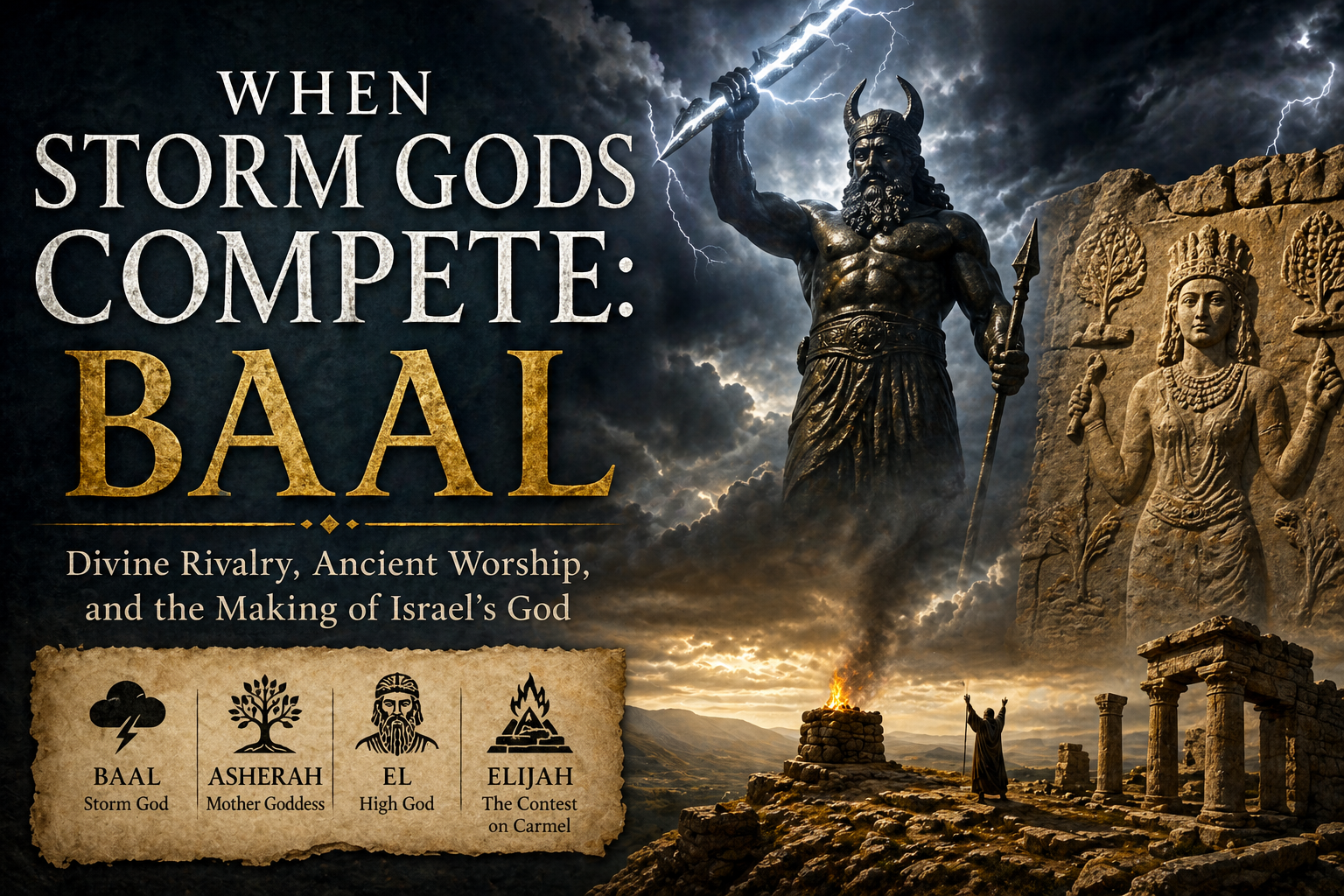
The ancient world’s divine landscape was far more complex than most people realize today. Walking through the biblical texts with fresh eyes reveals a fascinating competition between deities that shaped how ancient Israelites understood their God.
Baal appears throughout the Hebrew Bible as the great rival to Israel’s God, but the story runs deeper than simple opposition. The name itself worked on multiple levels in ancient Semitic languages. As a common honorific, “baal” simply meant lord, master, or husband. You could call any deity “baal” as a title of respect. The Hebrew Bible even applies this title to Adonai (a reverent substitute for the personal,4-letter name of God (YHWH), which is not pronounced in Jewish tradition)1 in certain contexts.
But Baal was also a proper name—the personal designation of a specific Northwest Semitic storm god who commanded the second tier of the divine pantheon. Ancient texts describe him differently depending on the tradition. Sometimes he’s Dagon’s son, other times El’s offspring. What remains consistent is his profile: a young, vigorous warrior who manifests through dark storm clouds, thunder, and lightning.
This storm imagery creates the tension. When I first encountered Psalm 29, the seven references to “the voice of Adonai” struck me as pure storm-god language—thunder crashing, lightning splitting cedar trees. The psalm even mentions three northern locations that fall outside Israel’s traditional heartland but align perfectly with Baal’s territory. The evidence suggests Israelite worshippers took an existing Baal hymn and reworked it for their own deity.
The appropriation makes historical sense. As Adonai’s worship spread into the central and northern hill country, his followers encountered established Baal traditions. Rather than abandon powerful storm imagery that resonated with agricultural communities dependent on rain, they claimed it for their God. The famous contest between Elijah and Baal’s prophets on Mount Carmel dramatizes this theological takeover. Both sides call for fire from heaven—essentially lightning—to consume their sacrifices. When Adonai sends the fire and Baal remains silent, the text declares who truly controls the storm.
Yet this borrowing created problems. The book of Hosea records a divine command that captures the discomfort: “You will no more call me Baal.” Even though “baal” could mean “my husband” in everyday speech, the association with the storm deity had become too problematic. Instead, Adonai instructs his people to use “Ishi”—“my man”—which preserves the marital metaphor while abandoning the loaded name.
The divine landscape included other major figures beyond this Adonai-Baal rivalry. Asherah occupied a central position in Northwest Semitic religion, though her origins likely predate the Semitic pantheon itself. Her non-Semitic name and appearances in Sumerian texts point to Amorite connections. She entered the Northwest Semitic pantheon as El’s consort—the high god’s wife—and became mother to the seventy deities of the second tier.
Asherah’s portfolio covered the concerns of daily life: motherhood, childbirth, nursing, protection. She maintained strong connections to the sea. Some traditions even position her as Baal’s mother, adding another layer to the divine family dynamics. Her widespread worship across the region meant Israelites constantly encountered her cult as they developed their own religious identity.
El himself stands at the apex of this divine hierarchy as the high god of the Northwest Semitic pantheon. The evidence points to El as Israel’s original patron deity, which raises profound questions about the relationship between El and Adonai in Israelite religion. The very name “Israel” contains El’s name, not Adonai’s.
Understanding these divine profiles and their interactions transforms how we read biblical texts. The prophets weren’t operating in a religious vacuum but actively negotiating with existing traditions. When they described Adonai with storm imagery or rejected certain divine titles, they participated in a broader ancient Near Eastern conversation about divine power and authority.
The process reveals something profound about religious development. New religious movements rarely start from scratch. They build on existing foundations, borrowing what serves their purposes and rejecting what doesn’t. The biblical writers took the religious vocabulary available to them—storm gods, mother goddesses, high deities—and reshaped it to express their understanding of their God’s unique character and exclusive claims.
This ancient theological competition still echoes in the biblical text. Every reference to clouds and thunder, every rejection of other deities, every insistence on exclusive worship carries the memory of these older conflicts. The Hebrew Bible preserves not just the victorious perspective but traces of the complex religious environment from which biblical monotheism emerged.
Reading these texts today, we glimpse the genuine struggles of ancient communities working out their religious identity. They faced real choices about which deity to serve, which divine profile to embrace, which ritual practices to maintain or abandon. Their decisions, preserved in scripture, shaped the religious traditions that billions follow today.
- Adonai (אֲדֹנָי) is a Hebrew name for God meaning “Lord,” “Master,” or “my Lords,” appearing over 400 times in the Hebrew Bible. It functions as a reverent substitute for the personal,4-letter name of God (YHWH), which is not pronounced in Jewish tradition. It signifies God’s sovereignty, authority, and personal connection as Master.