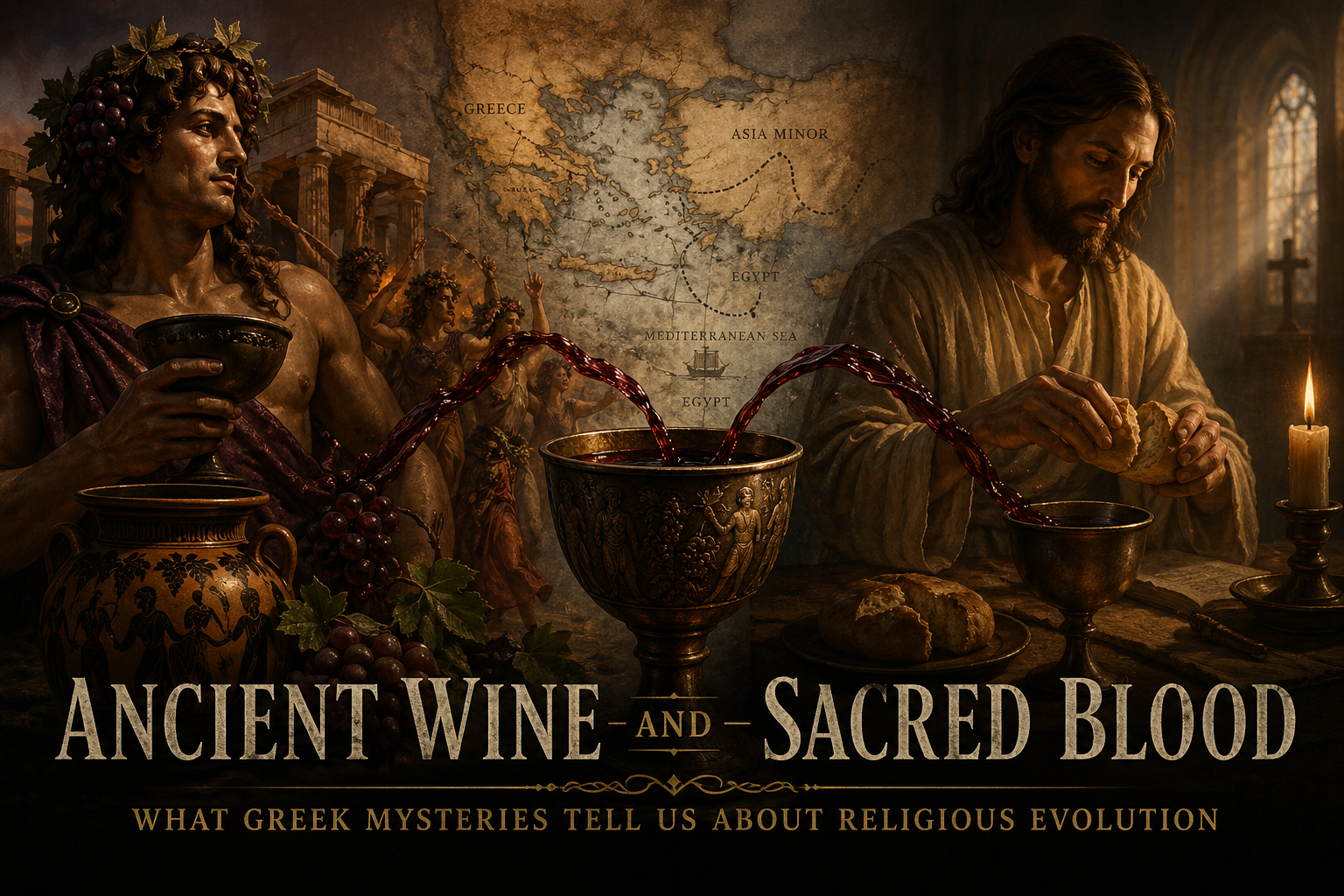
I’ve been spending time reading through ancient Greek texts lately, and it sent me down a fascinating rabbit hole about religious parallels that most people never hear about in Sunday school.
The story starts with Dionysus, the Greek god of wine and ecstasy. When you actually read the source materials—Euripides’ plays, Plutarch’s writings, Diodorus Siculus’s historical accounts—you find narrative elements that feel strangely familiar to anyone raised in the Christian tradition. Born from Zeus and a mortal woman named Semele, Dionysus was celebrated as a divine son who brought salvation to his followers. His cult, which flourished from at least the fifth century BCE, centered around wine rituals where participants believed they were consuming the god’s essence.
The parallels get more specific. Both traditions feature a divine figure who transforms water into wine as a defining miracle. Both speak of death and return from the underworld. Both use titles like “savior” and “son of God” for their central figure. The wine-as-divine-essence theme appears in both Dionysian mysteries and Christian communion.
Now, before anyone thinks I’m making wild claims, these observations aren’t new or controversial among scholars who study comparative religion. Justin Martyr, one of the earliest Christian apologists writing in the second century, directly addressed these similarities. He didn’t deny them—instead, he argued that demons had created these pagan myths to confuse people about the true faith. That’s a remarkable admission from someone defending Christianity in its early days.
But here’s where things get complicated, and where popular narratives often go off the rails. The Dionysus stories don’t present a clean, singular narrative. Different Greek sources tell different versions. Semele wasn’t a virgin in the traditional tellings—Zeus was very much involved in the conventional sense. The death and resurrection of Dionysus takes various forms across different texts and regions. Sometimes he’s torn apart and reconstituted, sometimes he descends to rescue his mother from Hades, sometimes he’s “twice-born” from Zeus’s thigh. The specific “three days dead” claim that circulates online doesn’t appear consistently in the primary sources I’ve examined.
The wine miracles differ substantially in their contexts too. In Dionysian myths, wine appears as fountains springing from the earth or flowing from temple fixtures during festivals—expressions of the god’s presence and power. The Gospel of John’s wedding at Cana presents Jesus performing a discrete miracle to save a host from social embarrassment, with deeper theological symbolism about transformation and the new covenant. Similar elements, different meanings.
What fascinates me most is how these mythological motifs traveled across cultures. The ancient Mediterranean was a connected world. Greek culture had spread throughout the region following Alexander’s conquests. Jewish communities existed in Greek cities. Early Christians wrote in Greek and quoted Greek philosophy. Cultural exchange was inevitable.
The real question isn’t whether Christianity emerged in conversation with existing religious traditions—of course it did. Every religious movement builds on what came before, reinterpreting older symbols and stories through new lenses. The question is what these parallels mean.
Some see borrowed mythology that undermines Christian claims to uniqueness. Others see universal human yearnings for divine connection, sacrifice, and renewal that different cultures expressed through their own narratives. Still others argue that surface similarities mask profound theological differences—that communion and Dionysian wine rituals, for instance, operate on completely different symbolic and spiritual logic despite both involving wine.
I find myself thinking about how we tell stories and why certain patterns recur across cultures. The dying-and-rising god appears in various forms throughout the ancient Near East—Osiris, Attis, Adonis. Virgin births show up in multiple traditions, though often with different meanings than the Gospel nativity accounts suggest. Sacred meals where participants commune with the divine through food and drink appear across numerous religions.
These patterns point to something deeper than simple borrowing. They suggest fundamental human concerns about death and renewal, divine incarnation in the material world, and the possibility of transformation. Different cultures clothed these concerns in different narratives, but the underlying questions remain consistent: Can death be overcome? Can the divine enter our world? Can we participate in something greater than ourselves?
Reading Justin Martyr’s defenses reminded me how early Christians wrestled with these questions. They knew their neighbors celebrated mysteries that seemed to echo Christian claims. Rather than denying the similarities, they had to explain them. Some, like Justin, saw demonic deception. Others might have seen God preparing the world for the Gospel through partial truths in pagan religions. Modern believers and skeptics continue these same debates, often with more heat than light.
The scholarly work on this topic fills libraries, and simplistic claims about “exact matches” or “complete fabrication” don’t do justice to the complexity. Primary texts require careful reading in their original languages and cultural contexts. Dating sources accurately matters enormously—later texts can’t influence earlier ones, regardless of thematic similarities. Archaeological evidence needs interpretation through multiple lenses.
What strikes me after wading through these materials is how much gets lost in translation—not just linguistic translation, but cultural and temporal translation. We read ancient texts through modern eyes, imposing our categories and concerns onto cultures that thought very differently about divinity, mythology, and truth. A Greek participant in Dionysian mysteries and an early Christian at communion might have used similar vocabulary—salvation, divine blood, transformation—while meaning profoundly different things.
This complexity makes the subject endlessly fascinating but also frustrating. Every time I think I’ve grasped a clear parallel or distinction, another text complicates the picture. Dionysus becomes Zagreus in Orphic traditions, with different death and rebirth narratives. Christian communities in different regions developed varying theological interpretations of communion. The neat comparison charts that circulate online dissolve into scholarly footnotes and competing interpretations.
Yet the exercise remains valuable. Understanding how religious traditions influence and respond to each other helps us see our own beliefs—whatever they are—in broader context. It reminds us that human beings have always asked the same big questions and that our answers, however deeply held, exist in conversation with centuries of other seekers, believers, and skeptics.
The next time someone tells you Christianity copied everything from Greek mystery religions, or that such parallels are complete fabrications, remember that the truth lies somewhere in the messy middle. Real historical analysis requires patience with ambiguity and respect for complexity. The ancient world was neither a collection of hermetically sealed cultures nor a homogeneous blend. It was a dynamic space where ideas met, merged, competed, and transformed.
Those transformations continue today as we interpret and reinterpret these ancient stories, finding in them what we need or expect to find. The parallels between Dionysus and Christ tell us as much about our own preoccupations as they do about ancient religions. We’re still asking the same questions our ancestors asked: Where do we come from? Why do we suffer? What happens when we die? Can we touch the divine?
The answers vary, but the questions unite us across millennia. In that sense, perhaps the most important parallel isn’t between specific myths but between the human beings who created and believed them, all searching for meaning in an uncertain world.