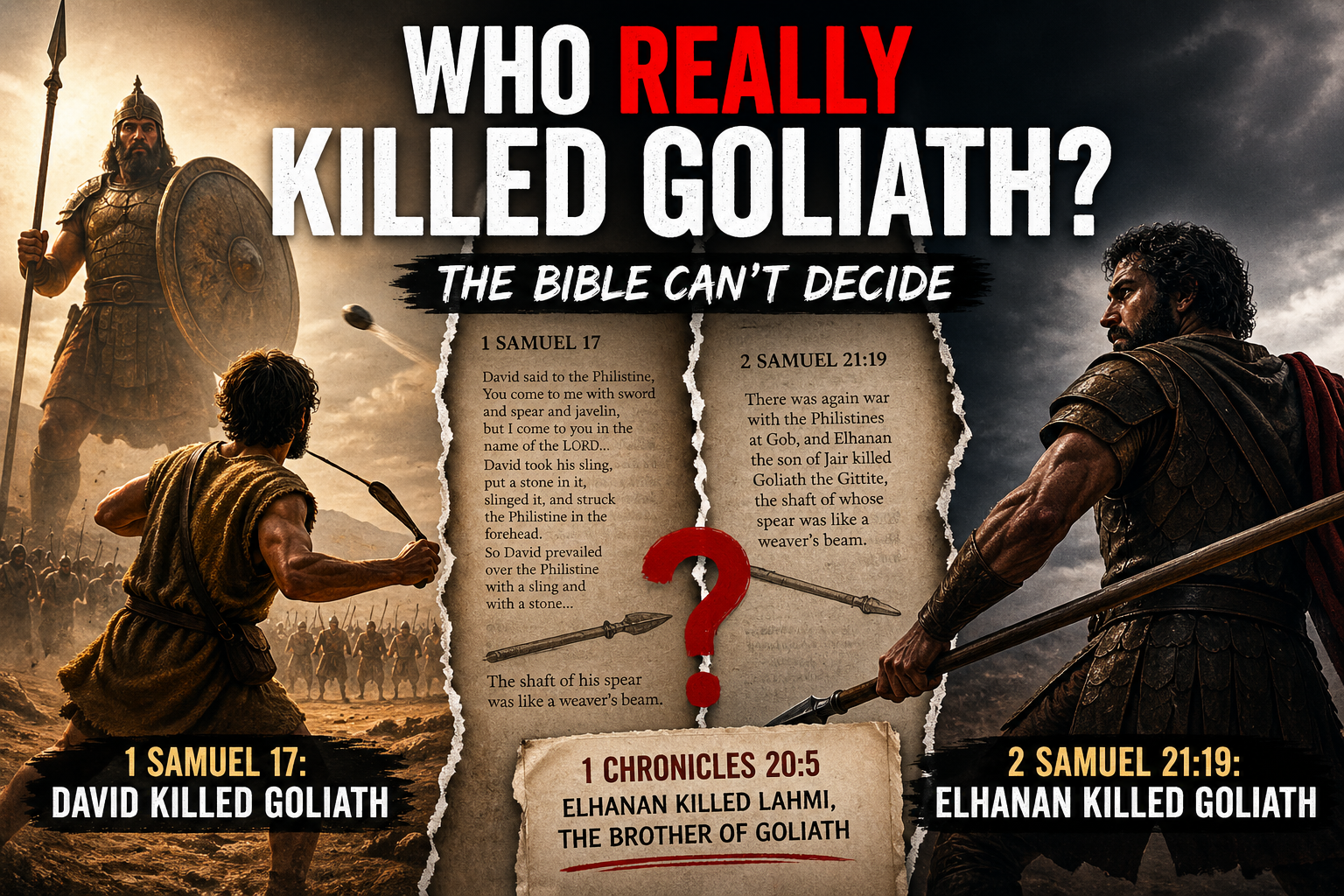
The story of David and Goliath sits at the center of biblical heroism—the young shepherd boy facing down a giant with nothing but a sling and stones. But what if I told you the Bible itself can’t agree on who actually killed Goliath?
I stumbled into this rabbit hole while comparing different biblical passages about the Philistine wars. The contradiction jumped out immediately once I knew where to look.
Everyone knows First Samuel 17. David volunteers to fight the Philistine champion when no Israelite soldier will. The text describes Goliath’s massive spear, noting its shaft was “like a weaver’s beam.” David slings a stone, hits the giant in the forehead, and becomes a national hero. Simple story, right?
Then you read Second Samuel 21:19.
This passage, buried in a list of battles against Philistine giants, states that Elhanan killed Goliath. Not someone like Goliath. Not a relative of Goliath. The text specifically says Elhanan killed “Goliath the Gittite” and even repeats that exact same description about the spear shaft being like a weaver’s beam. The parallel language makes it clear we’re talking about the same giant.
The chronicler who compiled First Chronicles apparently noticed this problem. In First Chronicles 20:5, the story changes again. Now Elhanan kills Lahmi, who gets identified as Goliath’s brother. The spear description remains, but suddenly Goliath has a conveniently inserted sibling to explain away the contradiction.
You can see the editorial hand at work here. The chronicler faced two incompatible traditions—David killed Goliath, Elhanan killed Goliath—and tried to smooth things over by inventing a brother. This kind of harmonization appears throughout Chronicles when the compiler encounters problematic passages from earlier texts.
The more I dug into this, the more fascinating the implications became. The David and Goliath narrative we all know appears to have been adapted from an earlier tradition, possibly one originally about Elhanan. Think about that specific detail—the spear shaft like a weaver’s beam. That’s not generic warrior description. That’s a specific narrative element that links these accounts together.
When editors compiled the stories of David’s rise to power, they apparently incorporated this giant-killing tradition into his biography. The original hero’s name survived in that brief mention in Second Samuel, like a fossil embedded in later rock layers. The chronicler, writing even later, tried to fix the inconsistency but only highlighted it further.
This isn’t just about one contradiction. It reveals how biblical texts developed over time, with editors collecting, adapting, and sometimes harmonizing different traditions. The Bible preserves multiple voices and perspectives, even when they disagree on basic facts like who killed the most famous giant in Israelite memory.
Reading these passages side by side changed how I approach biblical texts. Instead of expecting a single, unified narrative, I now see layers of tradition, editorial decisions, and attempts at reconciliation. The contradictions aren’t flaws to explain away—they’re windows into how these texts actually came together.
The next time someone mentions David and Goliath, remember Elhanan. His story got absorbed into a larger narrative, but traces remain for anyone willing to look closely at the text. The Bible tells us David killed Goliath. It also tells us Elhanan did. Both traditions survived the editorial process, sitting just chapters apart, waiting for readers to notice.