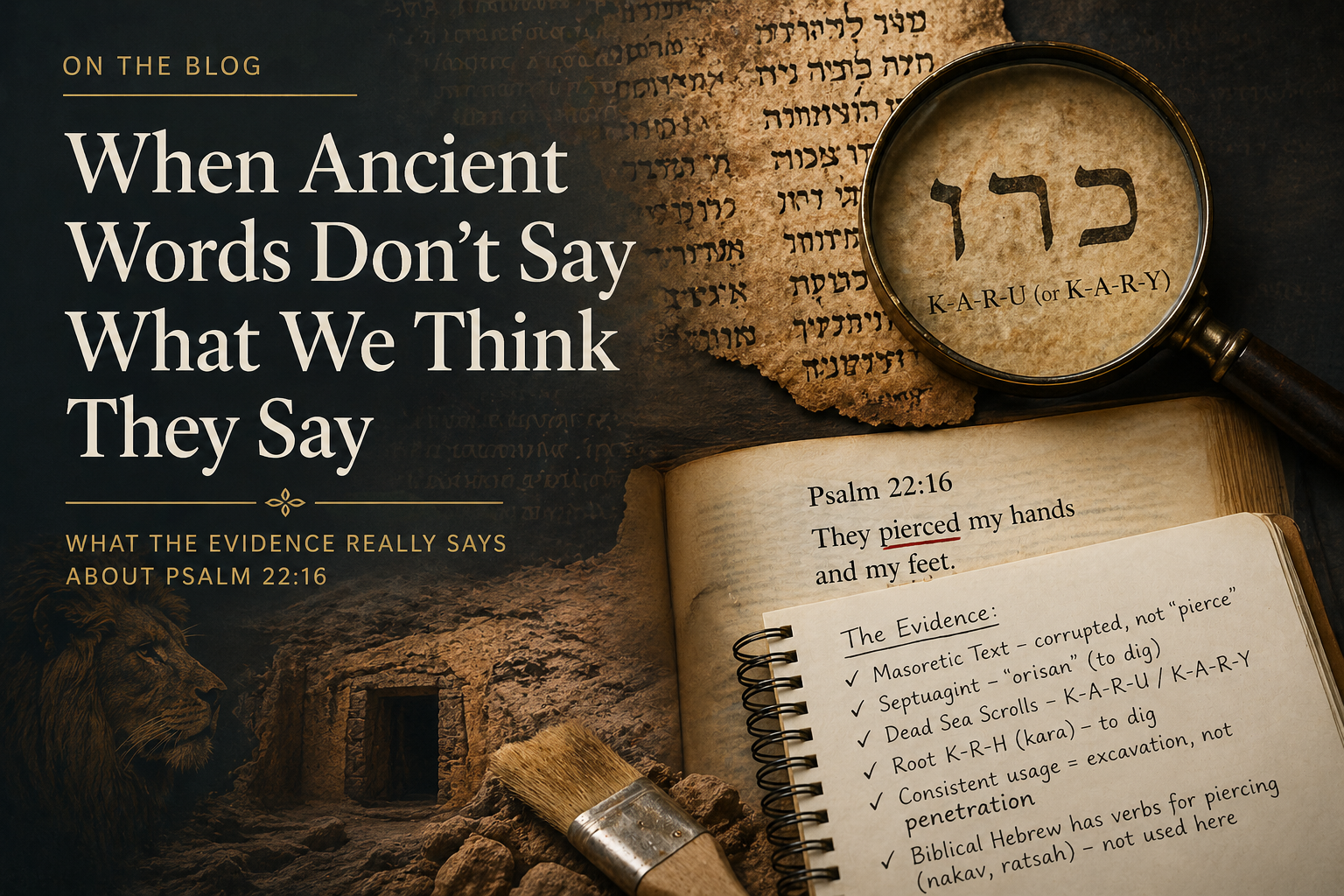
I first encountered this textual problem during coursework in ancient languages. The Course gave us pictures of the Dead Sea Scrolls fragment containing Psalm 22, asking us to transcribe what we saw. The letters were faint, the parchment damaged, but four characters stood out clearly: Kaf, Aleph, Resh, and then… something else. Was it a Yod? A Vav? The difference between these two Hebrew letters often comes down to a millimeter of ink—one is just a longer stroke than the other.
That fourth letter has sparked centuries of debate, and for good reason. Psalm 22:16 sits at the heart of Christian theology as a supposed prophecy of crucifixion. You know the verse, even if you don’t think you do: “they pierced my hands and my feet.” Jesus quotes the opening of this very psalm from the cross: “My God, my God, why have you forsaken me?” The connection seems perfect. Too perfect, actually.
The Text That Makes No Sense
The standard Hebrew text, the Masoretic Text that Jewish communities have preserved for over a millennium, reads something bizarre at this spot: “like a lion, my hands and my feet.” Just those words, hanging there without a verb. Like a lion… what? The sentence breaks off, incomplete and nonsensical.
This grammatical train wreck tells us something went wrong in transmission. Ancient scribes made mistakes—they were human, copying by candlelight, working with deteriorating manuscripts. When you encounter gibberish in an otherwise coherent text, you know corruption has crept in.
So scholars turn to other ancient witnesses. The Septuagint, that Greek translation made by Jewish scholars in Alexandria centuries before Christ, uses the verb “orisan”—to dig or hollow out. Not pierce. Dig. The Dead Sea Scrolls, our oldest Hebrew manuscripts, give us those four letters I mentioned: K-A-R-U (or possibly K-A-R-Y). But here’s the problem: Kaf-Aleph-Resh isn’t a Hebrew root. It doesn’t exist.
Reconstructing What Was Lost
To make sense of this mess, textual critics propose removing the Aleph—treating it as a scribal insertion error. This gives us the root K-R-H, pronounced “kara,” which actually exists in Hebrew. It means “to dig.”
Now, I’ve spent considerable time with this verb across the Hebrew Bible, and its usage is remarkably consistent. When Abraham’s servants kara a well, they’re excavating earth to create a water source. When someone kara a tomb, they’re hollowing out rock to make a burial chamber. When the psalmist warns about those who kara a pit, he’s talking about removing dirt to create a trap.
The semantic focus is always on removal of material to create space. You dig OUT a well. You hollow OUT a tomb. You excavate a pit. The verb describes the action of taking away substance to leave emptiness behind.
Why “Pierce” Doesn’t Work
Here’s where the linguistics get decisive. In my analysis of every single occurrence of “kara” in the Hebrew Bible—and I mean every single one—the verb never takes the material being acted upon as its direct object. You don’t “dig the ground”; you “dig a pit IN the ground.” You don’t “dig the rock”; you “dig a tomb IN the rock.”
Apply this rule to hands and feet. Even if we wanted to force “kara” to mean something it doesn’t typically mean, the grammar fights us. “They dug my hands and my feet” is as linguistically awkward in Hebrew as it sounds in English. Hands and feet are small, relatively flat body parts. You can’t dig them any more than you can dig a sheet of paper. The concept doesn’t compute.
I found one seemingly metaphorical use in Psalm 40:6: “ears you have dug for me.” But even this maintains the basic semantic idea—God hollowed out the ear canal, created the space that makes hearing possible. It’s still about excavation and creating cavities, not penetration.
The most abstract usage appears in Proverbs 16:27, where troublemakers “dig up evil.” They’re mining for it, dredging it up from wherever it was buried. Again, the focus is on excavating something, bringing it to the surface.
The Verbs That Weren’t Used
This is what sealed it for me: Biblical Hebrew has perfectly good verbs for piercing. The verb “nakav” means to perforate or puncture. Even better, “ratsah” specifically means to pierce through, and Exodus 21:6 uses this exact verb to describe boring a hole through someone’s ear with an awl.
If the psalmist wanted to say “they pierced my hands and my feet,” the language provided clear, unambiguous ways to say it. The fact that these words appear nowhere in any ancient manuscript of Psalm 22:16 speaks volumes.
Facing the Evidence
After examining every manuscript variant, analyzing the semantic range of the reconstructed verb, and reviewing its grammatical patterns throughout the Hebrew Bible, I reached an uncomfortable conclusion: The translation “they pierced my hands and my feet” has no basis in the actual text.
The Masoretic Text is corrupted but doesn’t say “pierce.” The Septuagint says “dig.” The Dead Sea Scrolls, our earliest witness, most likely says “dig” if we correct for the probable scribal error. No ancient manuscript supports “pierce.”
This matters because translation shapes theology. When we read our beliefs into ambiguous ancient texts, we’re not doing translation—we’re doing something else entirely. The evidence strongly suggests that Christians have been reading this verse through crucifixion-colored glasses for two millennia, seeing something that simply isn’t there in the original languages.
The corruption in Psalm 22:16 leaves us with uncertainty about what the text originally said. Maybe it was about lions surrounding the psalmist, with the verb lost to time. Maybe it used the digging metaphor in some way we can’t now reconstruct. But one thing the textual evidence makes clear: whatever the original reading was, it wasn’t “they pierced my hands and my feet.”
Understanding this doesn’t diminish the power of the psalm or its resonance with the crucifixion narrative. But it does remind us that ancient texts are complex, transmission is imperfect, and sometimes our cherished translations tell us more about what we want to find than what’s actually there.