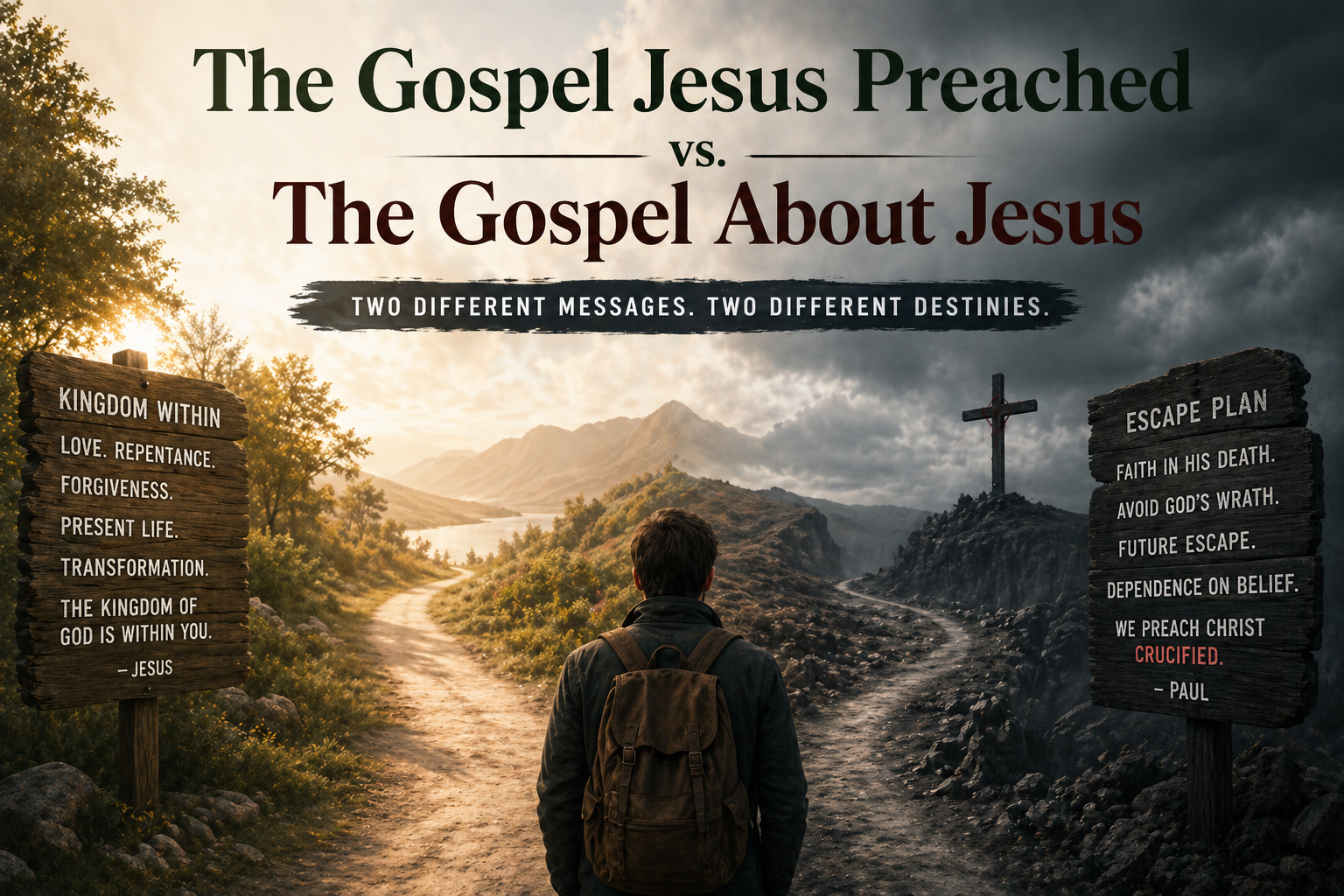
The first time I really wrestled with this question changed everything about how I read the New Testament. Sitting in a coffee shop with my worn study Bible, I kept flipping between Jesus’ words in the Gospels and Paul’s letters. Something felt off. The more I compared them, the more I noticed a fundamental disconnect in their messages about salvation.
Jesus spoke about the kingdom of God as something already here, something we could enter right now through love and repentance. Paul wrote about escaping God’s wrath through faith in Christ’s blood. These aren’t minor variations on a theme. They’re different religions.
What Jesus Actually Taught
When someone asked Jesus directly about eternal life, he didn’t mention his future death on a cross. He pointed to the commandments: love God with everything you have, and love your neighbor as yourself. “Do this and you will live,” he said. Present tense. Not “believe in my sacrificial death” or “accept me as your personal savior.” Just love. Do it, and you live.
The pattern repeats throughout his ministry. A tax collector stands in the temple, beats his chest, and prays, “God, have mercy on me, a sinner.” Jesus says this man went home justified before God. No blood sacrifice. No elaborate theology. Just genuine repentance.
A paralyzed man gets lowered through a roof by his friends. Jesus sees their faith and says, “Your sins are forgiven.” The religious authorities lose their minds because he’s bypassing their entire sacrificial system. He’s showing that forgiveness flows directly from God to anyone with faith and repentance.
A woman known for her sins crashes a dinner party, weeping at Jesus’ feet. The host judges her silently. Jesus tells him that her many sins are forgiven because she loved much. Again, no mention of needing a blood sacrifice. Her love and repentance were enough.
This pattern goes back to John the Baptist, who offered a baptism of repentance for the forgiveness of sins. No temple. No priests. No sacrificial animals. Just water, repentance, and a changed heart. Jesus endorsed this approach by getting baptized himself.
When Jesus talked about the kingdom of God, he said it was within us. Not a future escape from earth, but a present reality we enter through transformation. The eternal life he offered wasn’t about avoiding hell after death. It was about living in communion with God right now, manifested through loving action.
Paul’s Different Gospel
Paul never met Jesus during his earthly ministry. His gospel came from what he claimed were private revelations—visions and messages that no one else could verify. Based on these personal experiences, Paul constructed an entirely different framework for salvation.
In Paul’s system, humanity stands condemned under God’s wrath. We’re born guilty, stained by sin from birth. The only escape is believing that Jesus’ death paid the penalty we deserved. Without this belief, we face eternal punishment. God becomes a judge demanding payment, and Jesus becomes the currency.
This isn’t refinement or clarification of Jesus’ message. It’s replacement. Where Jesus emphasized love and forgiveness as pathways to life, Paul emphasized faith in a cosmic transaction. Where Jesus showed God eagerly forgiving anyone who turned to Him, Paul portrayed God as needing blood payment before He could forgive.
The practical implications are staggering. Under Jesus’ teaching, salvation is immediate and accessible to anyone willing to repent and love. Under Paul’s system, salvation depends on accepting a specific interpretation of a historical event. Jesus empowered people to change their lives. Paul’s gospel creates dependence on correct belief.
The Kingdom Within vs. The Escape Plan
Jesus consistently described the kingdom of God as something present, not just future. “The kingdom of God is within you,” he said. His parables portrayed it as yeast working through dough, a seed growing secretly, a treasure hidden in a field that someone discovers with joy. These are images of transformation happening now, in this life, in this world.
The Lord’s Prayer, which Jesus taught as the model prayer, asks for God’s kingdom to come “on earth as it is in heaven.” Not escape from earth, but earth transformed. Not abandoning creation, but redeeming it. The prayer focuses on daily bread, mutual forgiveness, and deliverance from evil—practical, present-tense concerns.
Paul’s gospel shifts the focus entirely. Earth becomes a sinking ship to abandon. Physical existence becomes something to endure until we reach our true home. The body becomes a prison for the soul. Creation groans, waiting for destruction and replacement. The goal isn’t transforming this world through love but escaping it through correct belief.
This shift has profound consequences. If the kingdom is within and among us now, we’re called to manifest it through love, justice, and mercy. If salvation is an escape plan, we just need to secure our tickets and wait for departure. One creates activists. The other creates passive believers.
The Forgiveness Revolution
Perhaps nowhere is the contrast starker than in their teachings about forgiveness. Jesus made forgiveness the centerpiece of his ministry. He taught his followers to pray, “Forgive us our debts, as we forgive our debtors.” He said if we don’t forgive others, God won’t forgive us. He told Peter to forgive not seven times, but seventy-seven times.
This wasn’t abstract theology. Jesus demonstrated immediate forgiveness to anyone who sought it. No waiting period. No ritual requirements. No blood sacrifice needed. When he forgave sins, the religious authorities accused him of blasphemy precisely because he was bypassing their entire sacrificial system.
The woman caught in adultery illustrates this perfectly. The religious leaders drag her before Jesus, rocks in hand, ready to execute the law’s demands. Jesus doesn’t say, “Wait until I die on the cross, then she can be forgiven.” He tells her accusers that whoever is without sin should throw the first stone. They all leave. He tells her, “Neither do I condemn you. Go and sin no more.”
That’s the Jesus model: immediate forgiveness available to anyone willing to receive it and extend it to others. It’s participatory. We’re not just recipients but active agents of forgiveness. The kingdom spreads through forgiven people forgiving others.
Paul’s system mechanizes forgiveness into a legal transaction. God’s wrath must be satisfied. Justice demands payment. Someone must die. Forgiveness becomes something achieved 2,000 years ago that we access through mental assent. It’s a one-time event rather than an ongoing practice. We become consumers of forgiveness rather than participants in it.
Living the Questions
I’ve spent years sitting with these differences, and they’ve revolutionized my spiritual practice. When I focus on Jesus’ actual teachings, faith becomes simple but demanding: love God, love people, forgive constantly, show mercy, pursue justice, care for the poor and marginalized. It’s immediate and practical.
The kingdom Jesus described doesn’t require elaborate theology or correct doctrinal positions. It requires transformed hearts that manifest love in concrete action. It’s available to anyone, anywhere, regardless of their access to scripture or theological education. A child can understand and live it. An illiterate peasant can embody it fully.
This isn’t about dismissing Paul entirely or creating division. It’s about recognizing that we’ve inherited multiple traditions within Christianity, and they don’t always align. When they conflict, I choose to prioritize the words and example of Jesus himself over later interpretations, no matter how influential those interpretations became.
The implications extend beyond personal faith. If salvation is about escaping this world, environmental destruction doesn’t matter. If the kingdom is within and among us, creation care becomes sacred duty. If God demands blood payment for sin, violence gets sanctified. If God freely forgives the repentant, mercy becomes our highest calling.
Every day, we choose which gospel to live. Do we participate in the kingdom through love and forgiveness, or do we wait for escape through correct belief? Do we transform the world through mercy, or do we abandon it as hopelessly corrupt? Do we extend the forgiveness we’ve received, or do we hoard it as our ticket out?
These aren’t academic questions. They shape how we treat strangers, how we respond to enemies, how we handle failure, how we face death. They determine whether we see God as a loving parent eager to embrace us or a wrathful judge demanding payment. They decide whether faith liberates or imprisons us.
The Jesus I encounter in the Gospels offers immediate access to eternal life through love and repentance. No gatekeepers. No elaborate theology. No blood payment required. Just transformation of heart manifesting as love in action. That’s the gospel that changes everything. That’s the kingdom available within us right now.