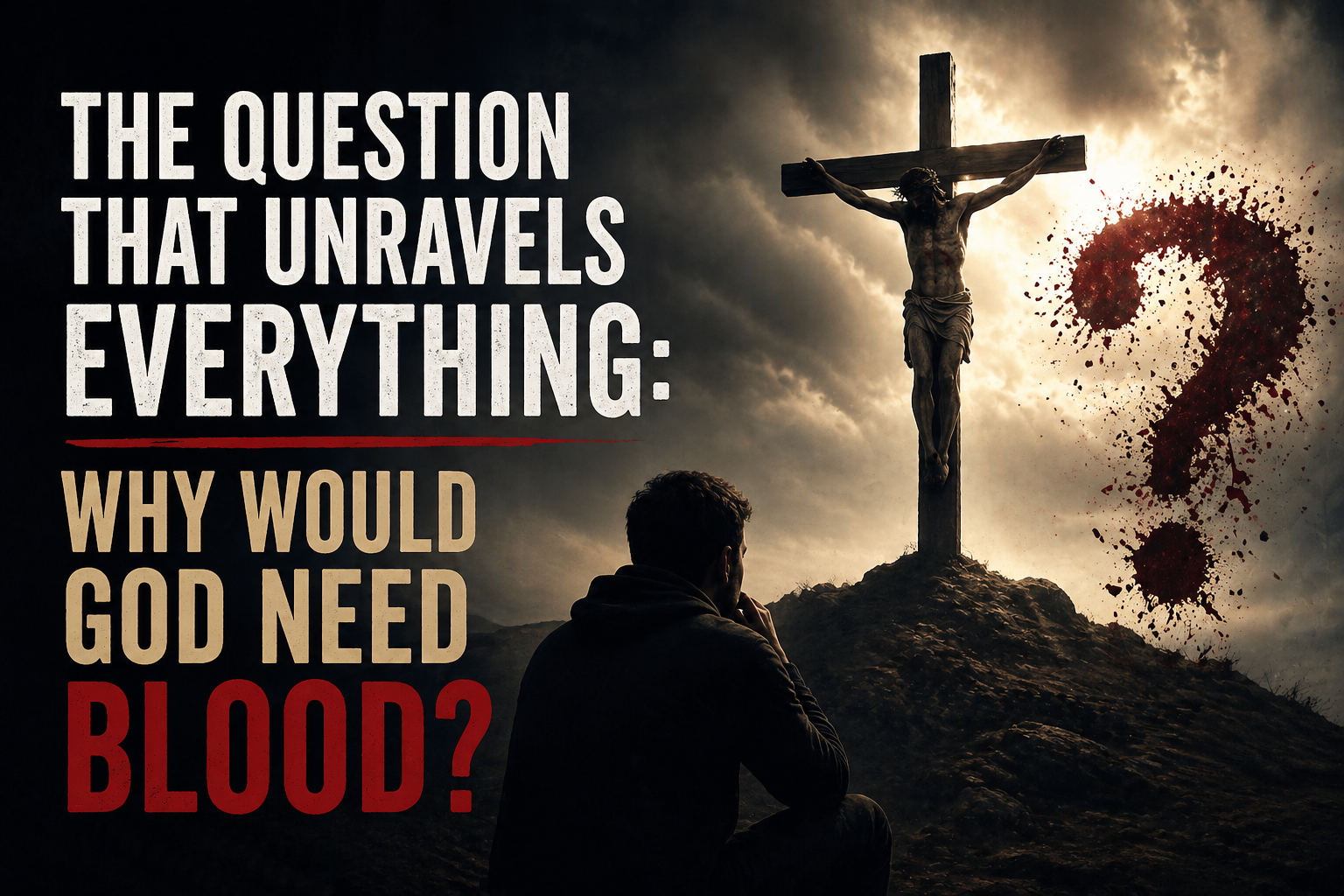
The conversation started innocently enough. My friend and I were sitting on his back porch, when the topic of faith came up again. We’d been dancing around it for months—him knowing I’d left the church, me knowing he was still deeply committed. Every previous attempt at discussing it had ended the same way: circular arguments about Biblical interpretation, historical evidence, and personal experiences that went nowhere.
This time, I tried something different.
“Can I ask you something about the crucifixion?” I said. “Not trying to debate, just curious about something I never really understood even when I was a believer.”
He relaxed a bit. “Sure.”
“How exactly does Jesus dying pay for our sins? I mean, what’s the actual mechanism there?”
He launched into the explanation I knew by heart—the one I’d given countless times myself. Old Testament sacrifices. The spotless lamb. Jesus as the perfect, ultimate sacrifice. Blood covering sins. The debt paid once and for all.
I nodded along, then asked the question that changed everything: “But why would God need blood to forgive? If God is all-powerful and loves us infinitely, what’s stopping him from just… forgiving? Why the blood requirement?”
The silence stretched longer than either of us expected.
The Question Nobody Asks
During my years in church, I memorized all the right answers about salvation. I could quote Romans road, explain substitutionary atonement, and defend the necessity of Christ’s sacrifice using a dozen different theological frameworks. But I’d never actually examined the foundational logic underneath it all.
Most Christians haven’t. We accept that Jesus died for our sins as the cornerstone of faith, but rarely interrogate the mechanism itself. We know the what—Jesus died for our sins. We know the why—because God loves us. But the how? That’s where things get interesting.
The standard Christian explanation goes like this: Humans sinned. Sin requires death as payment. God, being just, cannot simply ignore sin. So Jesus, being perfect, dies in our place. His blood covers our sins. We’re forgiven.
But this explanation assumes something massive—that an omnipotent being requires blood to extend forgiveness. Think about that for a moment. The entity that created quantum mechanics and DNA, that designed consciousness itself, needs blood to forgive?
Why This Matters
I’ve had this conversation with dozens of people since leaving Christianity. Former pastors, theology students, lifelong believers, recent converts. The pattern repeats with startling consistency.
First comes the standard explanation about sacrifice and substitution. Then, when pressed on why an all-powerful God would need this system, the responses fragment. Some pivot to mysterious ways. Others invoke justice and holiness as if these concepts somehow constrain omnipotence. Many simply haven’t thought about it before.
A theology professor once told me that God’s justice demands payment, that He cannot simply forgive without consequence. I asked him who exactly was enforcing this rule on God. Who wrote this cosmic law that even the Almighty must obey? If God is truly sovereign, truly omnipotent, then any requirement for blood is self-imposed. And if it’s self-imposed, then it’s arbitrary. And if it’s arbitrary, then the entire foundation starts to crack.
The Unexamined Foundation
What makes this question particularly powerful is its simplicity. You don’t need to know Greek or Hebrew. You don’t need a seminary degree. You don’t need to debate manuscript reliability or archaeological evidence. You’re simply asking someone to explain the basic logic of their most fundamental belief.
The question works because it targets something most Christians have never had to defend. They’ve defended the resurrection. They’ve defended Biblical reliability. They’ve defended the existence of God. But the actual mechanism by which salvation supposedly works? That’s treated as self-evident, above questioning.
I remember watching a debate between Aaron Ra and Wes Huff, a well-known apologist. When this exact question came up—why would God need blood—Huff struggled. Here was someone who debates atheists professionally, who has ready answers for virtually every challenge to Christianity, and he couldn’t provide a coherent explanation for why omnipotence requires hemoglobin.
The Conversation Continues
My friend eventually offered several attempts at an answer. Divine justice. The seriousness of sin. The need for consequences. But each explanation ran into the same wall: if God makes the rules, why make this rule? If God is love, why demand blood? If God is omnipotent, what prevents direct forgiveness?
The conversation didn’t end with him deconverting on the spot. That’s not how minds change. But I saw something I hadn’t seen in our previous discussions—genuine uncertainty. Not about peripheral issues or interpretation differences, but about the core mechanism of his faith.
We’ve talked several times since. Each conversation goes a bit deeper. He’s started asking questions he never asked before, examining assumptions he never knew he had.
A Tool for Honest Inquiry
This approach transformed how I discuss religion with believing friends and family. Instead of getting bogged down in debates about evolution or Biblical contradictions, I focus on this single, fundamental question. It cuts through years of apologetics training and theological study to expose an assumption so basic that most people have never examined it.
The question isn’t about winning debates. It’s about encouraging people to examine the logic of their own beliefs. When someone realizes they can’t explain why an omnipotent being would need blood for forgiveness—that they’ve simply accepted this as true without understanding why—it opens a door to deeper questioning.
Some people close that door immediately, retreating to faith beyond reason. Others walk through it, beginning their own journey of examination. Either way, they can no longer say they’ve never considered the question.
The most profound shifts in belief rarely come from external attacks. They come from internal recognition that something doesn’t add up. This question creates space for that recognition. It plants a seed that grows on its own timeline, watered by every subsequent sermon about sacrifice, every communion service, every Easter message about blood-bought redemption.
For those of us who’ve already walked this path, who’ve already grappled with these questions and found the answers lacking, this approach offers a way to share our journey without attacking or condemning. We’re not telling anyone what to believe. We’re simply asking them to examine what they already claim to believe.
And sometimes, that’s all it takes.