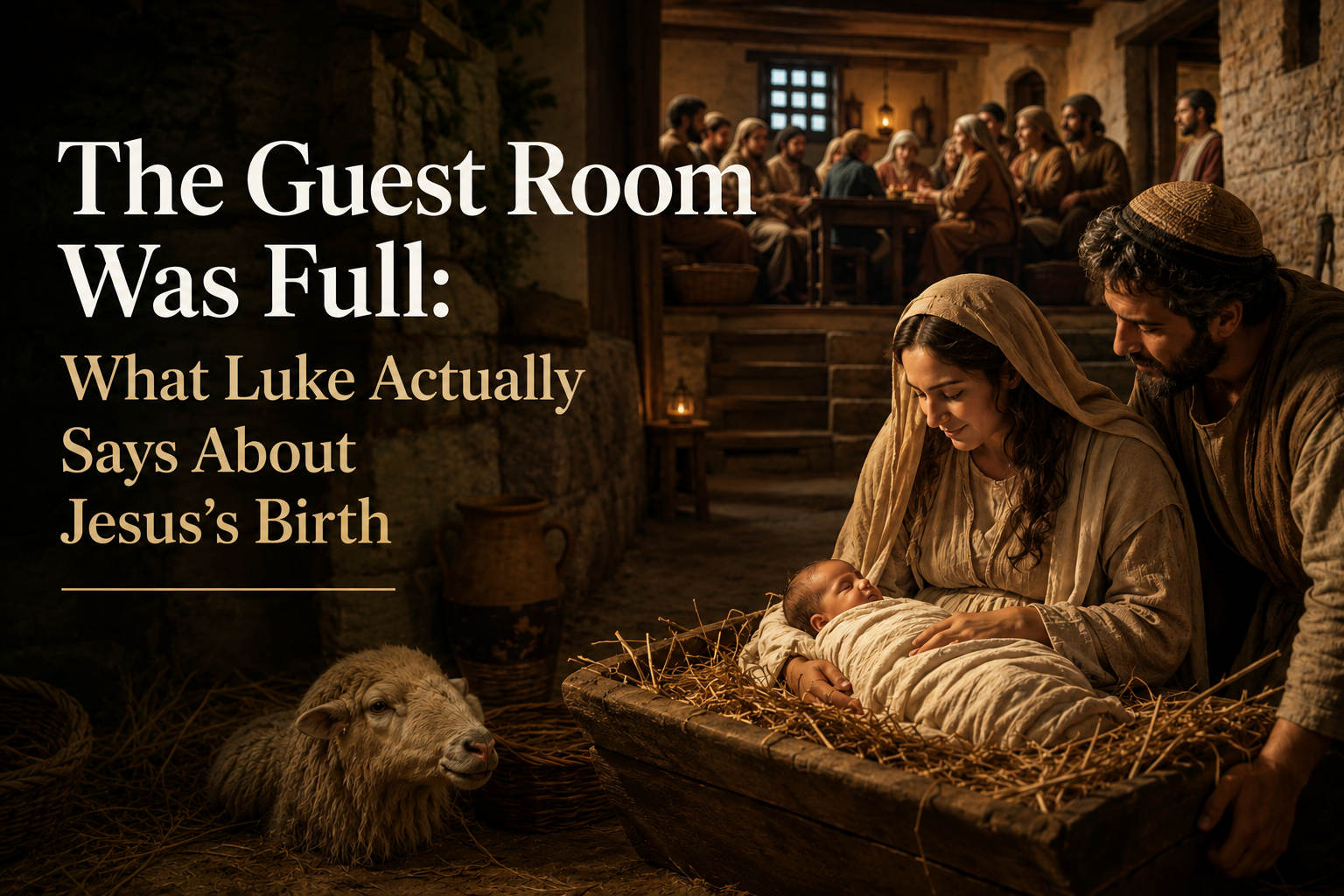
The guest room was full. That’s what Luke’s Gospel actually says about Jesus’s birth, though you wouldn’t know it from Christmas pageants and nativity scenes.
I’ve been digging into the Greek text of Luke 2:7 lately, and the traditional reading gets it wrong. The word everyone translates as “inn” is katalyma. This matters because Luke uses a completely different word—pandokheion—when he wants to talk about actual inns or public lodging houses. He knows the difference. He makes the distinction elsewhere in his writing.
Katalyma shows up in other places referring to guest rooms in private homes. In the Septuagint, the Greek translation of Hebrew scriptures, it sometimes means public accommodations, but that’s not how Luke uses it. When Luke wants to say “inn,” he says pandokheion. When he says katalyma, he means something else.
First-century Judean houses had a specific layout. I’ve studied the archaeological evidence and historical descriptions. The lower level was where daily activities happened—cooking, working, sometimes keeping animals. The upper level contained the guest room where families ate meals and slept. People also spent time on the flat roofs, especially in good weather.
These houses were built for extended families. When relatives came to town for something like a census, they stayed in the upper guest room. That’s the katalyma. If that room was already full of other family members who’d arrived earlier, late arrivals had to make do with whatever space remained.
The text says Mary placed Jesus in a manger because there was no room in the katalyma. A manger is a feeding trough. These were often built into the lower level of homes where families kept their animals at night. The animals provided warmth and were protected from theft. The manger would have been cleaned out and filled with fresh straw.
No stable appears in Luke’s account. No cave either. Those images come from later traditions and artistic interpretations, not from the text itself. The Greek doesn’t support them. The archaeology doesn’t support them. The actual words tell a different story.
What Luke describes is a young couple arriving at a family home in Bethlehem, finding the guest room already occupied by other relatives, and making do with the available space on the lower level. They weren’t rejected by an innkeeper. They weren’t turned away into the cold. They were taken in by family, given what shelter was available, and Mary gave birth surrounded by relatives, even if the accommodations were cramped.
This reading makes more sense culturally too. In that society, turning away pregnant relatives would have been unthinkable. Family obligations ran deep. Joseph had connections in Bethlehem—it was his ancestral home. They went there specifically because he had family there.
The traditional nativity scene misses this entirely. We picture isolation and rejection where the text suggests crowded hospitality. We imagine strangers turning away a desperate couple when the story actually describes relatives making room where they could.
The word choices matter. Luke could have written pandokheion if he meant a commercial inn. He could have explicitly mentioned a stable or cave if that’s where the birth happened. He didn’t. He chose katalyma, and he chose it deliberately.
Reading the text carefully changes the entire scene. Instead of a lonely birth in an abandoned stable, we get a home packed with extended family gathered for the census. Instead of rejection by strangers, we see relatives accommodating each other as best they can. The manger isn’t a sign of abandonment but of creative hospitality when space runs short.
This isn’t a minor detail. It reshapes how we understand the story. The birth of Jesus happens not in isolation but in the messy, crowded reality of family life. Not in the margins but in a home, even if not in the best room. The extraordinary event takes place in an ordinary setting—a working-class family making do with what they have.
Every Christmas, nativity plays and decorations reinforce the stable myth. Wooden structures, hay bales, sometimes even cave backdrops. None of it comes from Luke. None of it comes from Matthew either, for that matter. It’s tradition layered on tradition, assumption built on assumption, until the actual text gets buried.
The Greek text tells us what happened. Mary and Joseph arrived at a family home. The guest room was full. They settled in the lower level with the animals. Mary gave birth there, cleaned the manger, and laid her baby in it. Simple, practical, and completely different from what most people picture.
When you understand the actual living arrangements of first-century Judea, when you pay attention to Luke’s specific word choices, when you set aside centuries of artistic interpretation, a new picture emerges. Not a rejected holy family shivering in a stable, but relatives crowding together, making space where none existed, welcoming a new child into a packed household.
That’s what the text actually says. That’s what katalyma means in Luke’s Gospel. That’s what archaeology tells us about those homes. The familiar Christmas story needs revision, not because of skepticism or revisionism, but because careful reading demands it.