The first time I really questioned what I’d been taught about hell was during a late-night study session in a book called “The Bible In a Year”. I was comparing different Bible translations, trying to trace a single Greek word through the New Testament, when I noticed something odd. The same word that one translation rendered as “hell” appeared as “grave” in another and “destruction” in a third. That small discovery sent me down a research path that fundamentally changed how I understood one of Christianity’s most feared doctrines.
Growing up in a conservative church, hell was as real to me as the town I lived in. Sunday sermons painted detailed pictures of eternal flames, conscious torment that never ended, and the agonizing separation from God that awaited unbelievers. This wasn’t presented as metaphor or possibility—it was fact, as certain as any other biblical teaching. The pastor would describe the screams of the damned, the unquenchable thirst, the darkness pierced only by flames that burned but never consumed. These images haunted my childhood nights.
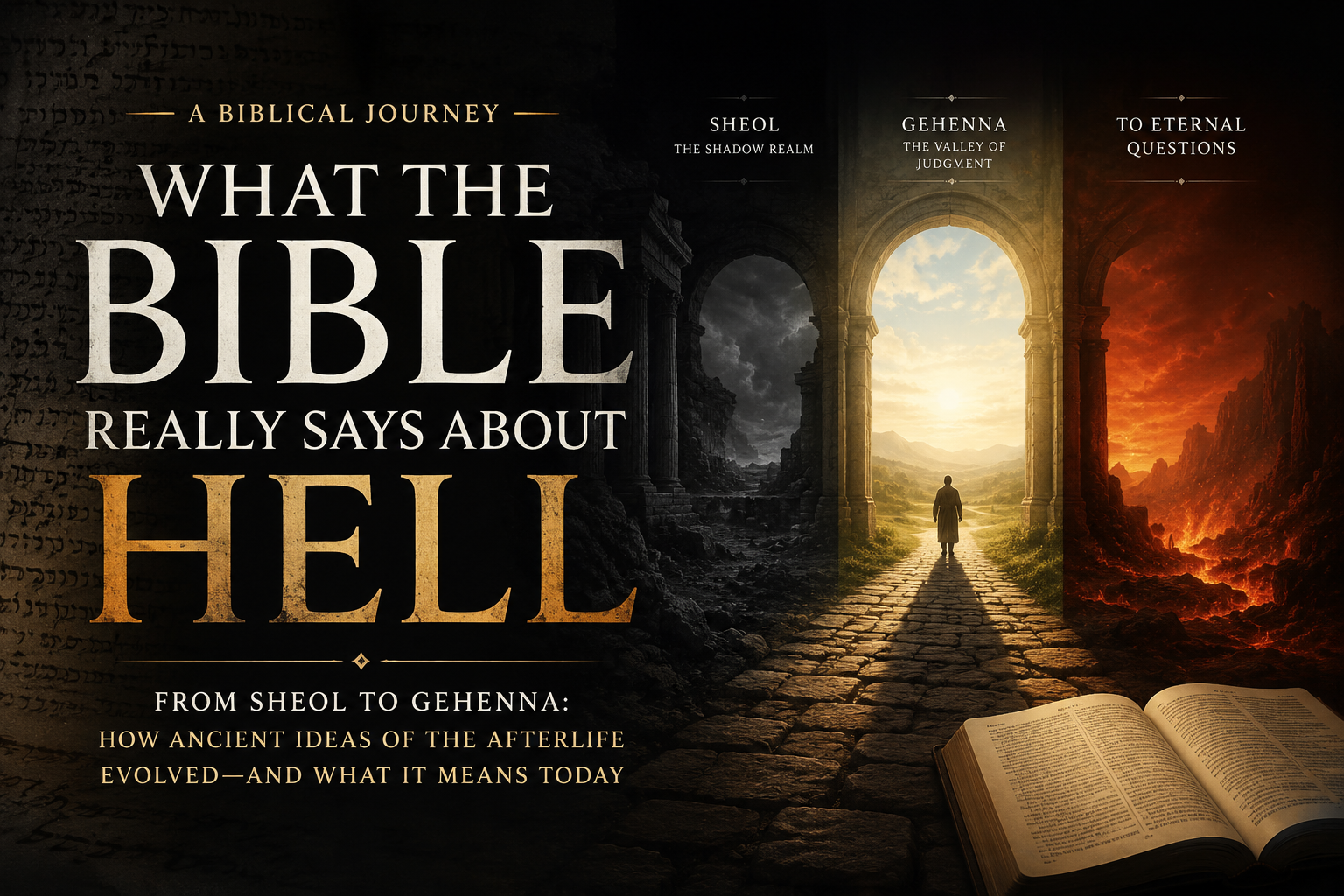
What I discovered in that study was that the hell I’d grown up fearing barely exists in the Bible itself. The Hebrew Bible—what Christians call the Old Testament—contains almost no concept of punishment after death. Instead, ancient Israelites believed in Sheol, a shadowy underworld where everyone went after dying. Kings and criminals, prophets and pagans, all ended up in the same gray, joyless realm. No fire, no torment, just a dim existence that applied equally to everyone.
This universal afterlife appears consistently throughout Hebrew scripture. When Jacob mourns his supposedly dead son Joseph, he expects to meet him in Sheol. When King David’s infant son dies, David consoles himself that while the child cannot return to him, he will one day go to the child—in Sheol. The witch of Endor summons the prophet Samuel from Sheol, not from heaven or hell. These weren’t different destinations based on moral behavior; death simply meant Sheol for everyone.
The shift began during what scholars call the Hellenistic period, roughly the last few centuries before Christ. Jewish communities lived under Greek and then Roman rule, watching corrupt leaders prosper while faithful Jews suffered persecution. This created a theological crisis: if God was just, why did the wicked thrive and the righteous suffer? The answer that emerged was revolutionary—divine justice would come after death. If you couldn’t see God’s justice in this life, it must occur in the next one.
The first hints appear in the very latest portions of the Hebrew Bible. The final verse of Isaiah speaks of corpses being consumed by undying worms and unquenchable fire. Daniel 12 mentions some awakening to everlasting life and others to shame and everlasting contempt. But these passages, likely written centuries after most Hebrew scripture, are brief and ambiguous. They’re hardly the detailed doctrine of hell that would later develop.
The real elaboration came through books like First Enoch, texts that weren’t included in the biblical canon but were widely read in ancient Jewish communities. These writings began sorting the dead into categories, describing different fates for different groups, and detailing specific punishments for specific sins. By the time of Jesus, multiple competing ideas about the afterlife circulated through Jewish thought.
The New Testament reflects this diversity rather than resolving it. The gospel writers use three different Greek words that English Bibles often translate as “hell,” but each carried different connotations. Hades was the Greek underworld, borrowed directly from pagan mythology. Tartarus, used only once in the entire New Testament, was the Greek prison for defeated titans. Gehenna came from the Valley of Hinnom outside Jerusalem, a place with a dark history of child sacrifice that had become a metaphor for judgment.
Jesus speaks of Gehenna more than anyone else in the New Testament, but his teachings don’t form a clear systematic doctrine. He warns about being thrown into Gehenna, about the fire of Gehenna, about how it would be better to lose a hand or eye than to enter Gehenna whole. But what exactly did he mean? The destruction of the body? The annihilation of the soul? Eternal conscious torment? Temporary punishment followed by restoration? Scholars still debate these questions because the texts themselves don’t provide definitive answers.
What struck me most in my research was how Paul, who wrote the earliest New Testament documents, barely mentions hell at all. He writes about death, destruction, and perishing as the fate of the unrighteous—language that suggests annihilation rather than eternal torment. When he does discuss judgment, he focuses on destruction, not endless punishment. This silence from Christianity’s most prolific early theologian seems significant.
The Book of Revelation provides the most vivid hell imagery in the New Testament with its lake of fire and smoke of torment rising forever. But Revelation is apocalyptic literature, filled with symbols and visions that resist literal interpretation. The same book describes a seven-headed dragon and locusts with human faces. How literally should we take any of it?
The systematization of hell as eternal conscious torment happened gradually over centuries after the New Testament was written. Church councils debated and voted, theologians argued and wrote treatises, and eventually, eternal conscious torment became the official position. But the debates never fully ended. Throughout Christian history, minority voices have argued for annihilationism or universal salvation, always pointing back to the same ambiguous biblical texts.
The medieval period transformed hell into the elaborate realm we recognize from popular culture. Artists and writers populated it with specific demons, organized it into circles or levels, and invented precise torments for particular sins. These details came from imagination, not scripture. Dante’s nine circles of hell have influenced Christian thinking for centuries, but they’re poetry, not theology. The pitchfork-wielding devil supervising torture chambers owes more to medieval art than biblical texts.
Understanding this history changed how I approach these texts. Instead of forcing diverse passages into a predetermined framework, I can appreciate their development and diversity. The Hebrew Bible’s Sheol reflects one understanding of death. The apocalyptic literature of the Hellenistic period responds to oppression with visions of divine justice. The New Testament authors grapple with these inherited ideas while processing the meaning of Jesus’s death and resurrection. Each stage represents human beings wrestling with ultimate questions about justice, suffering, and death.
This historical perspective also helped me understand why hell causes so much anguish for so many people. I’ve sat with parents terrified their unbaptized baby is in hell, with teenagers paralyzed by fear of eternal torment, with elderly people haunted by decades-old teachings about the fate of non-Christian loved ones. These fears rest on one particular interpretation of ambiguous texts, an interpretation that solidified through historical processes rather than clear biblical mandate.
The texts themselves tell a more complex story. Ancient Israelites imagined everyone sharing the same shadowy afterlife. Later Jewish thinkers, grappling with injustice, developed ideas about post-mortem judgment. Early Christians, processing these inherited concepts through their experience of Jesus, produced diverse and sometimes contradictory visions of final judgment. The church then spent centuries trying to harmonize these varied perspectives into systematic doctrine.
When people ask me now what the Bible says about hell, I can’t give the simple answer they usually want. The Bible doesn’t speak with one voice on this topic. It contains multiple perspectives that developed over time, influenced by historical circumstances, cultural exchange, and theological reflection. The modern Christian doctrine of hell represents one way of reading these diverse texts, but it’s not the only way, and it’s certainly not the clear, consistent biblical teaching I once believed it to be.
This doesn’t mean the question of ultimate justice becomes irrelevant. The human hunger for justice that drove the development of these ideas remains powerful and important. But recognizing the historical development of hell doctrine can free us from the paralyzying fear that one specific vision of eternal torment is the only possible reading of scripture. The texts are more interesting, more human, and more diverse than that.