The first time I really grasped how the Bible came together was during a study on ancient texts. I spent weeks examining manuscripts, comparing fragments, and tracing the evolution of biblical literature. What struck me most was how different the actual timeline looked from what I’d always assumed.
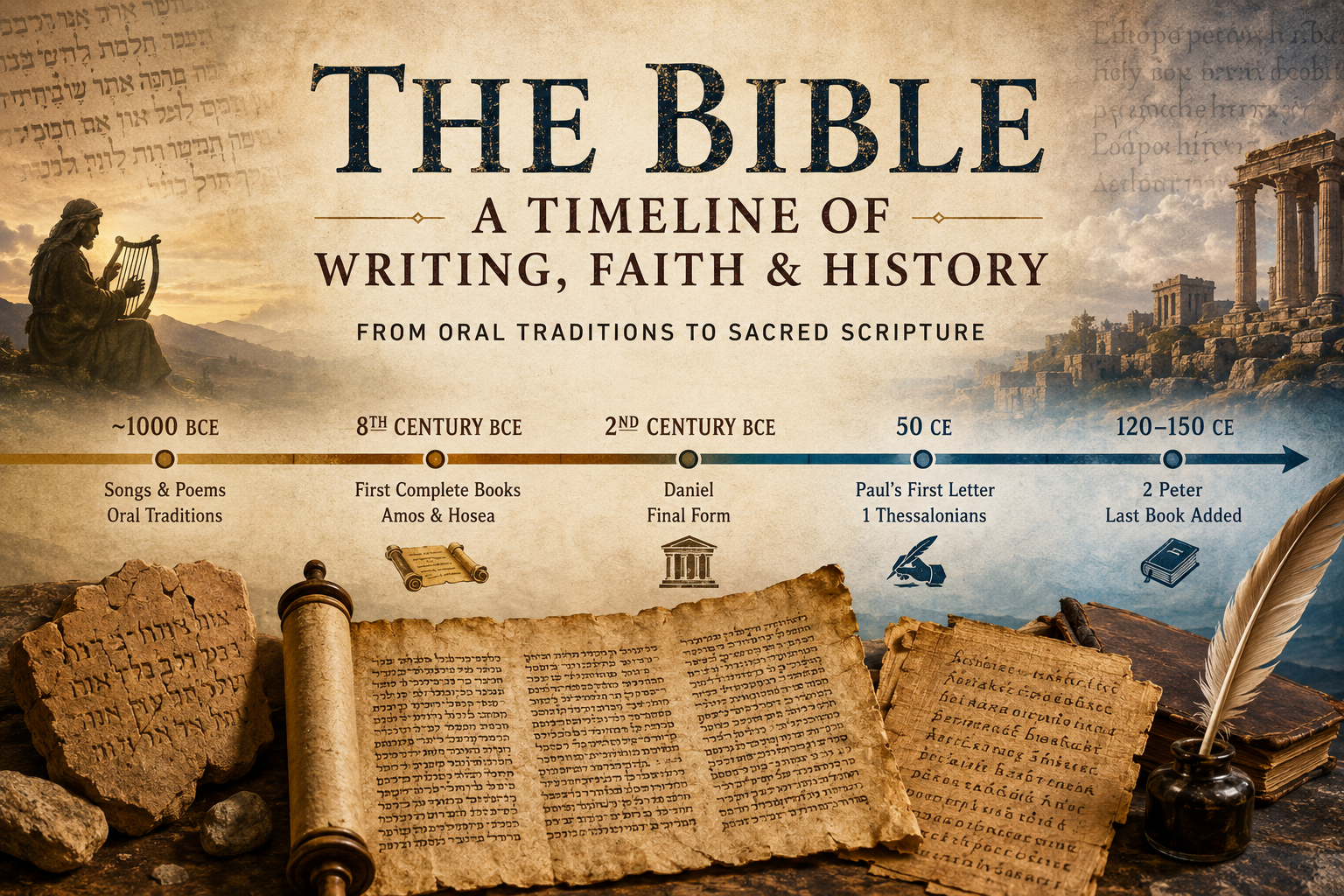
The Hebrew Bible didn’t emerge as a single, unified work. Its earliest pieces were songs and poems, passed down through generations of oral tradition before anyone wrote them down. These fragments—the Song of Deborah, portions of various Psalms, the Song of Moses—contain some of the oldest forms of biblical Hebrew we have. Linguists date them to around 1000 BCE based on their archaic language patterns and poetic structures.
But fragments aren’t books. When we talk about the first complete books of the Hebrew Bible, we’re looking at Amos and Hosea. These prophetic works took shape in the mid to late 8th century BCE, during a period of political upheaval in ancient Israel and Judah. The prophets spoke to their contemporary situations—Assyrian expansion, social injustice, religious corruption—and their words were written down relatively close to when they actually preached.
The process of creating these texts was nothing like modern publishing. Scribes would copy, edit, and sometimes expand earlier versions. A book would go through multiple redactions over decades or even centuries. Amos and Hosea reached something close to their current form within the same century they originated, but later hands still made adjustments.
At the other end of the Hebrew Bible’s timeline sits the book of Daniel. This text presents itself as the work of a 6th-century BCE exile in Babylon, but linguistic analysis and historical references reveal a different story. Significant portions were written in the 160s BCE, during the Maccabean revolt against Greek rule. The book uses coded language to describe contemporary events as if they were ancient prophecies. Its final form crystallized somewhere around the middle to end of the 2nd century BCE.
The New Testament has a tighter chronological span. Paul’s first letter to the Thessalonians, written around 50 CE, stands as the earliest surviving Christian text. Paul dictated this letter roughly twenty years after Jesus’s crucifixion, addressing specific concerns of a young church community in Macedonia. Reading it, you encounter Christianity in its rawest form—no developed theology of the Trinity, no elaborate Christology, just Paul’s urgent instructions to a community expecting Jesus’s imminent return.
The gospels came later. Mark probably wrote in the late 60s or early 70s CE, followed by Matthew and Luke in the 80s or 90s, with John closing out the first century. But the New Testament didn’t stop there.
The last book to enter the New Testament was 2 Peter, composed between 120 and 150 CE. This letter belongs to a category scholars call pseudepigrapha—writings falsely attributed to famous figures. The author wrote in Peter’s name to lend authority to his message, a common practice in the ancient world. The letter addresses second-century concerns: the delay of Christ’s return, the rise of alternative Christian teachings, and the need to establish orthodox doctrine.
This timeline reveals something profound about biblical literature. These texts emerged from specific historical moments, addressing real communities with urgent concerns. The Hebrew Bible spans nearly a millennium of composition, from oral traditions around 1000 BCE to Daniel’s final form in the 2nd century BCE. The New Testament’s creation was more compressed, stretching from Paul’s first letter in 50 CE to 2 Peter roughly a century later.
Understanding this chronology changed how I read these texts. When I open Amos, I’m reading the words of someone witnessing the Assyrian empire’s terrifying advance. When I read 2 Peter, I’m encountering a Christian community three generations removed from Jesus, struggling to maintain faith when the expected end hadn’t come. These aren’t timeless documents dropped from heaven; they’re human responses to divine encounters, shaped by the pressing realities of their day.
The Bible’s formation was messy, complicated, and thoroughly human. Texts were copied, edited, combined, and refined over centuries. Oral traditions became written documents. Anonymous works received famous names. Local texts became universal scripture. This process doesn’t diminish the Bible’s significance—it enriches it. We’re reading the accumulated wisdom, struggles, and revelations of countless individuals across more than a millennium, all wrestling with what it means to encounter the divine in human history.