I spent years reading biblical texts assuming certain connections were obvious. The devil in the garden. Lucifer’s fall from heaven. Satan as the ancient serpent. These seemed like fundamental religious knowledge that everyone shared. Then I started digging into the actual texts and their historical development, and discovered something surprising: these connections aren’t in the Bible the way I thought they were.
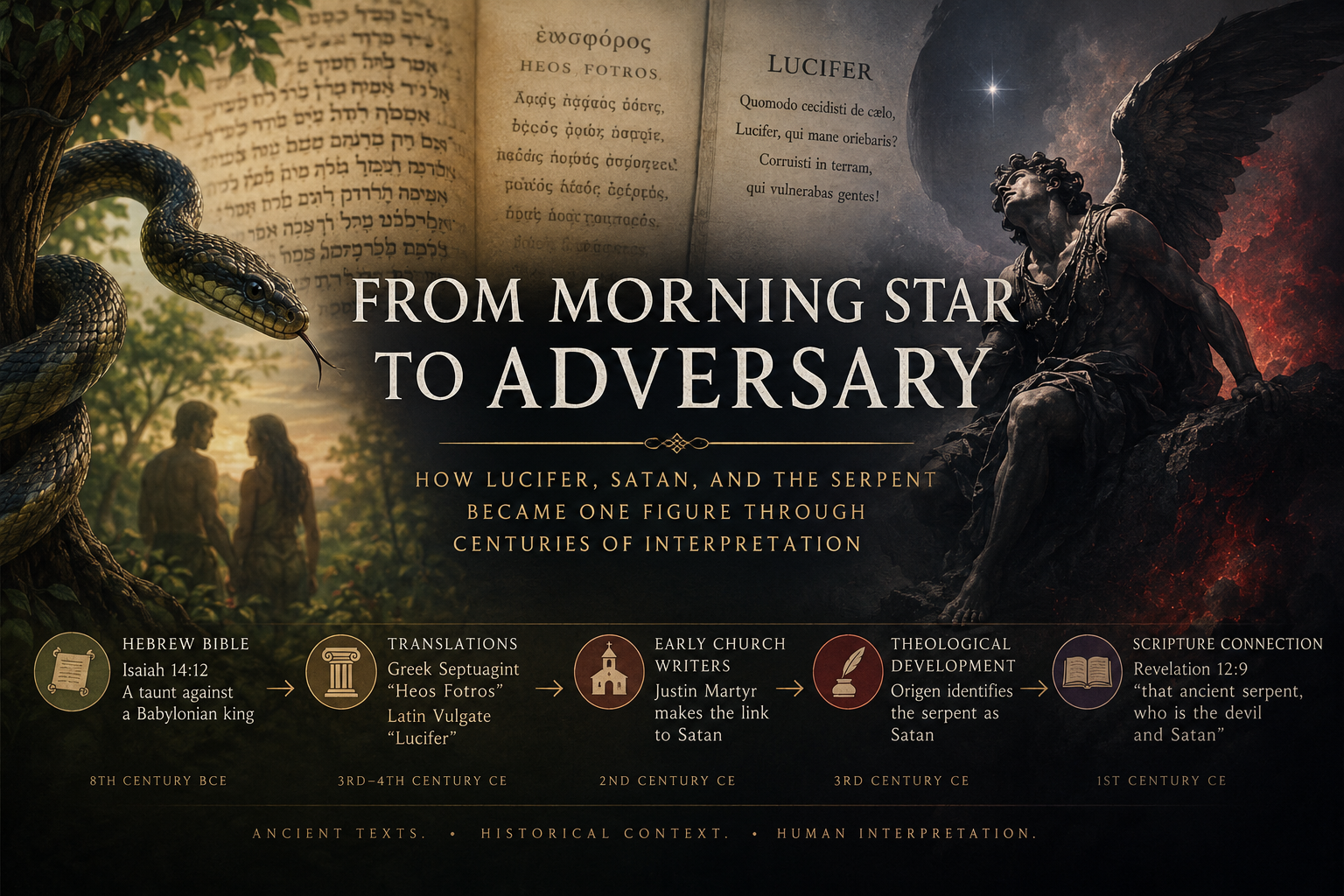
The name “Lucifer” appears exactly once in the Bible, in Isaiah 14:12. When I first read the Hebrew text, I found “Helel ben Shachar” - literally “shining one, son of the dawn.” The passage mocks a Babylonian king, comparing his arrogance to the morning star that briefly shines before disappearing at sunrise. The Hebrew prophet was making a pointed political critique, not describing a fallen angel.
The transformation began with translation. When Jewish scholars translated the Hebrew Bible into Greek (the Septuagint), they rendered this phrase as “Heos Fotros,” connecting it to Venus, the morning star. Later, when Jerome created the Latin Vulgate, he used “Lucifer” - the Roman name for the morning star deity. In Roman culture, Lucifer was simply the personification of Venus when it appeared before dawn.
What struck me most was discovering that nowhere in the Hebrew Bible or New Testament does any author connect this Isaiah passage to Satan. The text stands alone as a taunt against an earthly king. The association between Lucifer and Satan first appears in the writings of Justin Martyr in the second century CE - decades after the last biblical books were written.
The serpent in Eden presents a similar case. Genesis describes a clever serpent who tempts Eve, but never calls this creature Satan or the devil. The text treats the serpent as exactly what it appears to be: a talking snake. For ancient readers familiar with talking animals in other Near Eastern stories, this wouldn’t have seemed as strange as it does to us.
Some point to Wisdom of Solomon 2:24, which mentions that “death entered the world because of the envy of the devil.” Written sometime between 100 BCE and 100 CE, this text might hint at the Eden story, but it never explicitly names the serpent. The first clear statement that the Eden serpent was Satan comes from Origen of Alexandria in the third century CE - nearly a thousand years after Genesis was written.
The Book of Revelation, written around 95 CE, does make one connection. It describes “that ancient serpent, who is the devil and Satan.” This represents the earliest biblical text linking a serpent figure with Satan, but even here, the connection to Eden’s serpent requires interpretation. Revelation’s serpent draws more from Leviathan, the chaos monster of ancient Near Eastern mythology, than from Genesis.
Reading these texts in their original contexts changed how I understand religious history. Early Christian writers weren’t discovering hidden truths in scripture; they were creating new interpretations to address questions their communities faced. They needed to explain evil’s origin, reconcile diverse traditions, and compete with other religious systems that had elaborate cosmologies.
Justin Martyr wrote to Greek-speaking audiences familiar with stories of gods casting down titans. Origen engaged with Platonic philosophy that demanded systematic explanations for spiritual realities. These thinkers built theological frameworks that made sense in their time, using biblical texts as building blocks for larger structures.
The consolidation process fascinates me. Early Christians inherited diverse traditions: Hebrew creation stories, prophetic oracles against foreign kings, wisdom literature, and apocalyptic visions. They wove these threads into a coherent narrative. A sarcastic nickname for a Babylonian king became the name of heaven’s first rebel. A clever snake became the cosmic adversary. Scattered references merged into a single character with a complete biography.
This doesn’t diminish the power of these interpretations. They’ve shaped Western literature, art, and thought for nearly two millennia. Milton’s Paradise Lost, Dante’s Inferno, and countless other works depend on these post-biblical connections. The composite figure of Lucifer/Satan/the serpent has become more culturally significant than any of its component parts.
Understanding this development has taught me to read ancient texts more carefully. When Isaiah wrote about the morning star falling from heaven, he was crafting political satire, not systematic theology. When Genesis described a serpent, the authors were explaining why snakes crawl on their bellies, not documenting Satan’s biography. When Revelation described an ancient serpent, it was drawing on mythological imagery its readers would recognize, not providing a definitive identification guide.
The evolution from separate figures to unified character reveals how religious traditions develop. Communities take inherited texts and reinterpret them to address new questions. What seems like discovery is often creative construction. What appears ancient might be relatively recent. What we assume the Bible says might come from centuries of interpretation rather than the texts themselves.
This process continues today. Modern readers bring their own questions and frameworks to these ancient texts, finding meanings the original authors never imagined. We’re part of the same interpretive tradition that began with Justin Martyr and Origen, constantly reimagining these figures for our own time.
The next time someone mentions Lucifer’s fall or Satan in the garden, I remember that these connections emerged through centuries of theological creativity. The Bible contains the raw materials - a boastful king compared to the morning star, a clever serpent, various adversarial figures - but the familiar story we know today was assembled by generations of interpreters trying to make sense of evil, suffering, and human nature.