I’ve been wrestling with Romans 3 lately, and something struck me that I hadn’t noticed in twenty years of reading Scripture. You know that famous passage where Paul says “There is no one righteous, not even one”? The one that gets quoted in every evangelism tract and altar call? I decided to track down where Paul was quoting from, and what I found has kept me up at night.
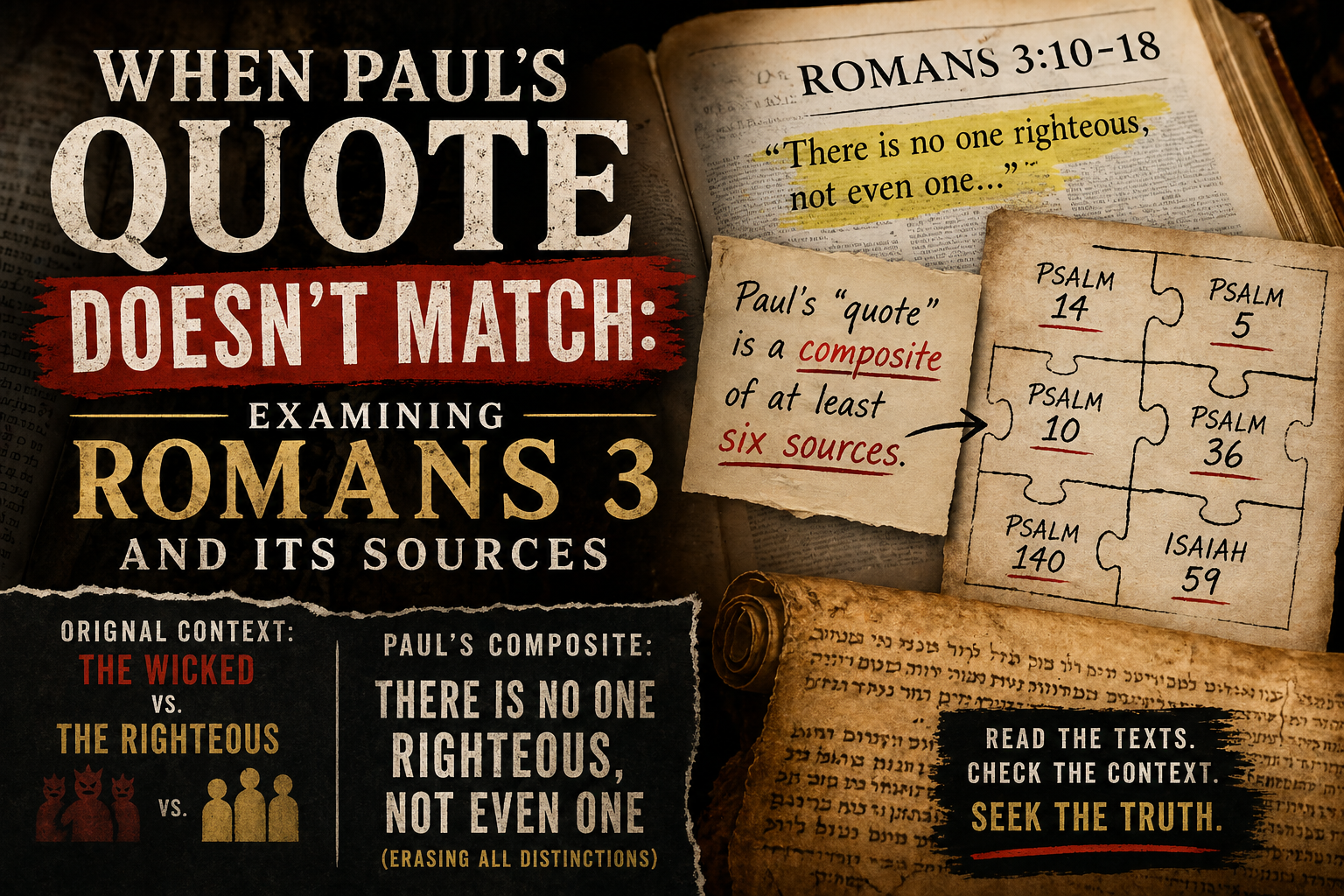
Paul presents this as if he’s quoting a single passage from the Old Testament. But when you actually look it up, Romans 3:10-18 is assembled from at least six different sources—Psalms 14, 5, 10, 36, 140, and Isaiah 59. He’s taken fragments from each and sewn them together into one seamless block quote.
Here’s what bothers me: when you read these passages in their original context, they’re not talking about all humanity. They’re specifically describing “the wicked” in contrast to “the righteous.”
Take Psalm 14, which Paul quotes most extensively. Yes, it starts with “The fool says in his heart, ‘There is no God.’ They are corrupt, their deeds are vile.” But keep reading. Just a few verses later, the same psalm mentions “the righteous generation” and says God is present with them. The psalmist draws a clear line between two groups: those who devour God’s people and those who are God’s people. The wicked and the righteous.
I went through each source text Paul uses. Same pattern everywhere. Psalm 5 contrasts the boastful and bloodthirsty with those who take refuge in God. Psalm 36 describes the wicked who plot on their beds versus those who feast on God’s abundance. Isaiah 59 specifically addresses Israel’s sins while calling for repentance and promising redemption. None of these texts claim universal human depravity. They’re all making distinctions.
This sent me back to the Gospels with fresh eyes. In Luke 1, Zechariah and Elizabeth are described as “righteous before God, walking blamelessly in all the commandments and ordinances of the Lord.” Not relatively righteous. Not righteous by human standards. Righteous before God.
Then there’s Matthew 25, where Jesus himself separates humanity into two groups—the righteous and the wicked—based on their actions. Feed the hungry, clothe the naked, visit the imprisoned, and you’re among the righteous who inherit eternal life. No mention of faith formulas or substitutionary atonement. Just deeds determining destiny.
I sat with this tension for weeks. How do we reconcile Paul’s composite quotation with what these texts actually say? With what Jesus taught?
Some argue Paul was using standard Jewish interpretive methods of his time—stringing together related texts to make a theological point. Fair enough. Second Temple Judaism did employ creative hermeneutics. But there’s a difference between creative interpretation and fundamentally reversing what texts say. The original passages distinguish between groups; Paul’s composite erases all distinctions.
The implications cascade from here. If humans aren’t universally depraved, if some people are actually righteous by their deeds, then the entire framework of salvation changes. The absolute necessity of blood sacrifice for every single person becomes questionable. The idea that good works are “filthy rags” contradicts Jesus directly.
I started examining how first-century audiences would have received this. Most Gentile converts couldn’t read Hebrew. They didn’t have personal copies of the Scriptures to cross-reference. When Paul presented this as God’s word about humanity’s condition, they had no way to verify the original contexts. They trusted the apostle’s representation.
But we can verify. We have the texts. We can read Psalm 14 in full. We can see that “God is with the righteous generation” appears just four verses after “there is none who does good.” We can observe that every source Paul cites maintains the wicked/righteous distinction he collapses.
This isn’t about attacking Paul or dismissing Romans. It’s about reading honestly. It’s about noticing when composite citations reshape meaning. It’s about asking whether our core doctrines rest on solid ground or selective quotation.
The early church fathers knew these tensions existed. Origin and Chrysostom wrestled with them. Jerome’s commentaries reveal his struggles to harmonize these passages. They weren’t blind to the difficulties; they just had different ways of resolving them.
I keep returning to Jesus’ words in Matthew 25. The Son of Man separates people “as a shepherd separates sheep from goats.” The righteous ask, “Lord, when did we see you hungry and feed you?” They don’t know they’ve been serving Christ. They just acted righteously, and that righteousness counted. No confession of faith mentioned. No blood covering required. Just righteous deeds leading to eternal life.
Compare that with how we typically read Romans 3. We’ve been taught that Paul’s composite quotation proves no one can be righteous through their actions. But Jesus explicitly rewards people for righteous actions. The disconnect is jarring once you see it.
I’m not suggesting we throw out two thousand years of theology. I’m saying we need to look more carefully at foundational texts. When someone claims to quote Scripture, we should check what they’re quoting and how. When theological systems rest on particular readings, we should examine whether those readings hold up under scrutiny.
The charge here is serious: that Paul created a universal statement about human depravity by combining texts that were never universal, removing their contexts, and presenting them as a single divine pronouncement. Whether you see this as legitimate interpretive technique or problematic proof-texting depends partly on your prior commitments. But the textual facts remain: the original passages distinguish between wicked and righteous people, while Paul’s composite quotation erases that distinction.
Where does this leave us? At minimum, it means we should read Romans 3 more carefully, recognizing it as Paul’s theological argument rather than straightforward Scripture quotation. It means we should take Jesus’ teachings about righteousness and judgment seriously, even when they seem to conflict with Paul’s framing. It means we should be honest about tensions in our sacred texts rather than harmonizing them away.
I’ve spent months checking and rechecking these passages, reading them in Hebrew and Greek, consulting commentaries ancient and modern. The pattern holds. The questions remain. And I find myself wondering how many other foundational claims rest on similarly questionable foundations—composite quotations that reshape meaning, decontextualized verses that reverse their original intent.
This kind of examination feels dangerous. It threatens comfortable certainties. It challenges systems we’ve built our lives around. But if our faith can’t withstand honest textual scrutiny, what kind of faith is it? And if our doctrines depend on misrepresented quotations, shouldn’t we know that?
The work continues. Each text demands careful attention. Each claim requires verification. The stakes are too high for anything less than rigorous honesty about what these passages actually say versus what we’ve been told they mean.