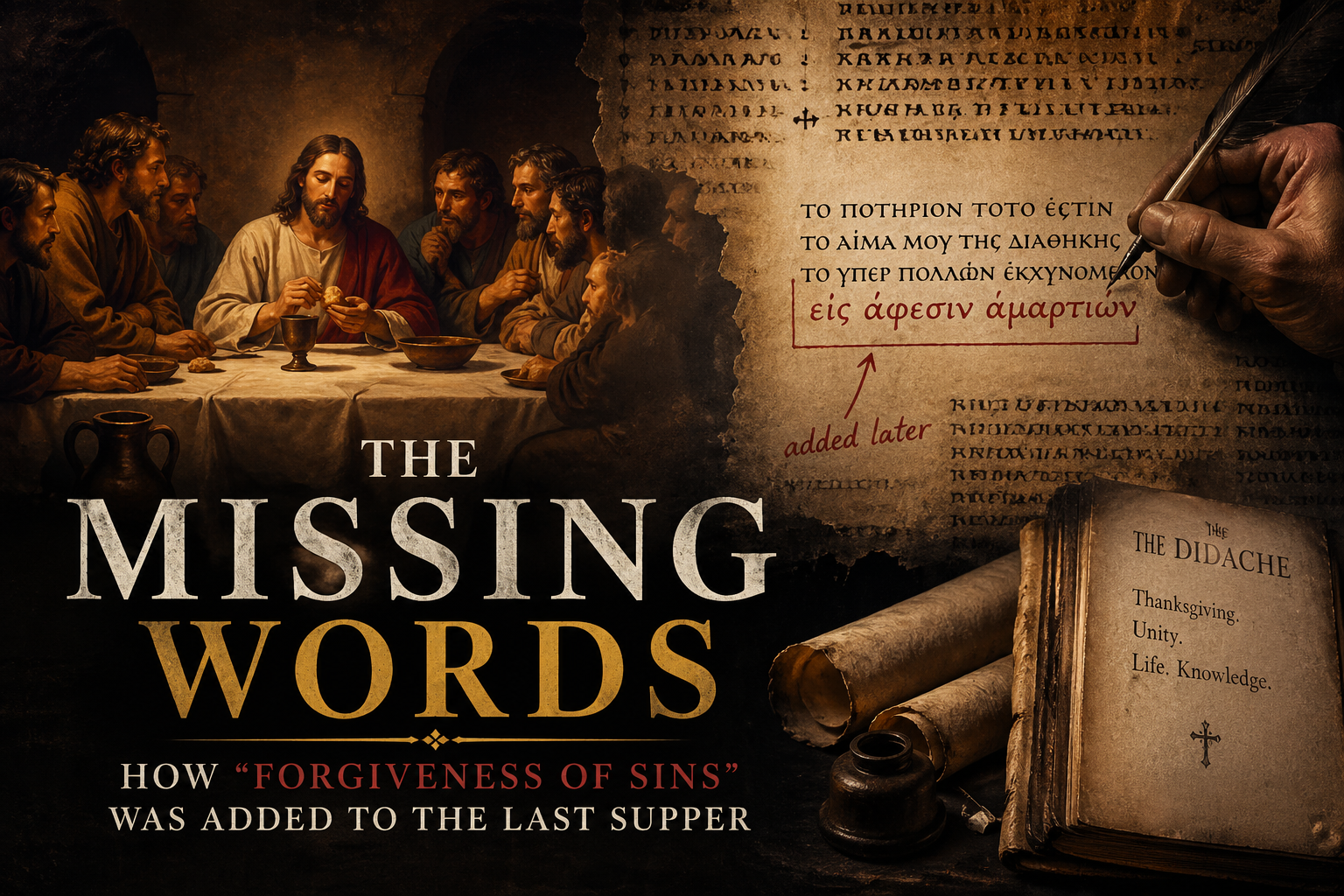
I’ve spent years examining the Last Supper accounts, and what I discovered changed how I understand this central Christian ritual. The phrase ‘for the forgiveness of sins’ that appears in Matthew’s Gospel wasn’t part of the original story. Matthew added it himself, decades after the event supposedly occurred.
Let me walk you through the evidence chronologically.
Starting with Paul’s Vision
The earliest written account of the Last Supper comes from Paul’s first letter to the Corinthians, written around 54 CE. Paul makes an extraordinary claim here. He says he received this ritual directly from Jesus through personal revelation. Not from Peter. Not from James. Not from any human who was actually present at the meal.
In Galatians, Paul doubles down on this claim. He insists his entire gospel came through divine revelation, not human teaching. Think about what this means: the ritual of eating Jesus’s body and drinking his blood originates from Paul’s private visions, not from eyewitness testimony.
Mark’s Account: The First Gospel Version
Mark wrote his Gospel at least twenty years after Paul’s letter. His Last Supper scene echoes Paul’s language but with one glaring omission. Mark quotes Jesus saying “this is my blood of the covenant poured out for many.” Full stop. No mention of forgiveness. No reference to sins being washed away through blood.
This absence matters. Mark was the earliest Gospel writer. If Jesus had actually spoken about forgiveness of sins at the Last Supper, why would Mark leave out such crucial words?
Matthew’s Strategic Addition
About ten years after Mark, Matthew wrote his Gospel using Mark as his primary source. He copied Mark’s Last Supper scene almost word for word, but then inserted five additional words that changed everything: “for the forgiveness of sins.”
This wasn’t a minor edit. Matthew took Mark’s text and added theological interpretation directly into Jesus’s mouth. He wanted readers to understand the meal through Paul’s lens of blood atonement. The anonymous author of Matthew (the Gospel originally had no name attached) made Jesus explicitly endorse a doctrine that Paul had been preaching for decades.
The Didache: A Different Tradition
The most striking evidence comes from a text that didn’t make it into the Bible: the Didache. This early Christian manual came from communities that followed Jesus’s original apostles rather than Paul’s teachings.
Their blessing prayers over bread and wine read completely differently. They thank God for the “Holy Vine” and for “life and knowledge” revealed through Jesus. No body. No blood. No sacrifice. No forgiveness through bloodshed. These Christians practiced a communal meal that had nothing to do with atonement theology.
The Didache shows us what the ritual looked like before Paul’s influence took hold. These communities, tracing their practices back to the original apostles, understood the shared meal as thanksgiving and unity, not as mystical consumption of flesh and blood.
The Pattern Becomes Clear
When you line up these texts chronologically, the evolution becomes undeniable:
- Paul claims private revelation about a body-and-blood ritual (54 CE)
- Mark writes the first Gospel account, mentioning blood but not forgiveness (70 CE)
- Matthew copies Mark but adds “for the forgiveness of sins” (80 CE)
- Meanwhile, the Didache preserves a completely different tradition with no sacrificial elements
Each step moves further from historical memory and deeper into theological interpretation. By the time Matthew writes, he’s not recording history. He’s crafting theology.
What This Means
The implications run deep. If “for the forgiveness of sins” was Matthew’s addition rather than Jesus’s words, then one of Christianity’s most fundamental claims rests on an editorial decision made by an anonymous author decades after the fact.
This doesn’t mean the Last Supper never happened. But it does mean we need to separate what Jesus actually did and said from what later writers wanted him to have said. The meal Jesus shared with his disciples was likely much simpler than what Christian tradition made it become.
I realize this challenges deeply held beliefs. But the textual evidence speaks for itself. The phrase millions of Christians hear every Sunday during communion wasn’t spoken by Jesus. It was penned by an anonymous Gospel writer who wanted to align Jesus’s final meal with Paul’s theology of blood sacrifice.
The original apostles, as reflected in texts like the Didache, remembered something different. They remembered thanksgiving, unity, and hope for God’s kingdom. They didn’t remember drinking blood for the forgiveness of sins because Jesus never said those words.
Understanding this textual evolution doesn’t destroy faith. It refines it. It helps us distinguish between the historical Jesus and the theological interpretations that accumulated around him. And perhaps most importantly, it reminds us that even our most sacred texts have human fingerprints all over them.