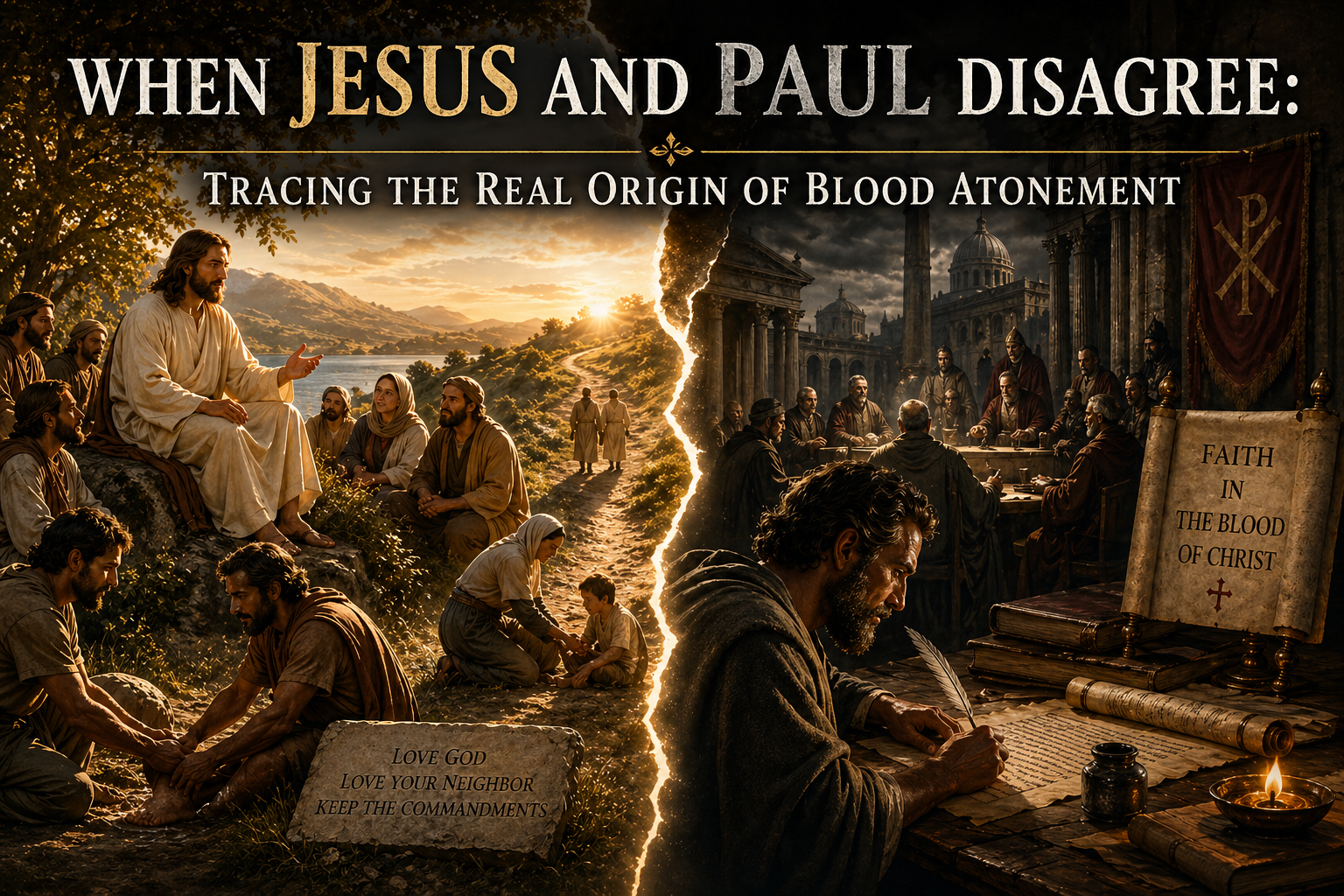
I’ve been wrestling with a fundamental question about Christianity that most people never stop to examine: where exactly does the doctrine of blood atonement come from? You know, the belief that Jesus had to die as a sacrifice for our sins so we could gain eternal life. After digging into the texts themselves, what I discovered completely changed my understanding of Christian doctrine.
The standard Christian teaching says we need to believe Jesus died for our sins to receive salvation. But here’s what struck me: when I actually read what Jesus himself taught about gaining eternal life, he never mentioned this requirement. Not once.
Take the story of the rich young ruler. This man comes to Jesus with the most direct question possible: “What must I do to have eternal life?” Jesus’s answer? “Keep the commandments.” He lists several of the Ten Commandments and adds “love your neighbor as yourself.” That’s it. No mention of believing in a future sacrificial death.
Or consider Luke 10:25-28, where a lawyer asks the same question. Jesus affirms that eternal life comes through loving God with all your heart, soul, mind, and strength, and loving your neighbor as yourself. His exact words: “Do this, and you will live.” Again, nothing about blood sacrifice or atonement.
This pattern holds true throughout the Gospels. Even after the resurrection, when Jesus had every opportunity to explain this supposedly essential doctrine to his disciples, the record shows no such teaching. If believing in his sacrificial death was the key to salvation, wouldn’t Jesus have made that crystal clear?
So where does this doctrine come from? The answer points directly to Paul.
Paul explicitly states in his letters that his teachings came from personal revelations, not from the original apostles who actually walked with Jesus. In 1 Corinthians 11:23-26, when Paul describes the Last Supper, he begins with “For I received from the Lord” – not “the apostles told me” or “eyewitnesses reported.” He’s claiming direct revelation for an event he didn’t witness.
This becomes particularly significant when you consider the timeline. Paul’s letters were written and circulating roughly 20-25 years before the Gospel of Matthew was composed. Matthew itself was written anonymously about 50 years after the crucifixion. By then, Paul’s theological interpretations had already spread throughout the early Christian communities.
The only place in the Gospels where Jesus mentions his blood being shed for the forgiveness of sins is Matthew 26, during the Last Supper. This single verse stands out as an anomaly. Without Paul’s letters providing context, it would seem random and unexplained. Given the chronology and Paul’s claim of revelation about this very event, it’s reasonable to question whether this verse represents Jesus’s actual words or a later theological insertion influenced by Pauline doctrine.
What really solidified this understanding for me was learning about the historical development of Christian doctrine. The belief in blood atonement didn’t become official church teaching through apostolic succession or unanimous agreement. It was established by vote among Roman Catholic bishops in the 4th century. After that vote, disagreeing with this doctrine became heresy – a criminal offense.
Think about the implications here. If salvation truly depended on believing Jesus died for your sins, and Jesus never taught this to anyone during his ministry, what would that say about him as a teacher? It would make him negligent at best, deliberately withholding the most crucial information his followers needed. That doesn’t align with the Jesus portrayed in the Gospels, who spoke plainly about the path to eternal life through love and obedience to God’s commandments.
The more I examined these texts and their history, the clearer it became that we’re dealing with two distinct messages: Jesus’s original teachings about salvation through love and righteousness, and Paul’s later revelation-based doctrine of salvation through faith in blood atonement. The second gradually overshadowed the first, eventually becoming so dominant that questioning it became unthinkable for most Christians.
This isn’t about attacking faith or belief. It’s about understanding where our religious doctrines actually come from and being honest about the differences between what Jesus taught and what developed later. When we read the Gospels without the lens of Pauline theology, a very different picture of salvation emerges – one rooted in active love and ethical living rather than belief in a blood sacrifice.
The evidence suggests that Christianity’s central doctrine doesn’t come from Christ himself but from Paul’s personal visions, later codified by church authorities centuries after Jesus walked the earth. Once you see this distinction, you can’t unsee it. The question then becomes: which teaching do you follow – the one Jesus explicitly gave when asked about eternal life, or the one Paul claimed to receive through revelation?