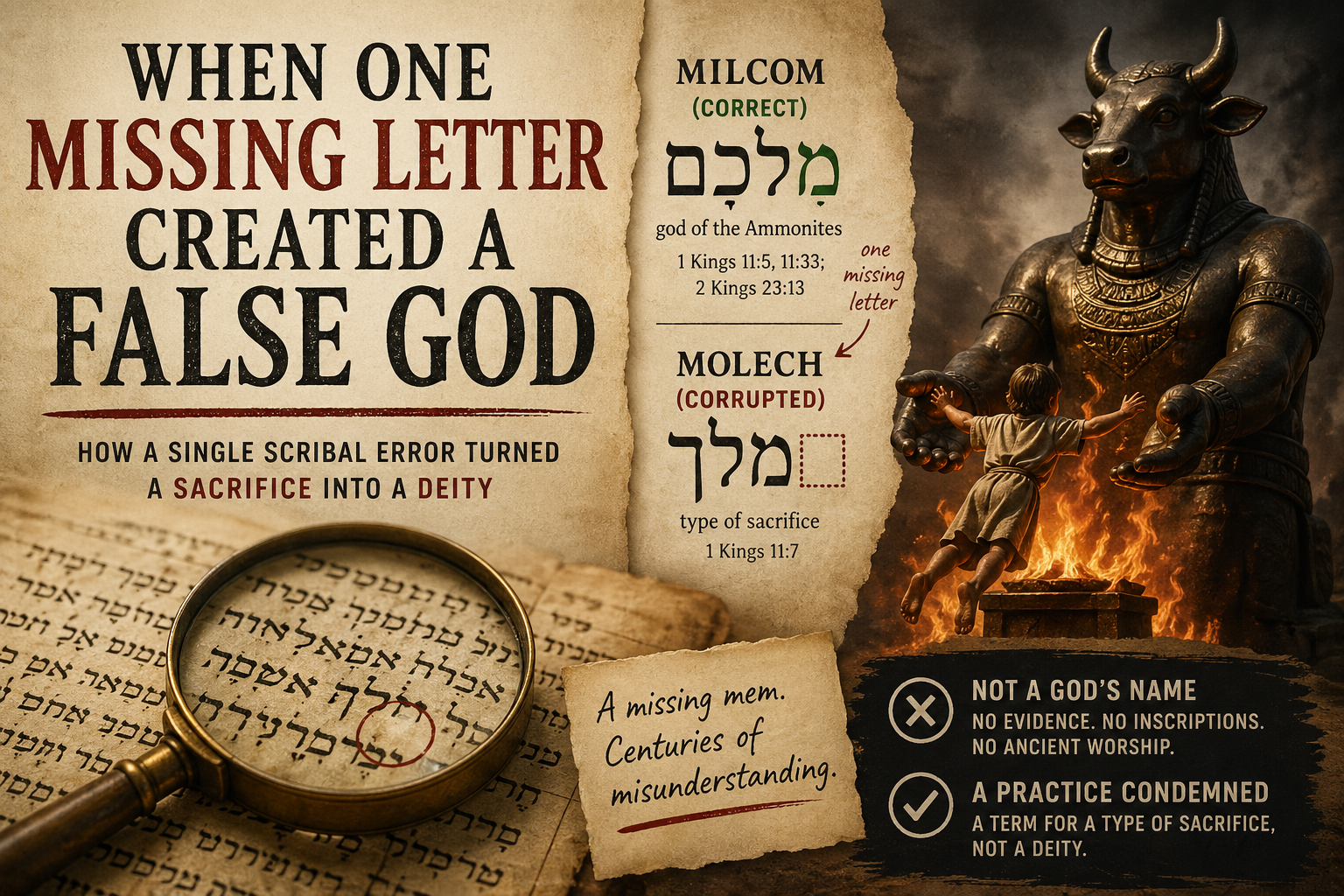
The first time I encountered the word “Molech” in the Hebrew Bible, I assumed what most people assume: here’s another ancient deity, probably one of those bloodthirsty gods demanding child sacrifice. Makes sense, right? The word appears in contexts discussing abominable practices, and popular culture has run wild with the image of a bronze bull-headed statue with outstretched arms, consuming children in fire.
But dig into the actual Hebrew text and something interesting emerges. “Molech” isn’t a god’s name at all. It’s an archaic noun describing a type of sacrifice.
This revelation came while working through a textual problem in 1 Kings. The verse that trips everyone up is 1 Kings 11:7, which seems to identify Molech as “the abomination of the Ammonites.” Case closed, you’d think. Molech must be the Ammonite patron deity.
Except the surrounding text tells a different story.
Look at 1 Kings 11:5, just two verses earlier. The text explicitly names Milcom as the god of the Ammonites. Not Molech. Milcom. Then check 1 Kings 11:33 - same thing. Milcom again. Jump ahead to 2 Kings 23:13, and once more we find Milcom identified as the Ammonite deity.
So what’s happening in verse 7? The answer lies in a single Hebrew letter: mem.
In Hebrew manuscripts, scribal errors happen. Letters get dropped, especially final letters at the end of words. The difference between “Milcom” (מלכם) and “Molech” (מלך) is that final mem. When a scribe’s eye slipped or his hand tired, that last letter disappeared, transforming Milcom into what looked like Molech.
This isn’t speculation or creative interpretation. The manuscript evidence points clearly to textual corruption. Three separate passages identify Milcom as the Ammonite deity. One passage says Molech. The simpler explanation wins: a scribe dropped a letter.
Understanding this changes how we read these texts. All those passages about passing children “through fire to Molech” aren’t describing worship of a specific deity. They’re describing a sacrificial practice - one that the biblical authors condemned regardless of which god supposedly received the offering.
The academic consensus on this is remarkably unified. No archaeological evidence exists for a deity named Molech in the ancient Near East. No inscriptions. No temple dedications. No theophoric names (personal names incorporating a deity’s name). The word appears only as a term for a type of offering, not as a divine name.
This matters for how we understand ancient religion and biblical polemic. The Hebrew Bible’s authors weren’t cataloging a pantheon of rival gods with Molech among them. They were condemning specific ritual practices, using technical terminology that later readers mistook for proper names.
The confusion persists because once an interpretation takes hold in popular consciousness, it’s hard to dislodge. Commentaries repeat the error. Sermons build on the misunderstanding. Horror movies and metal bands perpetuate the image of Molech the demon-god.
But the text itself, read carefully with attention to its manuscript history and linguistic context, tells a simpler story. Milcom was the god of the Ammonites. Molech was a term for a type of sacrifice. And sometimes, a missing letter makes all the difference.
Working through these textual issues reminds me why close reading matters. You can’t just grab a verse in isolation and build a theology around it. The broader context, the manuscript tradition, the linguistic evidence - these things matter. They’re the difference between understanding what the text actually says and perpetuating centuries-old misreadings.
The next time you encounter Molech in a biblical passage, remember: you’re not reading about an ancient deity. You’re reading about an ancient practice, one condemned by biblical authors who used specific technical vocabulary to describe it. And in at least one case, you’re reading about a scribe who forgot to write one last letter, creating centuries of confusion in the process.