I’ve been wrestling with something that fundamentally changed how I view religious texts. After years of study, I discovered the Bible contains direct contradictions that cannot be reconciled through interpretation alone.
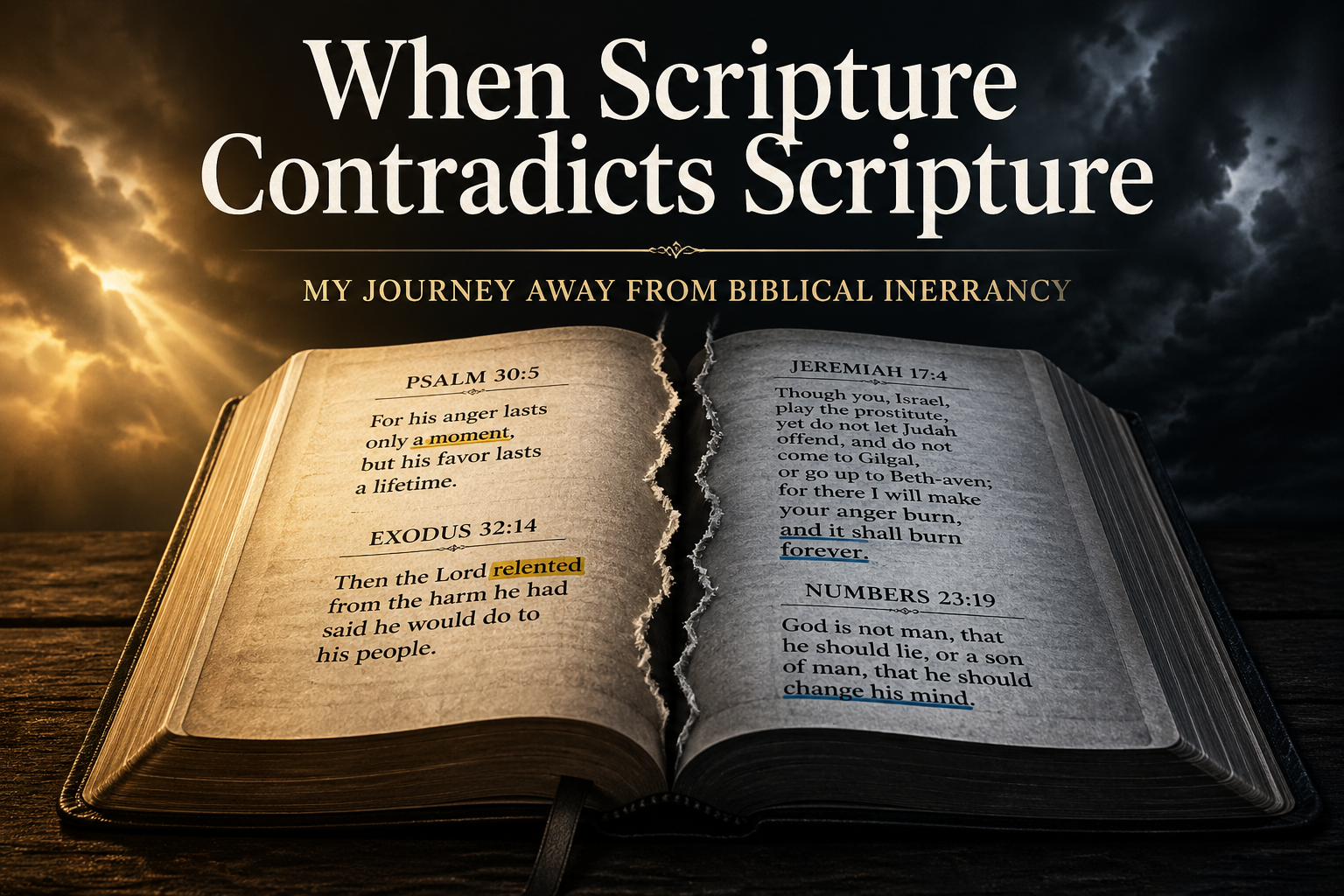
The most striking contradictions concern God’s basic nature. In Psalm 30:5, I read that God’s anger lasts only a moment. Then I turned to Jeremiah 17:4, where God declares his anger will burn forever. These aren’t metaphorical differences. They’re opposite statements about the same divine attribute.
The question of whether God changes his mind created another crisis in my understanding. Exodus 32 explicitly describes God relenting from his plan to destroy Israel after Moses intercedes. Yet Numbers 23 states definitively that God is not a man that he should change his mind. Both cannot be true.
Even more troubling was discovering that Genesis 22:1 says God tempted Abraham to sacrifice Isaac, while James 1:13 insists God tempts no one. This isn’t a translation issue. The texts directly contradict each other about God’s actions.
The visibility of God presents similar problems. Jacob claims in Genesis 32:30 that he saw God face to face and lived. Exodus describes Moses speaking with God face to face. But John 1:18 states categorically that no one has ever seen God, and Exodus 33:20 warns that no one can see God and live. These passages cannot all be accurate.
Historical accounts within the Bible also conflict in ways that defy harmonization. The story of who killed Goliath seems straightforward until you read both versions. First Samuel credits David with the victory. Second Samuel says Elhanan killed Goliath. Attempts to explain this away as two different Goliaths or scribal errors only highlight the problem.
The census that brought judgment on Israel has two completely different origins. Second Samuel says God commanded David to take the census. First Chronicles says Satan incited David to do it. This isn’t a minor detail—it’s about whether God or Satan was responsible for a major national catastrophe.
Numerical discrepancies appear throughout parallel accounts. David killed either 700 charioteers according to 2 Samuel or 7,000 according to 1 Chronicles. A divinely announced famine would last either seven years or three years, depending on which book you read. King Jehoiakim took the throne at age 18 or age 8. These aren’t rounding errors.
The flood narrative within Genesis itself contains contradictions. Genesis 7 first states the flood lasted 40 days, then later says waters prevailed for 150 days. Genesis 6 instructs Noah to take two of every animal, but Genesis 7 specifies seven pairs of clean animals. These conflicting instructions appear in the same story.
The New Testament presents its own set of contradictions. Matthew and Luke provide different genealogies for Jesus, disagreeing on who Joseph’s father was—Jacob or Heli. The location of Jesus’s most famous sermon differs between Gospel accounts, with Matthew placing it on a mountain and Luke on a plain.
Peter’s denial receives different predictions. Matthew says Jesus told Peter he would deny him three times before the rooster crowed. Mark’s version has Jesus saying it would happen before the rooster crowed twice. These specific predictions cannot both be what Jesus actually said.
What happened to Judas’s blood money? Acts says Judas bought a field with it. Matthew says the priests bought the field after Judas died. Again, both cannot be true.
Perhaps most significantly, I discovered there are two different sets of Ten Commandments in Exodus. The famous version appears in Exodus 20. But Exodus 34 presents a completely different set, including the command not to boil a goat in its mother’s milk. The text explicitly calls this second set “the Ten Commandments,” not the first.
These contradictions forced me to reconsider claims about biblical perfection and inerrancy. A perfect text wouldn’t contain statements that directly negate each other. An inerrant document wouldn’t have conflicting accounts of the same events or contradictory descriptions of God’s nature.
Some argue these contradictions result from different perspectives or emphases. But saying God’s anger lasts a moment versus forever isn’t a matter of perspective. Claiming God both does and doesn’t change his mind isn’t emphasis. These are mutually exclusive statements.
Others suggest copying errors or translation problems. But these contradictions appear in the earliest manuscripts we have and persist across translations. They’re baked into the text itself.
The presence of these contradictions doesn’t necessarily negate the Bible’s spiritual value or historical importance. Many find meaning and wisdom in its pages despite these inconsistencies. But we cannot honestly claim the text is perfect or without error when it contains such clear contradictions.
After compiling and verifying these contradictions, I had to abandon the notion of biblical inerrancy. The evidence within the text itself makes that position untenable. The Bible may contain profound truths and valuable teachings, but it also contains undeniable contradictions that challenge any claim to textual perfection.