When Noah’s Instructions Don’t Add Up
I first noticed the problem during a lecture on biblical texts. The professor asked us to read Genesis chapters 6 and 7 carefully, back to back. What struck me wasn’t just a minor discrepancy—it was a fundamental contradiction about the most basic element of the Noah story.
The Numbers Game
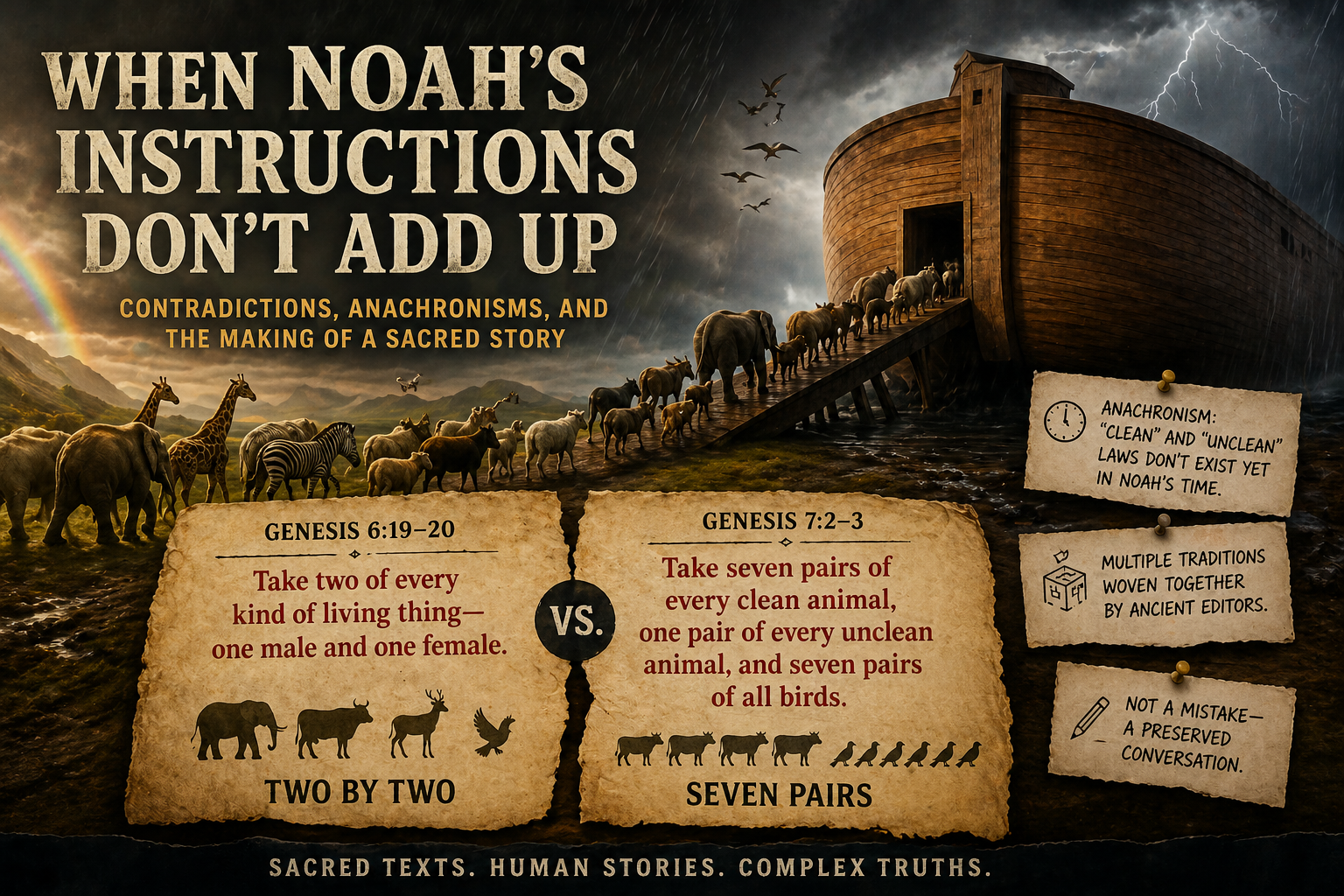
We all know the Noah’s Ark story. Animals march up the ramp, two by two, while the rain begins to fall. This image comes straight from Genesis 6, where God tells Noah to bring two of every living thing into the ark—one male, one female. Simple enough.
But turn the page to Genesis 7, and the instructions change completely. Now God tells Noah to take seven pairs of every clean animal, one pair of every unclean animal, and seven pairs of all birds. That’s not a clarification or a minor adjustment. That’s an entirely different set of marching orders.
Think about the practical implications. If you’re Noah, do you bring two cows or fourteen? Two doves or fourteen? The text gives both answers, and they can’t both be right.
Why the Contradiction Exists
The explanation lies in how Genesis came together. The book isn’t a single narrative written by one author. Instead, it combines multiple flood traditions that ancient editors wove into one text. Each tradition had its own priorities and theological concerns.
One source valued simplicity and symmetry—hence the clean “two by two” formula. Another source cared more about religious practice, particularly sacrifice and ritual purity. This second tradition needed Noah to have extra clean animals on hand because immediately after leaving the ark, Noah builds an altar and offers burnt sacrifices.
You can’t sacrifice your only breeding pair if you want the species to survive. So this tradition required seven pairs of clean animals—enough for both sacrifice and reproduction.
The Anachronism Problem
Here’s where things get even more interesting. The categories of “clean” and “unclean” animals that appear in Genesis 7 shouldn’t exist yet. These dietary and ritual laws don’t get defined until much later in the biblical timeline, specifically in the Law of Moses.
So how does Noah know which animals are clean and which aren’t? The classification system hasn’t been invented yet. It’s like finding a character in a medieval manuscript checking his smartphone.
This anachronism reveals something important about how these texts developed. Later editors, working with established religious categories, went back and inserted these concepts into earlier stories. They retrofitted the flood narrative with their contemporary understanding of ritual purity.
What This Means for the Text
The fascinating part isn’t that these contradictions exist—it’s that both versions survived the editing process. The final text preserves both the “two by two” instruction and the “seven pairs” instruction, one chapter after the other. No attempt was made to harmonize them or smooth over the contradiction.
This preservation tells us something profound about how these texts functioned in ancient communities. The editors weren’t trying to create a perfectly consistent historical account. They were preserving different traditions, each with its own theological value.
The “two by two” version gives us narrative elegance—it’s memorable, teachable, and symbolically powerful. The “seven pairs” version makes the religious practices work—it explains how Noah could offer sacrifices without causing extinctions.
Editorial Compromise in Sacred Texts
What we see in the flood narrative isn’t divine dictation producing a flawless text. It’s editorial compromise—human beings trying to preserve multiple sacred traditions even when those traditions conflict.
The Bible, in this sense, argues with itself. Different voices within the text offer different perspectives on the same events. Rather than seeing this as a weakness or error, we can understand it as the natural result of a living religious tradition that valued multiple viewpoints enough to preserve them all.
This approach to sacred texts was remarkably inclusive for its time. Rather than declaring one tradition correct and discarding the others, the editors created a composite that maintained the theological insights of each source. The inconsistencies weren’t bugs—they were features.
Reading Ancient Texts on Their Own Terms
Understanding these contradictions changes how we read these stories. We stop trying to force them into modern categories of historical or scientific accuracy. Instead, we can appreciate them as sophisticated theological documents that preserve multiple perspectives on fundamental questions about divine justice, human responsibility, and cosmic order.
The flood narrative isn’t trying to give us blueprints for ark construction or a passenger manifest. It’s exploring what happens when the divine-human relationship breaks down so completely that creation itself needs to restart. Different traditions approached this theme differently, and the final text honors that diversity.
When we recognize the editorial seams in texts like Genesis, we gain access to the conversations and debates that shaped these foundational stories. We see not a monolithic religious viewpoint but a dynamic tradition wrestling with profound questions through narrative.
The contradiction between Genesis 6 and Genesis 7 isn’t an embarrassment to be explained away. It’s a window into how sacred texts actually developed—through compilation, compromise, and the careful preservation of competing traditions. The ark may have had one door, but the text that describes it opens multiple doorways into understanding ancient religious thought.