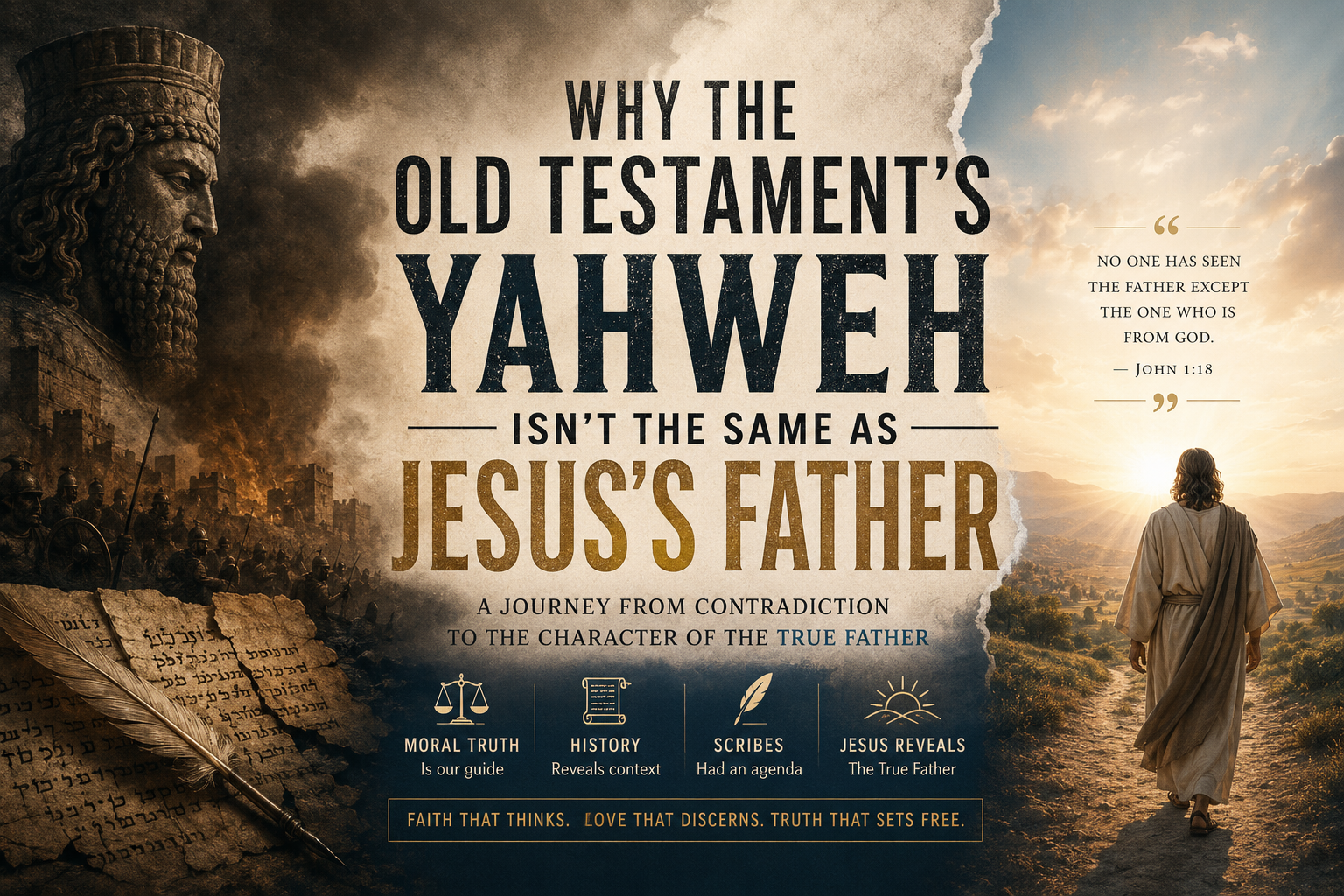
The first time I encountered the argument that the Old Testament’s Yahweh wasn’t the same as Jesus’s Father, I felt my entire theological foundation crack. Years of Sunday school had taught me to accept certain contradictions without question, but once I started examining them directly, the discomfort became impossible to ignore.
The problem starts with basic moral intuitions. When we read about genocide in Rwanda or Cambodia, we recognize evil. When we hear about someone killing children as collective punishment, we condemn it. These reactions come naturally—they don’t require theological training. Yet when these same acts appear in Old Testament narratives attributed to Yahweh, I watched fellow believers perform mental gymnastics to reframe them as divine justice.
The logical structure here is straightforward. If genocide, collective punishment, and killing children are evil acts, and if God doesn’t commit evil acts, then any being who commits these acts cannot be God. When I first worked through this syllogism, I expected to find some flaw in the reasoning. I didn’t. The conclusion follows necessarily from the premises.
This forced me to examine the historical context more carefully. The texts we call the Old Testament didn’t drop from heaven in their current form. Jewish scribes extensively edited these books during and after the Babylonian captivity—a period when the entire religious and cultural identity of the Jewish people underwent massive upheaval. We simply don’t know what these texts looked like before this redaction process.
The book of Daniel reveals something interesting about these scribes. They were educated in Chaldean literature—the wisdom traditions of Babylon’s mystery schools and occult practices. These weren’t neutral copyists preserving ancient texts. They were intellectuals shaped by the religious and philosophical currents of one of the ancient world’s most syncretic cultures.
Jeremiah’s words haunted me when I discovered them in this context: he directly accuses the scribes of making God’s law into a lie through their “lying pens.” This isn’t some modern skeptic questioning ancient texts—this is a biblical prophet calling out the very people responsible for transmitting and editing scripture.
Once I saw this pattern, I couldn’t unsee it. The character of Yahweh in many Old Testament passages reads like the tribal war deity of a small ancient Near Eastern people, complete with demands for territorial conquest and ethnic cleansing. This bears little resemblance to the Father that Jesus describes—the one who makes the sun rise on evil and good alike, who calls us to love our enemies.
The comfortable assumption I’d carried for years was that Jewish scribes accurately identified Yahweh as the true God. But why should I accept their testimony uncritically? They had every incentive to elevate their national deity to supreme status, especially after the trauma of exile and the need to rebuild their religious identity.
Working through these issues didn’t destroy my faith—it transformed it. I began to see Jesus’s ministry in a new light. His constant conflicts with religious authorities, his reframing of scripture (“You have heard it said… but I say to you”), his revelation of the Father’s true character all made more sense if he was correcting fundamental misunderstandings about God’s nature.
The way forward isn’t about abandoning scripture or faith. It’s about reading more carefully, thinking more critically, and being willing to follow the logic and evidence where they lead. When Jesus says “No one has seen the Father except the one who is from God,” perhaps he means it more literally than we’ve assumed. Perhaps the violent, vengeful deity of certain Old Testament passages is exactly what Jesus came to correct.
This perspective shift changes everything about how I read the Bible. Instead of trying to harmonize irreconcilable portraits of God, I can acknowledge the human fingerprints all over these texts. I can appreciate the Jewish scribes’ attempt to make sense of their history and their God while recognizing their limitations and biases.
The community of believers exploring these questions continues to grow. We’re not destroying faith—we’re purifying it, stripping away the accumulated assumptions and getting back to the radical message Jesus actually taught. His way leads somewhere different than the path of uncritical acceptance of scribal tradition.
Every believer eventually faces this choice: continue accepting inherited contradictions or have the courage to examine them honestly. The syllogism stands there, simple and uncompromising. The historical evidence raises questions that demand answers. The character of the Father that Jesus reveals calls us toward something better than the tribal deity of ancient warfare.
I made my choice. The cognitive dissonance of defending genocide as divine justice while condemning it as human evil became unbearable. The God Jesus showed us doesn’t need such defense. That revelation alone has been worth the journey through doubt and reconstruction.