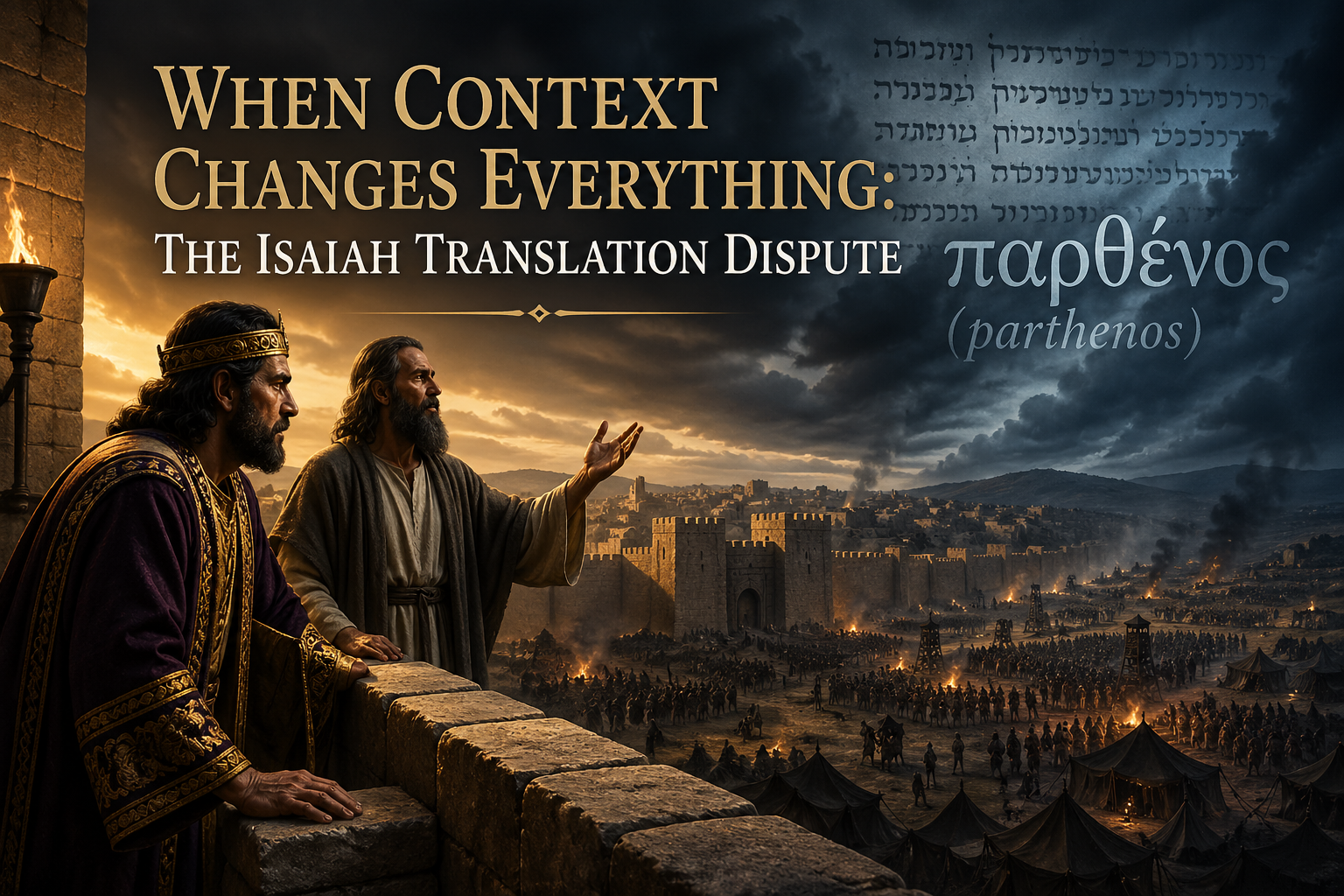
The ancient city of Jerusalem sat under siege. Two armies pressed against its walls while King Ahaz paced his chambers, calculating his dwindling options. This was eighth century BCE, and the kingdom of Judah faced annihilation. Into this crisis walked Isaiah the prophet, summoned to provide divine counsel to a desperate king.
What happened next became one of history’s most consequential translation disputes.
The passage in question appears in Isaiah 7. Ahaz needs immediate reassurance that his kingdom will survive the siege. Isaiah delivers an oracle—a sign meant to steady the king’s nerves and confirm divine protection. The prophet speaks of a young woman who will bear a child, and before that child reaches a certain age, the threat facing Jerusalem will dissipate.
This was emergency counsel for an emergency situation. The sign served a specific purpose: convincing Ahaz that the armies at his gates would fail. The timeline mattered. The immediacy mattered. The political context of two hostile armies threatening Jerusalem’s survival mattered.
Centuries later, the authors of the New Testament wrote their accounts in Greek. They worked from a Greek translation of the Hebrew scriptures, where the word “parthenos” appeared in this Isaiah passage. Here’s where things get complicated. “Parthenos” can mean virgin, but it can also simply mean young woman. The Greek translators who produced that version made a choice—one that would echo through millennia of theological debate.
I’ve spent considerable time with both the Hebrew and Greek texts, and what strikes me most forcefully is how extracting a single word from its narrative destroys the passage’s coherence. When you read Isaiah 7 as a complete unit, as a historical document emerging from a specific crisis, the interpretation shifts dramatically. This isn’t abstract theology floating free from history. This is a prophet speaking to a king with enemy soldiers literally at the gates.
The original audience—Ahaz and his court—needed immediate assurance, not predictions about events seven centuries in the future. Isaiah’s sign had to make sense to them, in their moment of crisis. A prophecy about a distant virgin birth would have offered zero comfort to a king wondering if he’d survive the week.
The broader narrative arc reinforces this reading. The chapters surrounding this oracle deal with the immediate political and military realities facing Judah. The Syro-Ephraimite crisis, the threat from Assyria, the fate of the northern kingdom—these pressing concerns dominate the text. Isaiah addresses real-time geopolitical chaos, not distant messianic expectations.
The child mentioned in the prophecy appears again in the very next chapter, Isaiah 8, where the prophet’s own son becomes part of the prophetic sign system. The text maintains its focus on the immediate crisis and its resolution. The narrative coherence depends on reading these signs as contemporary to Ahaz’s situation.
What we have, then, is a translation decision that became theological bedrock. The Greek “parthenos” opened interpretive doors that the Hebrew context keeps firmly shut. But focusing solely on that single word misses the larger methodological point: meaning emerges from context, not from isolated lexical analysis.
The stakes here extend beyond academic debate. How we read ancient texts—whether we honor their historical contexts or extract convenient fragments—shapes entire theological systems. The difference between reading a verse and reading a passage can be the difference between understanding what an author meant and imposing what we wish they had said.
When I teach this material, I always start with the siege. I put students in Ahaz’s position: your city surrounded, your options vanishing, your kingdom hanging by a thread. Now a prophet arrives with a message. What do you need to hear? What kind of sign would actually help you? The answer becomes obvious—you need assurance about the immediate threat, not cryptic predictions about the distant future.
The discipline required here is reading the text as it presents itself, embedded in its historical moment, addressing specific people facing specific crises. The eighth-century BCE political emergency that frames Isaiah 7 isn’t decorative background. It’s the essential context that governs interpretation.
This isn’t about diminishing anyone’s faith or challenging cherished beliefs. It’s about intellectual honesty in approaching ancient texts. When we read Isaiah 7 within its narrative boundaries, when we respect its historical setting, when we acknowledge the translation complexities, we arrive at a different understanding than when we pluck individual verses for theological purposes.
The young woman in Isaiah’s oracle served her purpose—providing Ahaz with a time-bound sign of deliverance from immediate danger. The fact that later interpreters, working from Greek translations, saw additional meanings in those words tells us more about the evolution of religious thought than about Isaiah’s original intent.
Reading ancient texts demands that we resist the temptation to make them say what we want them to say. It requires sitting with their strangeness, their distance from us, their embeddedness in worlds we can only partially reconstruct. But that discipline—reading in context, attending to historical setting, acknowledging translation issues—ultimately serves truth better than any amount of creative interpretation.
The siege of Jerusalem lifted. Ahaz’s kingdom survived. Isaiah’s sign proved true in its original context. That should be enough.