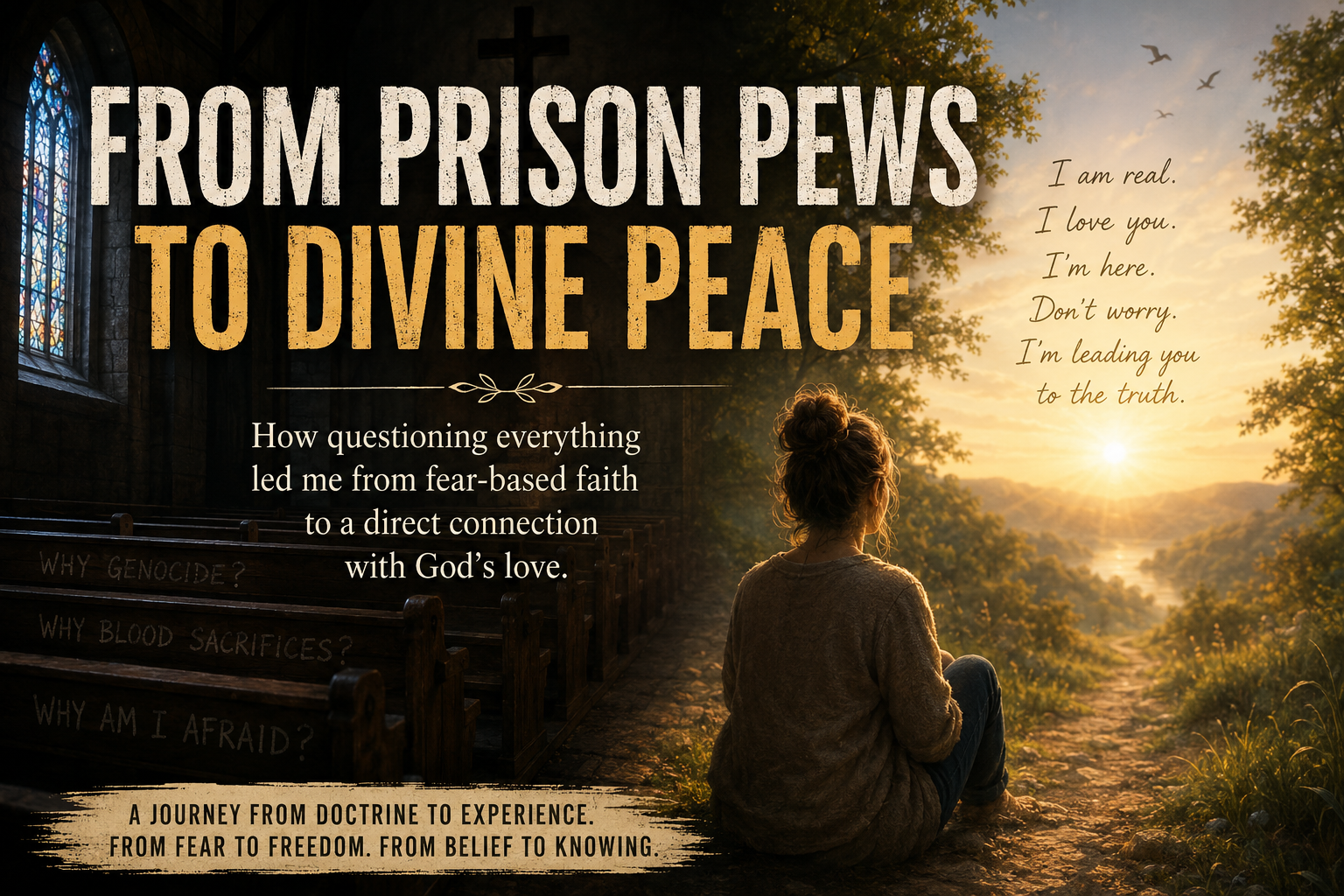
Church felt like prison. Every Sunday, I sat there wrestling with questions that nobody wanted to answer. Why did the God of love order genocide in the Old Testament? Why did He need blood sacrifices to forgive? Why was I terrified instead of peaceful?
The Questions That Wouldn’t Go Away
My faith had always rested on shaky ground, though I’d spent years pretending otherwise. The contradictions screamed at me:
A perfect God created humans, knowing they’d fail, then punished them eternally for being exactly what He made them to be. He drowned nearly everyone in a flood because His creation disappointed Him. He demanded animal blood to forgive sins, as if forgiveness required payment. Then He tortured and killed His own son to satisfy His own wrath.
When I brought these concerns to pastors and elders, they offered the same tired response: “God’s ways are higher than ours.” Translation: stop thinking and just believe. The more they repeated this mantra, the more it sounded like cult programming designed to shut down critical thought.
But questioning felt dangerous. What if hell was real and I was gambling with eternal torment? What if discovering the truth meant losing everything I’d built my life around?
Into the Unknown
I chose to face the fear. If God was real, He could handle my questions. If He wasn’t, I needed to know.
I started reading biblical scholars—not the devotional writers who already agreed with my beliefs, but historians who studied the texts as ancient documents. The evidence of human tampering was overwhelming. Entire books attributed to apostles were forgeries. Stories had been edited, rewritten, and inserted centuries after the events they described.
My worst fear seemed confirmed: none of it was real.
In that moment of despair, something unexpected happened. As I sat, crying out one more time for God to reveal Himself, I heard a voice. Not audible, but unmistakably clear in my mind: “I am real. I love you. I’m here. Don’t worry. I’m leading you to the truth.”
The words carried a peace I’d never experienced in church. Not the forced calm of trying to believe harder, but a genuine knowing that I was loved and guided.
The Message Behind the Message
Days later, a friend sent me a video that changed everything. It argued that Paul—the apostle who wrote most of the New Testament—was actually a false teacher who corrupted Jesus’ original message.
At first, this seemed blasphemous. But as I researched, the pieces fell into place. Jesus never endorsed blood sacrifice. He quoted Hosea: “I desire mercy, not sacrifice.” He called the temple a “den of thieves” and physically drove out those profiting from the sacrificial system. His death wasn’t a payment to God but an exposure of religious violence.
The real message was simpler and more radical: we could experience direct connection with God, the same “sonship” Jesus demonstrated. No priests, no temples, no blood required. Just love your neighbor as yourself and seek the divine presence within through meditation and contemplation.
Finding What I’d Always Sought
I began practicing silent meditation, sitting in stillness and opening myself to divine presence. Instead of begging God to hear me, I learned to listen. The constant anxiety that had defined my existence began dissolving.
The peace wasn’t just emotional relief. It was a tangible presence, a knowing that I was held and loved regardless of my beliefs or behaviors. The God I encountered in silence bore no resemblance to the angry judge I’d feared my entire life.
Beyond Fear-Based Faith
Traditional Christianity had given me a God who demanded perfection while knowing I couldn’t achieve it, who created hell before creating humans, who required blood to forgive. This God kept me in constant fear of making the wrong choice, believing the wrong doctrine, or not being sincere enough in my faith.
The path I discovered led to a different understanding entirely. God wasn’t waiting to punish me for thought crimes. The divine presence was already within, waiting to be recognized. Heaven and hell weren’t future destinations but present realities we create through our choices to love or hate, to connect or separate.
This shift from fear to love, from belief to experience, transformed everything. Prayer became conversation instead of performance. Scripture became wisdom literature instead of a rule book. Faith became trust instead of intellectual agreement with doctrines.
A Community of Seekers
The journey from dogma to experience isn’t easy. It requires releasing certainty and embracing mystery. It means admitting that the answers we were given might be wrong. But on the other side of that fear lies a peace that no doctrine could ever provide—the direct, unmediated experience of divine love.
For those still sitting in those prison-bar pews, wrestling with questions that won’t go away, know that you’re not alone. The fear of questioning is often stronger than the questions themselves. But truth can withstand scrutiny. Love doesn’t require blood. And the peace you’re seeking might be found not in believing harder, but in having the courage to seek something real.