From a long time pastor…
The first time I really read Job in Hebrew, I sat in my study at 2 AM with a lexicon, a worn Hebrew Bible, and years of sermons I’d preached about Satan running through my head. What I found in those ancient words upended everything I thought I knew.
For twenty-five years, I stood behind a megachurch pulpit and told thousands of people about Satan. The fallen angel. The ruler of hell. God’s eternal enemy locked in cosmic battle for human souls. My congregations knew this figure well—he shows up in movies, literature, even Halloween decorations. This Satan has a biography: once the beautiful angel Lucifer, cast from heaven for his pride, now commanding legions of demons in opposition to God.
That night in my study, hunched over the Hebrew text, I discovered this entire narrative was missing from the original sources.
A Title, Not a Name
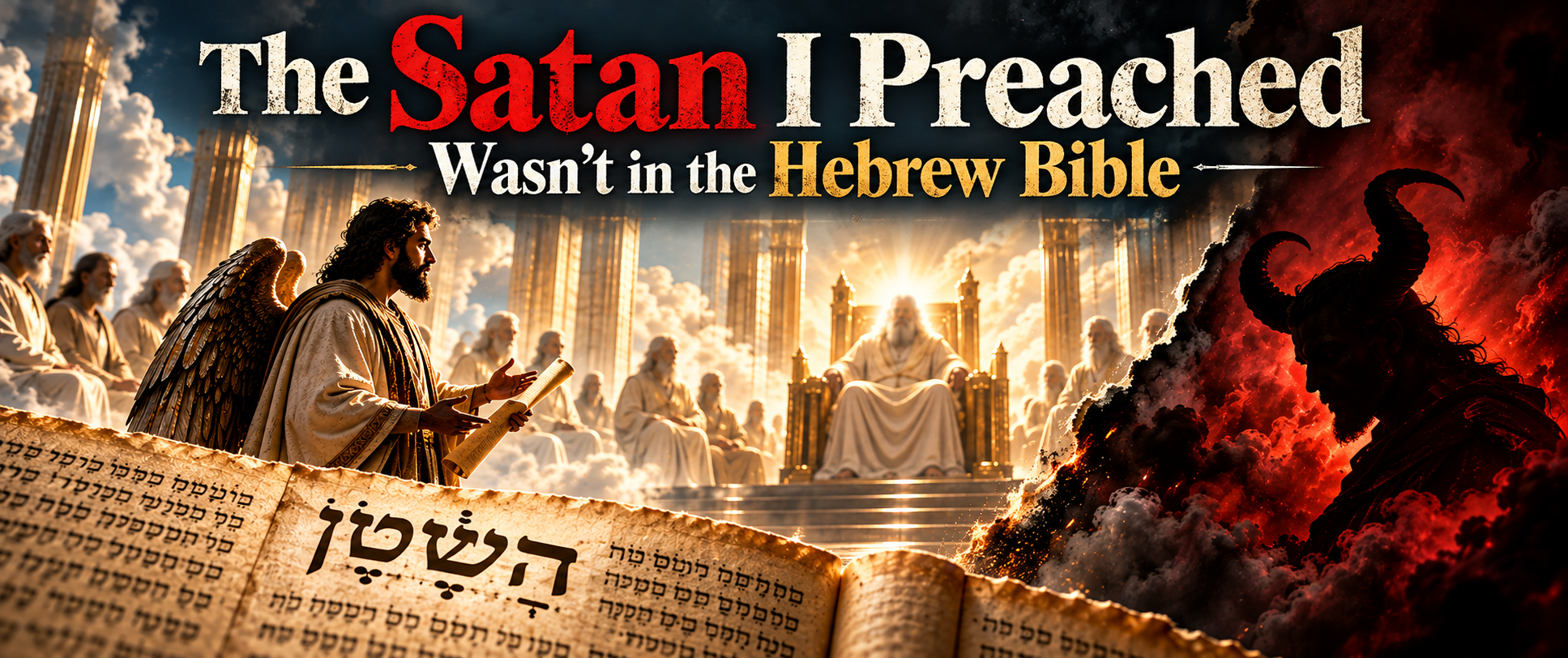
The book of Job introduces a character that English Bibles call “Satan.” But the Hebrew text reads “ha-satan.” That two-letter prefix—“ha”—changes everything. It’s the definite article in Hebrew, equivalent to “the” in English. Hebrew doesn’t attach this article to proper names. Nobody says “the Abraham” or “the Sarah.” Yet every single time this figure appears in Job, the text says “ha-satan”—the satan.
This isn’t a name. It’s a job description.
The root word “satan” means adversary or accuser. In ancient Near Eastern legal proceedings, this described the prosecutor’s role—the one who brings charges, tests testimonies, challenges claims. When I understood this, the scenes in Job suddenly looked different. This wasn’t a cosmic rebel crashing God’s throne room. This was a prosecutor showing up for work.
Inside the Divine Council
Job chapters one and two place ha-satan among the “sons of God” in the divine council. He doesn’t break in. He doesn’t disguise himself. He “presents himself” along with other members of God’s heavenly administration because he belongs there.
The conversation between God and ha-satan reads like a performance review. God asks where he’s been. Ha-satan reports he’s been roaming the earth, observing. God brings up Job’s righteousness. Ha-satan questions whether Job’s faithfulness runs deeper than self-interest—would Job maintain his integrity if he lost everything?
What happens next changed how I understand the entire story. Ha-satan needs permission to test Job. He can’t act independently. God sets explicit boundaries: touch his possessions and family, but not Job himself. Later, when ha-satan returns, God permits him to afflict Job’s body but forbids taking his life.
This prosecutor operates entirely within divine parameters. Every action requires authorization. Every test has limits.
The Comfortable Story We Tell
Standing before my congregation week after week, I wove elaborate narratives about Satan’s rebellion. I quoted Isaiah 14 about the fall of Lucifer. I referenced Ezekiel 28’s lamentation over the King of Tyre. I painted dramatic scenes of war in heaven, angels choosing sides, the birth of evil through prideful rebellion.
These stories resonated. They explained why bad things happen to good people. They gave us an enemy to blame, a cosmic scapegoat for human suffering. They preserved God’s goodness by attributing evil to a rogue agent working against divine will.
But none of this appears in Job. Or Genesis. Or Exodus. The Hebrew Bible’s earliest texts present ha-satan as a member of God’s court fulfilling an assigned role—testing human integrity, ensuring righteousness isn’t just performance, putting faith through quality control.
When Prosecutor Became Prince
The transformation from heavenly prosecutor to Prince of Darkness didn’t happen overnight. It took centuries of cultural cross-pollination and theological evolution.
During the Babylonian exile, Jewish thinkers encountered Zoroastrianism with its cosmic dualism—forces of light battling forces of darkness. This framework offered compelling explanations for evil and suffering. Greek philosophy later added concepts of spiritual hierarchies and emanations. By the time intertestamental literature emerged, writers were filling narrative gaps with elaborate angelic rebellions and demonic hierarchies.
Early Christianity inherited these accumulated traditions and synthesized them into the Satan we recognize today. The prosecutor became the enemy. The accuser became the rebel. The tester became the tempter.
Sitting With Discomfort
Reading ha-satan as God’s prosecutor rather than God’s enemy creates profound theological tension. If suffering comes through God’s court rather than despite it, what does this say about divine nature? If the accuser operates with divine permission, how do we understand God’s relationship to evil?
Job himself wrestles with these questions. He doesn’t know about ha-satan’s role or the divine council’s deliberations. He only knows his suffering, and he demands answers from God. When God finally responds, the answer isn’t about rebellious angels or cosmic battles. God speaks about creation’s complexity, the limits of human understanding, the vastness of divine perspective.
The Hebrew text refuses to give us the comfortable distance of blaming a cosmic villain. It places the source of Job’s suffering squarely within God’s administrative system. Ha-satan isn’t defying God’s will—he’s executing it.
What We Lose and Gain
Years after that late-night study session, I still wrestle with these insights. The traditional Satan narrative serves important functions. It helps people externalize evil, cope with trauma, and maintain faith in God’s goodness despite experiencing suffering. Taking away the cosmic rebel leaves us with harder questions and fewer satisfying answers.
But reading ha-satan as prosecutor rather than rebel also opens new understanding. It suggests evil doesn’t require a supernatural emperor. Human choices, natural processes, and systemic injustices create plenty of suffering without needing demonic orchestration. It implies that testing and adversity might serve purposes we don’t fully understand. It acknowledges that some suffering happens within divine permission rather than against divine will—a difficult but perhaps more honest theological position.
The Employee, Not the Enemy
The evolution from ha-satan to Satan tells us as much about human psychology as theology. We need narratives that make sense of suffering. We want clear villains and heroes. We prefer external enemies to internal struggles.
But the Hebrew Bible’s ha-satan offers a different paradigm. Not a rebel angel nursing cosmic grudges, but a divine employee doing difficult work. Not the source of all evil, but an instrument for testing integrity. Not God’s enemy, but God’s prosecutor.
This reading doesn’t diminish evil’s reality or suffering’s weight. Job’s anguish was real. His losses were devastating. But locating their source in God’s court rather than in cosmic rebellion forces us to grapple with more complex questions about divine justice, human suffering, and the nature of faith itself.
Every time I hear someone describe Satan’s fall from heaven or his dominion over hell, I remember ha-satan standing in the divine council, briefcase in hand, requesting permission to do his job. The distance between these two figures spans centuries of human meaning-making, our endless attempt to understand why life hurts and where suffering originates.
The prosecutor in God’s court became the enemy at God’s gates because we needed him to. But perhaps there’s value in returning to that original figure—not because it’s comfortable, but because it’s honest about the complexity of divine justice and the reality that some tests come not from rebellion against God, but from within God’s own mysterious purposes.